Showing posts with label babies. Show all posts

Thursday, February 4, 2016

Video Shows Planned Parenthood Executive Sought to Hide Profits from Baby-Parts Sales

Breitbart | by DR. SUSAN BERRY | 3 Feb 2016


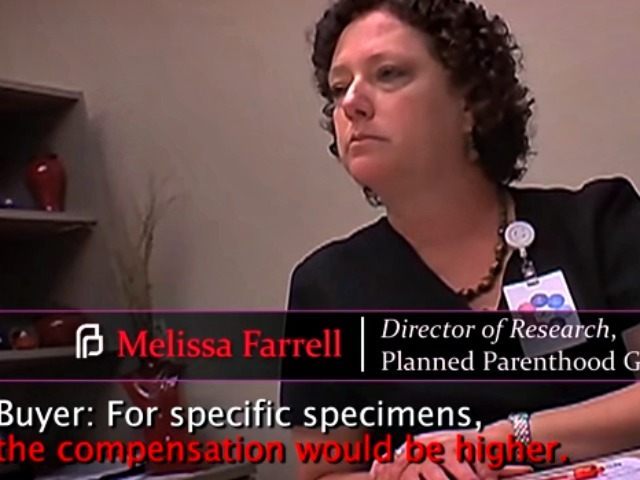
A new video released by the Center for Medical Progress (CMP) appears to show how Planned Parenthood uses accounting gimmicks to hide profits created through the sale of body parts of aborted babies.

A financial benefit “is what staff and management need to see,” says an executive at a Planned Parenthood facility in Texas.


The video highlights footage from the April 9, 2015 visit of investigative journalists David Daleiden — director of the Center for Medical Progress (CMP) — and CMP employee Sandra Merritt to Planned Parenthood Gulf Coast’s (PPGC) abortion facility in Houston.

“We had two levels of invoicing for them. We had it worded as ‘per consent,’” explains PPGC Director of Research Melissa Farrell. In the video, Farrell states “per consent” is the phrase used in PPGC budgeting in place of “per specimen” for fetal tissue.

Farrell discusses that while a woman may consent to supply her aborted baby’s tissue, the specimen itself may not be useable for experimentation.

“There’s probably some situations where somebody would consent and then just not, we didn’t get a sample, or she changed her mind, or something happened to the specimen,” she says, adding, “Now obviously, we don’t want to end up paying for material that we can’t use,” and suggests that there be a line item fee or “something else that represents the specimens.”

“I just don’t want it to turn into a situation that is not financially beneficial for you,” says Merritt.

“Yeah, yeah. And we’ll, I’ll take you up on that. I’ll take you up on that. I’ll take you up on that,” Farrell repeats, laughing. “We definitely want to do that, because that’s what staff and management need to see.”

PPGC CEO Melaney Linton also appears in the video advising that Farrell will “work on all of that with you” when it comes to “remuneration” and “compensation” for fetal tissue.

Farrell explains to Daleiden and Merritt over lunch that her department – which has overseen the organization’s fetal tissue supply program since 2006 — “contributes so much to the bottom line of our organization here.”


Rep. Marsha Blackburn (R-TN), chairman of the House’s Select Investigative Panel on Infant Lives, said the new video footage is “deeply disturbing.”

Blackburn said in a statement:
The comments in this video by an employee of a large abortion provider are deeply disturbing and seem to demonstrate a willingness to obfuscate and hide their true intentions. The Select Investigative Panel on Infant Lives is examining these issues and this new video, once again, raises more questions about the medical procedures and business practices used by entities involved in fetal tissue procurement. Our panel intends to follow the facts where they lead us.

Daleiden and Merrit – who were indicted by a Harris County, Texas grand jury while Planned Parenthood was entirely cleared of wrongdoing – are presenting themselves to the court in Houston on Thursday morning. At that time, national pro-life leaders will present over 100,000 signatures calling on District Attorney Devon Anderson to drop the charges against the journalists, Operation Rescue reports.

According to Associated Press, these are not the first allegations of bias Anderson – who ran for office as a pro-life Republican — has faced:

Anderson was barely three months into office when the anti-abortion group Operation Rescue accused a Houston doctor of performing late-term abortions. The activist behind those allegations, Troy Newman, was also a founding member of the Center for Medical Progress — the anti-abortion group headed by Daleiden…
Operation Rescue had released disturbing photos and accusations from the former staff of Dr. Douglas Karpen. A grand jury declined to indict Karpen; the abortion provider’s lawyer, Chip Lewis, said Karpen was smeared by doctored pictures and false allegations made by individuals who were paid by Operation Rescue.
Lewis, a longtime political donor in Houston whose beneficiaries include Anderson, said he helped soften the political fallout for her in Republican circles.
“I told them, ‘Don’t hitch your wagon to this. They’re crooks, and it’s going to be exposed,'” Lewis said, referring to Operation Rescue.
Kansas-based Operation Rescue has denied paying informants and had questioned the evidence seen by the grand jury. Anderson’s handling of both cases is also questioned by Texas Right to Life, a prominent anti-abortion group that endorsed the district attorney in 2014.
“It’s incomprehensible,” Conway said of Anderson’s actions.
Anderson acknowledged in August that a prosecutor on her staff was a board member of the Houston Planned Parenthood clinic but said that person would not be involved in the grand jury case. In a statement announcing Monday’s charges, Anderson said, “As I stated at the outset of this investigation, we must go where the evidence leads us.”
Lewis said the assistant prosecutor who oversaw the Karpen investigation also handled the Planned Parenthood case. “I don’t think she forgot what she uncovered,” Lewis said…
Planned Parenthood attorney Josh Schaffer said a prosecutor told him the grand jury never even voted on possible criminal charges against the nation’s largest abortion provider.


“Planned Parenthood’s self-interested political maneuvers will never silence free speech or the citizen press,” Daleiden said in a statement. “The new video released today shows that no amount of half-baked barratry can conceal Planned Parenthood’s barbaric harvesting and profiting off baby body parts.”

Peter Breen, special counsel with the Thomas More Society – which is representing Daleiden, said:

The charges against David Daleiden are legally and factually baseless. David used standard undercover journalism techniques to catch Planned Parenthood staff agreeing to alter abortion procedures to get more intact organs and tissue from aborted babies, presumably without telling their patients. David also caught Planned Parenthood staff discussing how to adjust accounting line items to conceal profits from baby body part transactions. Planned Parenthood’s lawyers in Houston have now admitted they dreamed up and demanded the charges against David, apparently in order to distract prosecutors and the public from their own bad acts. We intend to seek to have these charges dismissed at the earliest opportunity.

Wednesday, February 3, 2016

Babies With Genes From Three People Could Be Ethical, Panel Says

KRWG | By ROB STEIN | Feb 3, 2016


Editor's note: This post was updated Feb. 3, 2016, at 12:25 pm to include a statement from the Food and Drug Administration.

Would it be ethical for scientists to try to create babies that have genetic material from three different people? An influential panel of experts has concluded the answer could be yes.


The 12-member panel, assembled by the National Academies of Sciences, Engineering and Medicine, released a 164-page report Wednesday outlining a plan for how scientists could ethically pursue the controversial research.

"The committee concludes that it is ethically permissible" to conduct such experiments, the report says, but then goes on to detail a long list of conditions that would have to be met first.

For example, scientists would have to perform extensive preliminary research in the laboratory and with animals to try make sure it is safe. And then researchers should initially try to make only male babies, because they would be incapable of passing their unusual amalgamation of DNA on to future generations.

"Minimizing risk to future children should be of highest priority," the committee writes.

The report was requested by the Food and Drug Administration in response to applications by two groups of scientists in New York and Oregon to conduct the experiments. Their goal is to help women have healthy babies even though they come from families plagued by genetic disorders.

A statement issued by the FDA immediately after the report's release raised questions about whether the FDA would permit the research to move forward.

The FDA email praised the "thoughtful work" of the panel and said the agency would be "reviewing" the recommendations. But it noted that federal law "prevents the FDA from using funds to review applications in which a human embryo is intentionally created or modified to include" changes that could be passed down to future generations. As a result, the email says, any such research "cannot be performed in the United States."

"I think it's a great step in the right direction," Mark Sauer, a professor of obstetrics and gynecology at Columbia University who is a member of one of the teams, said of the National Academies report in an interview before the FDA issued its statement.

Sauer calls the report more of a "yellow light" than a "green light," because of the long list of caveats and cautions. But that is "better than a red light," he says.

"Most importantly to us is that it allows the work to continue to hopefully produce children without these disorders," Sauer says.

Critics, however, say the number of women who could benefit from the experiments are so small that it's not worth crossing a line that's long been considered off limits – making genetic changes that could be passed down for generations.

"The possibility of what you could call mission creep is very real," says Marcy Darnovsky, executive director of the Center for Genetics and Society, a watchdog group based on Berkeley, Calif. "People are talking about going forward not just with this but with the kind of genetic engineering that will produce outright genetically modified human beings."

Once that happens, Darnovsky says, "I think you get into a situation of where some people are genetically enhanced and other people are the regular old variety of human being. And I don't think that's a world we want to live in."

The goal of the research to help women carrying diseases known as mitochondrial disorders, which are only passed down by women through defects in the genetic material in their eggs.

Specifically, the defects are in a type of genetic material known as mitochondrial DNA.

Unlike the DNA that most people are familiar with — the 23 pairs of human chromosomes that program most of our body processes and traits — mitochondrial DNA consists of just 37 genes inside mitochondria, which are structures inside cells that provide their energy.

Mitochondrial disorders range from mild to severe. In many cases there is no treatment, and the affected child dies early in life after suffering progressive, debilitating symptoms.

In the experiments, scientists would take eggs from women carrying defective mitochondrial DNA, remove all the genes except for the mitochondrial DNA, and then do the same thing to eggs that have been donated by women with healthy genes.

The DNA of the woman who wants to have the healthy child would be transferred into that egg, which would then be fertilized in the laboratory with sperm and implanted in her womb to develop.

The British government recently approved such experiments in that country.

But this remains controversial, not only due to the fact that the resulting children would have DNA from three people. Because the transplanted DNA could be passed down for generations, critics fear it could accidentally introduce errors into the human gene pool that could create new diseases.

They also worry it would set a precedent that could open the door to creating designer babies, in which parents can pick and chose the traits of their children.

Because of such concerns, making any change in DNA that could be passed down for generations has long been considered off limits.

The committee report acknowledged that making babies with DNA from three different people could create have "psychological and social effects" on the offspring, including issues about their "conception of identity."

In addition, the committee acknowledged the possibility that it could lead to attempts at genetic "enhancements."

Such work would raise thorny regulatory issues, the committee noted. For example, the federal government is prohibited from funding research that involves destroying human embryos. As a result, "even an agency request" for data from such research in support of FDA approval "could well be controversial," the report says.

Nevertheless, the committee says the potential benefits make the work worth pursuing with careful oversight.

Moreover, the FDA could at some point even consider letting experiments proceed to try to create female babies if certain criteria are met, the report said, including the production of "clear evidence of safety and efficacy from male" experiments and signs that it would be publicly acceptable.