Showing posts with label indictment. Show all posts

Thursday, February 11, 2016

Clinton Foundation received subpoena from State Department investigators

The Washington Post | By Tom Hamburger and Rosalind S. Helderman February 11 at 12:18 PM

Hillary Clinton, accompanied by Huma Abedin, stops at a Dunkin’ Donuts in Manchester, N.H., on Feb. 7. (Melina Mara/The Washington Post)


Investigators with the State Department issued a subpoena to the Bill, Hillary and Chelsea Clinton Foundation last fall seeking documents about the charity’s projects that may have required approval from the federal government during Hillary Clinton’s term as secretary of state, according to people familiar with the subpoena and written correspondence about it.


The subpoena also asked for records related to Huma Abedin, a longtime Clinton aide who for six months in 2012 was employed simultaneously by the State Department, the foundation, Clinton’s personal office, and a private consulting firm with ties to the Clintons.

The full scope and status of the inquiry, conducted by the State Department’s inspector general, were not clear from the material correspondence reviewed by The Washington Post.

A foundation representative, who spoke on the condition of anonymity to discuss an ongoing inquiry, said the initial document request had been narrowed by investigators and that the foundation is not the focus of the probe.

A State IG spokesman declined to comment on that assessment or on the subpoena.

Representatives for Hillary Clinton’s presidential campaign and Abedin also declined comment.

There is no indication that the watchdog is looking at Clinton. But as she runs for president in part by promoting her leadership of the State Department, an inquiry involving a top aide and the relationship between her agency and her family’s charity could further complicate her campaign.

For months, Clinton has wrangled with controversy over her use of a private email server, which has sparked a separate investigation by the same State Department inspector general’s office. There is also an FBI investigation into whether her system compromised national security.

Clinton was asked about the FBI investigation at a debate last week and said she was “100 percent confident” nothing would come of it. Last month, Clinton denied a Fox News report that the FBI had expanded its probe to include ties between the foundation and the State Department. She called that report “an unsourced, irresponsible” claim with “no basis.”

During the years Clinton served as secretary of state, the foundation was led by her husband, former president Bill Clinton. She joined its board after leaving office in February 2013 and helped run it until launching her White House bid in April.

Abedin served as deputy chief of staff at State starting in 2009. For the second half of 2012, she participated in the “special government employee” program that enabled her to work simultaneously in the State Department, the foundation, Hillary Clinton’s personal office and Teneo, a private consultancy with close ties to the Clintons.

Abedin has been a visible part of Hillary Clinton’s world since she served as an intern in the 1990s for the then-first lady while attending George Washington University. On the campaign trail, Clinton is rarely seen in public without Abedin somewhere nearby.


Republican lawmakers have alleged that foreign officials and other powerful interests with business before the U.S. government gave large donations to the Clinton Foundation to curry favor with a sitting secretary of state and a potential future president.

Both Clintons have dismissed those accusations, saying donors contributed to the $2 billion foundation to support its core missions: improving health care, education and environmental work around the world.

Sen. Bernie Sanders (Vt.), Clinton’s opponent in the Democratic primary, has largely avoided raising either issue in his campaign. Last spring, Sanders expressed concerns about the Clinton Foundation being part of a political system “dominated by money.”

Sanders has batted away questions about the email scandal, famously saying at a debate last fall that, “The American people are sick and tired of hearing about your damn emails.”

The potential consequences of the IG investigation are unclear. Unlike federal prosecutors, inspectors general have the authority to subpoena documents without seeking approval from a grand jury or a judge.

But their power is limited. They are able to obtain documents, but they cannot compel testimony. At times, IG inquiries result in criminal charges, but sometimes they lead to administrative review, civil penalties or reports that have no legal consequences.


The IG has investigated Abedin before. Last year, the watchdog concluded she was overpaid nearly $10,000 because of violations of sick leave and vacation policies, a finding that Abedin and her attorneys have contested.

Republican lawmakers, led by Senate Judiciary Committee Chairman Charles E. Grassley (R-Iowa), have alleged that Abedin’s role at the center of overlapping public and private Clinton worlds created the potential for conflicts of interest.

State Dept to release 550 Clinton emails over Presidents' Day weekend

The Hill | By Julian Hattem - 02/10/16 11:22 PM EST


The State Department will release 550 emails from Hillary Clinton’s private sever this weekend, under pressure from a federal judge who earlier this week appeared visibly annoyed at its delayed efforts.


In a court filing late on Wednesday night, State Department official Eric Stein told the U.S. District Court for the District of Columbia that department staffers have made “significant progress” on preparing the emails for release.

As a result, the department will now be able to release the roughly 550 emails — which represent roughly 14 percent of the 3,700 remaining Clinton emails — on Saturday, in the middle of the three-day Presidents' Day weekend. The department had previously said that it could not release the emails until late next week.

Releasing the emails on Saturday “provides time to address any additional problems that may arise,” Stein wrote, “as have occurred in the past at this final stage in the process.”

The Obama administration is already more than a week behind schedule on the emails, which were all supposed to have been released by Jan. 29.

But last month, in a surprise announcement shortly ahead of the Iowa caucuses, the State Department said that the last of Clinton’s emails would not be made public until the end of February.

Before Judge Rudolph Contreras on Tuesday, the administration said that it could not even release a fraction of those emails until at least next Thursday. In Stein’s filing late on Wednesday, however, he claimed that the State Department had brought on “additional resources” that have helped it speed up the process.

The State Department has been releasing the roughly 30,000 allegedly work-related emails from Clinton’s “homebrew” server on a monthly basis since last year, as result of a lawsuit filed by Vice News reporter Jason Leopold. The monthly tranches have steadily added to the fire surrounding the former secretary of State's bespoke email setup, which has been highly criticized from Republicans on the presidential campaign trail.

In court on Tuesday, the administration said that it had approximately 570 emails ready to be posted to the Internet, but that it would take days for officials to do so.

Posting the documents to the Internet “could be upwards of 16 hours,” Stein wrote on Wednesday — or two 8-hour work days.

“Posting documents on State’s FOIA [Freedom of Information Act] website involves several steps, and State’s ability to efficiently carry out these steps is sometimes limited by the available technology and by the availability of personnel who are sufficiently familiar with the technology,” Stein wrote. “The FOIA system where the documents reside … can be extremely rigid and slow, making the necessary steps in the process more time-consuming than one might otherwise expect.”

Clinton’s server is currently in the hands of the FBI, which confirmed to the State Department this week that it has an ongoing investigation related to the machine. The bureau is exploring the possibility that classified information was mishandled, and some of Clinton’s critics have hoped for a criminal indictment.

More than 1,500 emails released by the State Department from Clinton’s inbox have been classified at some level. Twenty-two emails, which the department did not release, even in a redacted form, were classified at the highest level of “top secret.”

The emails were not marked as classified when they were sent, officials have noted, and Clinton’s presidential campaign has brushed off the government actions as “over-classification run amok.”

Tuesday, February 9, 2016

Judicial Watch: New Emails Show Hillary Clinton and Aides Had Classified Information on Non-Government Email Accounts

Judicial Watch | FEBRUARY 09, 2016


(Washington, DC) – Judicial Watch today released nearly 70 pages of State Department records that show that former Secretary of State Hillary Clinton and her top aides, Deputy Chiefs of Staff Huma Abedin and Jake Sullivan, received and sent classified information on their non-state.gov email accounts. 


 The documents, also available on the State Department website, were obtained in response to a court order from a May 5, 2015,lawsuit filed against the State Department (Judicial Watch, Inc. v. U.S. Department of State (No. 1:15-cv-00684)) after it failed to respond to a March 18 Freedom of Information Act (FOIA) request seeking:

  • All emails of official State Department business received or sent by former Deputy Chief of Staff Huma Abedin from January 1, 2009 through February 1, 2013 using a non-“state.gov” email address.

The new documents show that Hillary Clinton used the clintonemail.com system to ask Huma Abedin (also on a non-state.gov email account) to print two March 2011 emails, which were sent from former British Prime Minister Tony Blair (using the moniker “aclb”) to Jake Sullivan on Sullivan’s non-state.gov email account. The Obama State Department redacted the Blair emails under Exemption (b)(1) which allows the withholding of classified material. The material is marked as being classified as “Foreign government information” and “foreign relations or foreign activities of the US, including confidential sources.”

Another email shows that Clinton wanted to know how meetings in Washington, including a four-hour meeting concerning America’s war on Libya, would impact her Hampton vacation. Responding to an email that details the sensitive meetings in DC, Clinton emails Abedin on August 26, 2011, “Ok. What time would I get back to Hamptons?” Again, this email discussion takes place on non-state.gov email accounts.

The documents also include advice to Clinton on Libya from Sidney Blumenthal, a Clinton Foundation employee who, according to a Judicial Watch investigative report, also had business interests in Libya. Clinton wanted Blumenthal’s March 9, 2011, Libya memo to be printed “without any identifiers.”

The newly released Abedin emails include a lengthy exchange giving precise details of Clinton’s schedule using unsecured government emails. The email from Lona J. Valmoro, former Special Assistant to Secretary of State Clinton, to Abedin and Clinton reveals exact times (including driving times) and locations of all appointments throughout the day. Another itinerary email provides details about a meeting at the United Nations in New York at 3:00 on Tuesday, January 31, 2012, with the precise disclosure, “that would mean wheels up from Andrews at approximately 12:00pm/12:15pm.”

“These emails show that Hillary Clinton isn’t the only Obama official who should be worried about being prosecuted for mishandling classified information. Her former top State aides (and current campaign advisers) Huma Abedin and Jake Sullivan should be in the dock, as well,” said Judicial Watch President Tom Fitton. “The Obama State Department has now confirmed that Clinton, Abedin, and Sullivan used unsecured, non-government email accounts to communicate information that should now be withheld from the American people ‘in the interest of national defense or foreign policy, and properly classified.’ When can we expect the indictments?”

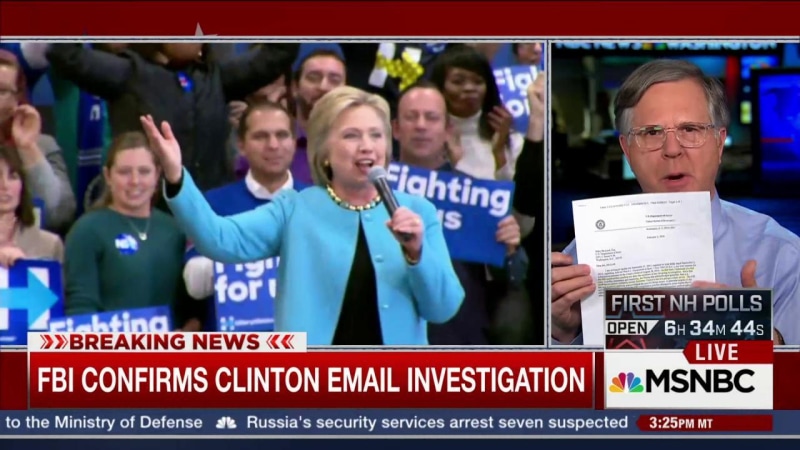
FBI formally confirms its investigation of Hillary Clinton’s email server

MSNBC | By Pete Williams | 02/08/16 05:30 PM


In a letter disclosed Monday in a federal court filing, the FBI confirms one of the world’s worst-kept secrets: It is looking into Hillary Clinton’s use of a private email server.


Why say this at all, since it was widely known to be true? Because in August in response to a judge’s direction, the State Department asked the FBI for information about what it was up to. Sorry, the FBI said at the time, we can neither confirm nor deny the existence of any investigation.

Now, in a letter dated February 2 and filed in court Monday, the FBI’s general counsel, James Baker, notes that in public statements and congressional testimony, the FBI “has acknowledged generally that it is working on matters related to former Secretary Clinton’s use of a private email server.”

Baker says the FBI has not, however, “publicly acknowledged the specific focus, scope or potential targets of any such proceedings.”

He ends the one-paragraph letter by saying that the FBI cannot say more “without adversely affecting on-going law enforcement efforts.”

The letter was filed in one of the Freedom of Information Act cases brought against the State Department over access to documents from Hillary Clinton’s time as secretary of state. This one was filed by Judicial Watch.

Thursday, February 4, 2016

Clinton’s Security Clearance Is Under Scrutiny

Bloomberg | By Eli Lake & Josh Rogin | FEB 4, 2016 6:00 AM EST

SHE'S USED TO SCRUTINY. PHOTOGRAPHER: SAUL LOEB/AFP/GETTY IMAGES

Now that several e-mails on Hillary Clinton's private server have been classified, there is a more immediate question than the outcome of the investigation: Should the former secretary of state retain her security clearance during the inquiry? Congressional Republicans and Democrats offer predictably different answers.


The State Department announced Friday that it would not release 22 e-mails from Clinton’s private server after a review found they contained information designated as top secret. U.S. officials who reviewed the e-mails tell us they contain the names of U.S. intelligence officers overseas, but not the identities of undercover spies; summaries of sensitive meetings with foreign officials; and information on classified programs like drone strikes and intelligence-collection efforts in North Korea.

The FBI is investigating the use of Clinton’s home server when she was secretary of state, which the bureau now has. The New York Times reported in August that Clinton is not a target of that investigation. We reported in September that one goal is to discover whether a foreign intelligence service hacked in.

Representative Adam Schiff, the ranking Democrat on the House Intelligence Committee, said Clinton should not lose her security clearance for receiving information that was not marked classified at the time. "I'm sure she does hold a clearance, and she should," he told us.

Representative Mike Pompeo, a Republican member of that committee who also has read the e-mails, told us, "It's important, given all the information we now know, that the House of Representatives work alongside the executive branch to determine whether it's appropriate for Secretary Clinton to continue to hold her security clearances."

Senate Intelligence Chairman Richard Burr told us the decision lies with the White House. “I think that’s up to what the National Security Council is comfortable with,” he said.

Burr, who has also read all 22 e-mails, said Clinton should have known to better protect the information they contain. “They are definitely sensitive," he said. "Anybody in the intelligence world would know that the content was sensitive.”

His Democratic counterpart, Senator Dianne Feinstein, who also read them, told us that Clinton didn’t originally send any of the e-mails and that they were largely from her staff, although she did sometimes reply. Feinstein said the intelligence community is being overly cautious by designating the e-mails as top secret.

“There’s no question that they are over-classifying this stuff,” she said.

Clinton’s discussion of classified programs on an unclassified e-mail system is hardly rare. The issue, called “spillage,” has plagued the government for years. It can apply to anything from a spoken conversation about intelligence programs outside of a secure facility, to printing out a document with classified information on an insecure printer.

Still, it is forbidden. The State Department's Foreign Affairs Manual says "transmitting classified information over a communication channel that is unauthorized for the level of information being transmitted" is a "security violation." Such violations must be investigated by the State Department's own bureaus of human resources and diplomatic security. Punishment can vary from a letter of reprimand to loss of security clearance, according to the manual.

When asked about the status of Clinton's security clearance, State Department spokesman John Kirby said: "The State Department does not comment on individuals’ security clearance status. We will say, however, that generally speaking there is a long tradition of secretaries of state making themselves available to future secretaries and presidents. Secretaries are typically allowed to maintain their security clearance and access to their own records for use in writing their memoirs and the like.”

The Clinton campaign declined to comment.

During the Obama administration, it has not been automatic for officials to lose their security clearance while an investigation is underway. Just last week, the Washington Post reported that the chief of naval intelligence, Vice Adm. Ted Branch, had his security clearance suspended because he is wrapped up in a Justice Department investigation into contracting corruption. He has not been able to read, see, or hear classified information since November 2013. Branch has not been charged with any crime and continues to serve in that post.

But when then-CIA director David Petraeus came under FBI investigation at the end of 2012, his security clearance was not formally revoked. After he resigned, his access to classified information was suspended, according to U.S. officials. In that case, Petraeus had provided notebooks with highly classified information to his biographer and mistress Paula Broadwell, whose security clearances did not permit her to receive it.

Unlike Broadwell, officials familiar with the e-mails tell us that Clinton and her e-mail correspondents were cleared to receive the information that has been classified after the fact. Steven Aftergood, who heads the project on government secrecy for the Federation of American Scientists, told us, "It's entirely possible for information to start out as unclassified and to be classified only when the question of public disclosure arises."

William Leonard, who oversaw the government's security classification process between 2002 and 2008 as the director of the Information Security Oversight Office, told us this kind of "spillage" was common. "The bottom line is this, if you have the opportunity to pore through any cleared individual's unclassified e-mail account, it's almost inevitable you would find material that someone, some way would point out should be classified." He also said that in Clinton's case, "there is no indication that she deliberately disregarded the rules for handling classified information so I see no reason why she should not remain eligible for a security clearance."

Nonetheless, Leonard added that Clinton's decision to use the private e-mail server as secretary of state "reflected exceedingly poor judgment, and those that advised her on this did not serve her well."

The FBI investigation may determine that neither Clinton nor her aides broke the law, but Clinton herself has said she used poor judgment. It's an open question how that poor judgment will affect her access to state secrets, during and after the FBI's investigation.

Feds fight disclosure of Hillary Clinton Whitewater indictment drafts

Politico | By JOSH GERSTEIN | 02/03/16 05:33 PM EST

IMAGE CREDIT: GETTY

The National Archives is fighting a lawsuit trying to force disclosure of several draft indictments of Hillary Clinton prepared by a Whitewater prosecutor in the 1990s.


In a brief filed late Tuesday, Justice Department lawyers and the Archives argue that disclosure of the draft indictments would lead to an unwarranted invasion of Clinton's privacy and violate a court rule protecting grand jury secrecy.

"Despite the role that Mrs. Clinton occupied as the First Lady during President Clinton's administration, Mrs. Clinton maintains a strong privacy interest in not having information about her from the files of the Independent Counsel disclosed," wrote Martha Wagner Murphy, chief of the Archives "special access" branch that stores records of former independent counsels. "As an uncharged person, Hillary Rodham Clinton retains a significant interest in her personal privacy despite any status as a public figure."

The conservative group Judicial Watch, which filed suit for the records in October under the Freedom of Information Act, is arguing that Clinton's ongoing bid for the presidency reinforces the public interest in records about her alleged misconduct.

"She's one of the most well-known women in the world, seeking the office of the presidency and her privacy interests outweigh the public interest in knowing what's in that indictment? It's absurd and it's shameful that the administration is proposing this," Judicial Watch President Tom Fitton said in an interview. "This is a political decision to protect her candidacy—because it is laughable, legally."

The Archives and Justice Department were dismissive about the impact of Clinton's presidential bid on public access to the records.

"While there may be a scintilla of public interest in these documents since Mrs. Clinton is presently a Democratic presidential candidate, that fact alone is not a cognizable public interest alone under FOIA, as disclosure of the draft indictments would not shed light on what the government is up to," Murphy wrote.

"Her interest in avoiding disclosure of the drafts is not diminished by the fact that she is a former public official who is running for President," Justice Department lawyers added in their brief.

Law enforcement records about living people who did not face charges in criminal investigations normally are not released under FOIA, or the names are sanitized from the records before they're published. However, sometimes judges have ordered the release of such records in cases involving public officials.

Despite the usual practice, though, the Archives has released fairly detailed information about the independent counsel's focus on Hillary Clinton. Just last week, Judicial Watch announced it had received 246 pages of records describing the crimes some prosecutors believed were committed in connection with the Whitewater land deal and related matters. Some of the memos are from the "HRC Team" in the counsel's office—apparently a team focused on Clinton. One discusses the jury appeal or lack thereof of a case based solely on circumstantial evidence. One prosecutor put the chance of a conviction for Clinton at 10 percent.

It's not clear from the government's court filings why the draft indictments would be more sensitive than that kind of analysis, but the new submissions do argue that the drafts are covered by grand jury secrecy. In its initial response to Judicial Watch, the Archives relied solely on Clinton's privacy (and that of others) and did not mention the grand jury secrecy issue. But the brief filed Tuesday contends the drafts would provide insight into the grand jury's activities by revealing the identities of witnesses and that they quote from grand jury testimony.

Fitton said that "if Mrs. Clinton was being truly transparent," she would provide a privacy waiver that could ease release of the records.

Spokesmen for the Clinton campaign did not respond to a request for comment on the legal filings.

Friday, January 29, 2016

Official: Some Clinton emails 'too damaging' to release

By Catherine Herridge, Pamela K. Browne | Published January 29, 2016 | FoxNews.com


EXCLUSIVE: The intelligence community has now deemed some of Hillary Clinton’s emails “too damaging" to national security to release under any circumstances, according to a U.S. government official close to the ongoing review. A second source, who was not authorized to speak on the record, backed up the finding. 


The decision to withhold the documents in full, and not provide even a partial release with redactions, further undercuts claims by the State Department and the Clinton campaign that none of the intelligence in the emails was classified when it hit Clinton's personal server.

Fox News is told the emails include intelligence from "special access programs," or SAP, which is considered beyond “Top Secret.” A Jan. 14 letter, first reported by Fox News, from intelligence community Inspector General Charles McCullough III notified senior intelligence and foreign relations committee leaders that "several dozen emails containing classified information” were determined to be “at the CONFIDENTIAL, SECRET, AND TOP SECRET/SAP levels."

The State Department is trying to finish its review and public release of thousands of Clinton emails, as the Democratic presidential primary contests get underway in early February.

Under the Freedom of Information Act, or FOIA, there is an exemption that allows for highly sensitive, and in this case classified, material to be withheld in full -- which means nothing would be released in these cases, not even heavily redacted versions, which has been standard practice with the 1,340 such emails made public so far by the State Department.

According to the Justice Department FOIA website, exemption “B3” allows a carve-out for both the CIA and NSA to withhold "operational files." Similar provisions also apply to other agencies.

Fox News reported Friday that at least one Clinton email contained information identified as "HCS-O," which is the code for intelligence from human spying.

One source, not authorized to speak on the record, suggested the intelligence agencies are operating on the assumption there are more copies of the Clinton emails out there, and even releasing a partial email would provide enough clues to trace back to the original – which could allow the identification of “special access programs” intelligence.

There was no comment to Fox News from the Office of the Director of National Intelligence, the Office of the Intelligence Community Inspector General, or the agency involved. Fox News has chosen not to identify the agency that provided sworn declarations that intelligence beyond Top Secret was found in the Clinton emails.

Reached for comment by Fox News, a State Department official did not dispute that some emails will never be made public.

“We continue to process the next set of former Secretary Clinton’s emails for release under the FOIA process and will have more to say about it later,” the official said. “As always, we take seriously our responsibilities to protect sensitive information.”

The State Department was scheduled to release more Clinton emails Friday, while asking a D.C. federal court for an extension.

FBI investigators looking into the emails are focused on the criminal code pertaining to “gross negligence” in the handling and storage of classified information, and “public corruption.”

“The documents alone in and of themselves set forth a set of compelling, articulable facts that statutes relating to espionage have been violated,” a former senior federal law enforcement officer said. The source said the ongoing investigation along the corruption track “also stems from her tenure of secretary. These charges would be inseparable from the other charges in as much as there is potential for significant overlap and correlation."

Based on federal regulations, once classified information is spilled onto a personal computer or device, as was the case with Clinton and her aides, the hardware is now considered classified at the highest classification level of the materials received.

While criticized by the Clinton campaign, McCullough, an Obama administration appointee, was relaying the conclusion of two intelligence agencies in his letter to Congress that the information was classified when it hit Clinton’s server -- and not his own judgment.

Joseph E. Schmitz, a former inspector general of the Department of Defense, called the attacks on McCullough a “shoot the watchdog” tactic by Clinton’s campaign.

The developments, taken together, show Clinton finding herself once again at the epicenter of a controversy over incomplete records.

During her time as the first female partner at the Rose Law firm in Arkansas during the mid-1980s, she was known as one of the “three amigos” and close with partners Webb Hubbell and Vince Foster. Hubbell ended up a convicted felon for his role in the failure of the corrupt Madison Guaranty, a savings and loan which cost taxpayers more than $65 million. Hubbell embezzled more than a half-million dollars from the firm.

Foster killed himself in Washington, D.C., in July 1993. As Clinton’s partner in the Rose Law firm, he had followed the Clintons into the White House where he served as the Clintons’ personal lawyer and a White House deputy counsel.

Clinton’s missing Rose Law billing records for her work for Guaranty during the mid-1980s were the subject of three intense federal investigations over two years. Those records, in the form of a computerized printout of her work performed on behalf of Guaranty, were discovered under mysterious circumstances in the Book Room of the private White House living quarters.

The discovery of those records was announced during a blizzard in January 1996 by attorney David Kendall, who still represents Hillary Clinton. After Clinton testified before a grand jury, prosecutors concluded there was insufficient evidence to prove beyond a reasonable doubt she committed perjury or obstruction of justice.

Despite Clinton’s recent public statements about not knowing how the technology works, at least one email suggests she directed a subordinate to work around the rules. In a June 2011 email to aide Jake Sullivan, she instructed him to take what appeared to be classified talking points, and "turn into nonpaper w no identifying heading and send nonsecure."

A State Department spokesman could not say whether such a fax was sent.


Catherine Herridge is an award-winning Chief Intelligence correspondent for FOX News Channel (FNC) based in Washington, D.C. She covers intelligence, the Justice Department and the Department of Homeland Security. Herridge joined FNC in 1996 as a London-based correspondent.

State to release some Clinton emails on Friday; thousands still delayed

The Hill | By Julian Hattem - 01/29/16 09:14 AM EST

IMAGE SOURCE: WIKIPEDIA

The State Department on Friday will release roughly 2,000 pages of Hillary Clinton’s emails, but will delay the final batch of messages until after voters go to the polls in early primary states.


In a court filing late on Thursday evening, the department insisted that it “regrets” its inability to publish the final 7,000 pages on Friday, as a federal court ordered it to do last year.

Yet it defended the delay, blaming an internal oversight and the snowstorm that crippled Washington in the past week.

As part of the process of making the emails public, the State Department is required to have other agencies review Clinton’s emails to check if any information should be redacted or marked as classified.

According to the department, it simply “missed” sending roughly 7,000 pages of emails to other agencies, and did not notice the oversight until earlier this month. Its efforts to correct the problem were further delayed by the snowstorm, which closed the federal government through Wednesday.

The department has not even sent out documents to 12 agencies to review, it said.

Last week, the department pushed to delay the final deadline until Feb. 29.

As the journalist who sued the department to force the emails’ release pointed out, however, that would be after voters in the first four primary states have gone to the polls.

“[I]f the Court allows State to delay release of thousands of pages of Democratic presidential candidate Hillary Clinton’s official work emails, a substantial portion of the electorate will be forced to vote without the benefit of important information to which it is entitled about the performance of one of the candidates for U.S. President while serving as Secretary of State,” lawyers opposing the department’s schedule claimed earlier this week.

The Obama administration was unmoved.

“Upcoming electoral events, while admittedly important to the public, do not change the fact that State needs this reasonable amount of additional time to complete the final stage of this enormous and complex undertaking,” lawyers representing the State Department wrote.

Critics have warned that the final tranche of emails could contain scandalous or scintillating nuggets about Clinton’s time in the State Department. Administration lawyers this week attempted to dismiss those allegations.

The 7,000 pages of emails that won’t be out for another month needed to go through “multiple” other agencies for review, they claimed.

“But that does not mean that these emails are more ‘controversial’ than other emails, or that the oversight that led to them not being sent to all the necessary agencies was related to their substance," they wrote.

Monday, January 25, 2016

Reporter fights Hillary Clinton email delay

Politico | By JOSH GERSTEIN | 01/25/16 12:30 PM EST


Lawyers for a journalist seeking release of Hillary Clinton's email trove are objecting to the State Department's request for a month-long delay to complete disclosure of the final set of the former secretary of state's messages, warning that allowing the process to drag out until the end of February could deprive voters in early caucus and primary states of information on the Democratic presidential candidate.

State asked for an extension last week, telling U.S. District Court Judge Rudolph Contreras that State officials overlooked more than 7,000 pages of emails that were in need of interagency consultation and that the weekend's winter storm was complicating efforts to process the records.

"Unless and until State explains how over 7,000 pages that were already reviewed and identified as needing review by at least one other agency were lost for up to six months, and then suddenly found again just weeks before the deadline to produce them, the Court should view skeptically State’s assertion that this constitutes a legitimate 'unexpected' event," lawyers Ryan James and Jeffrey Light wrote in a court filing Monday morning on behalf of Vice News reporter Jason Leopold.

"Allowing State to delay the release of thousands of pages of a presidential candidate's work emails, especially when they have already garnered so much media and public attention, until after four states have voted and until just hours before another 11 states and American Samoa will vote, would deny Mr. Leopold of the opportunity to realize the fruits of his year-long pursuit of these records which he and the public have a legal right under [the Freedom of Information Act] to obtain," James and Light wrote.

Contreras issued an order in May requiring monthly release of batches of the 54,000 pages of emails Clinton kept on a private server and turned over to her former agency in December 2014. The judge set monthly goals for the percentage of pages released, but he ordered that the process be completed by Friday, Jan. 29.

State missed the monthly goals on two occasions, but subsequently made up the shortfalls. Now, it wants the final deadline extended to Feb. 29.

Leopold's attorneys said State hasn't provided enough detail about how the 7,254 pages were overlooked and whether the foul-up was due to "agency negligence or malfeasance." They said that if Contreras is inclined to grant State more time, a hearing should be held on what time is necessary.

It's unclear when Contreras will act on State's extension motion, which was filed Friday afternoon as the federal government shut down for the approaching storm. The court remains closed Monday as Washington digs out.

Friday, January 22, 2016

EVERYONE BUT HILLARY THINKS HER EMAILS WERE HACKED

Infowars.com | Rob Dew | JANUARY 22, 2016

Presidential candidate Hillary Clinton denied reports that her private email server had been hacked after being confronted by an Infowars correspondent at a campaign stop in Iowa on Thursday.

BREAKING: HILLARY DENIES EMAIL HACK

Mikael Thalen | Infowars.com - JANUARY 22, 2016

IMAGE CREDIT: INFOWARS.COM

Presidential candidate Hillary Clinton denied reports that her private email server had been hacked Thursday after being confronted by an Infowars correspondent at a campaign stop in Iowa.


“Secretary Clinton, last week it was reported on Infowars.com that your email server was hacked and you knowingly continued to use your email server,” Infowars’ Richard Reeves said. “Can you comment on that?”

“It’s totally untrue. Totally untrue,” Clinton replied.

The question stems from an exclusive Infowars interview earlier this month in which former Secret Service agent Dan Bongino reported that Clinton continued using her private email to discuss classified information despite knowing her server had been compromised.

“A source fed to me… and by the way Alex, an unimpeachable source by any measure… This is an unimpeachable source who said, ‘Not only was the email server hacked,’ which is breaking news… but not only was it hacked Alex, but the Clintons knew it was hacked and they kept using it,” he said.


Clinton’s denial came only hours after former Secretary of Defense Robert Gates agreed that the “odds are pretty high” that Russia, China, and Iran accessed the presidential candidate’s server.

“Well, given the fact that the Pentagon acknowledges that they get attacked about 100,000 times a day, I think the odds are pretty high,” Gates told radio host Hugh Hewitt.

Just last Tuesday a letter written by Intelligence Community Inspector General I. Charles McCullough III. obtained exclusively by Fox News revealed that a comprehensive review of Clinton’s email by intelligence agencies found not only dozens of additional classified messages but emails classified above the top secret level.

“To date, I have received two sworn declarations from one [intelligence community] element. These declarations cover several dozen emails containing classified information determined by the IC element to be at the confidential, secret, and top secret/sap levels,” the letter, written to both lawmakers and the State Department, said.

In response, the Clinton campaign accused investigators of working with Republicans to politicize the issue in order to damage the former first lady’s run for the presidency.

The latest release of emails from the State Department also found that Clinton instructed an aide to remove classification markings from sensitive documents before having them sent in an insecure manner.

Facebook: https://www.facebook.com/mt.examiner
Twitter: https://twitter.com/MikaelThalen
Email: Mikael@infowars.com (PGP Key)
OTR: Mikaelthalen@dukgo.com

Former Defense Secretary Gates: ‘Odds Are Pretty High’ Iran and Russia Accessed Hillary’s Email

Mediaite | by Alex Griswold | 7:50 am, January 22nd, 2016

IMAGE CREDITS: R. D. WARD, WIKIMEDIA COMMONS.


Former Bush and Obama Secretary of Defense Robert Gates said Thursday that “the odds were pretty high” that governments hostile to the United States accessed Hillary Clinton‘s private server.

Gates said on The Hugh Hewitt Show that the Clinton email controversy was “a concern for me. I never used email when I was head of CIA or head of the Department of Defense… I preferred dealing with people face to face and putting a signature on a piece of paper on matters of real national security and importance.”

“One of your colleagues, Mike Morell, said on this program, or actually agreed with my assertion that almost certainly, Russians, Chinese and Iranians had compromised the home brew server of the former Secretary of State…” Hugh Hewitt noted. “Do you agree with his assessment of my assessment?”

Gates said he did. “Well, given the fact that the Pentagon acknowledges that they get attacked about 100,000 times a day, I think the odds are pretty high.”


He wasn’t willing to say that those hacks undermined national security, however. “It would depend entirely on what she put on there. And I just, I haven’t read any of these emails, so I don’t know what was on those servers.

Listen above, via The Hugh Hewitt Show.