Showing posts with label hackers. Show all posts

Wednesday, February 10, 2016

The IRS Says Identity Thieves Hacked Its Systems Again

Fortune | by Jonathan Chew | FEBRUARY 10, 2016, 8:25 AM EST


Identity thieves attempted to breach computer systems at the Internal Revenue Service to file fraudulent tax refunds.


The criminals were especially after E-file PINs, which are used by some individuals to electronically file a return, the agency said in a statement released Tuesday. Around 464,000 unique social security numbers were involved, and of that total, 101,000 SSNs were used to successfully access an E-file PIN.

The thieves used personal taxpayer data that was stolen elsewhere to help generate the PINs, the agency said. No personal data was compromised or disclosed by IRS systems, and affected taxpayers will be notified by mail of the attack. “The IRS is also protecting their accounts by marking them to protect against tax-related identity theft,” the agency added.


Last week, the IRS temporarily could not accept many taxpayer returns after a systemwide computer failure occurred. The agency said this attack was unrelated to the outage.

This year’s attack follows a massive data breach at the IRS in 2015, when hackers stole information from 330,000 taxpayers to successfully file bogus tax refunds and obtain $50 million in federal funds.

A later inspector general report found that the computer system the IRS had been using to detect identity theft may have been vulnerable to hackers.

Tuesday, February 9, 2016

Judicial Watch: New Emails Show Hillary Clinton and Aides Had Classified Information on Non-Government Email Accounts

Judicial Watch | FEBRUARY 09, 2016


(Washington, DC) – Judicial Watch today released nearly 70 pages of State Department records that show that former Secretary of State Hillary Clinton and her top aides, Deputy Chiefs of Staff Huma Abedin and Jake Sullivan, received and sent classified information on their non-state.gov email accounts. 


 The documents, also available on the State Department website, were obtained in response to a court order from a May 5, 2015,lawsuit filed against the State Department (Judicial Watch, Inc. v. U.S. Department of State (No. 1:15-cv-00684)) after it failed to respond to a March 18 Freedom of Information Act (FOIA) request seeking:

  • All emails of official State Department business received or sent by former Deputy Chief of Staff Huma Abedin from January 1, 2009 through February 1, 2013 using a non-“state.gov” email address.

The new documents show that Hillary Clinton used the clintonemail.com system to ask Huma Abedin (also on a non-state.gov email account) to print two March 2011 emails, which were sent from former British Prime Minister Tony Blair (using the moniker “aclb”) to Jake Sullivan on Sullivan’s non-state.gov email account. The Obama State Department redacted the Blair emails under Exemption (b)(1) which allows the withholding of classified material. The material is marked as being classified as “Foreign government information” and “foreign relations or foreign activities of the US, including confidential sources.”

Another email shows that Clinton wanted to know how meetings in Washington, including a four-hour meeting concerning America’s war on Libya, would impact her Hampton vacation. Responding to an email that details the sensitive meetings in DC, Clinton emails Abedin on August 26, 2011, “Ok. What time would I get back to Hamptons?” Again, this email discussion takes place on non-state.gov email accounts.

The documents also include advice to Clinton on Libya from Sidney Blumenthal, a Clinton Foundation employee who, according to a Judicial Watch investigative report, also had business interests in Libya. Clinton wanted Blumenthal’s March 9, 2011, Libya memo to be printed “without any identifiers.”

The newly released Abedin emails include a lengthy exchange giving precise details of Clinton’s schedule using unsecured government emails. The email from Lona J. Valmoro, former Special Assistant to Secretary of State Clinton, to Abedin and Clinton reveals exact times (including driving times) and locations of all appointments throughout the day. Another itinerary email provides details about a meeting at the United Nations in New York at 3:00 on Tuesday, January 31, 2012, with the precise disclosure, “that would mean wheels up from Andrews at approximately 12:00pm/12:15pm.”

“These emails show that Hillary Clinton isn’t the only Obama official who should be worried about being prosecuted for mishandling classified information. Her former top State aides (and current campaign advisers) Huma Abedin and Jake Sullivan should be in the dock, as well,” said Judicial Watch President Tom Fitton. “The Obama State Department has now confirmed that Clinton, Abedin, and Sullivan used unsecured, non-government email accounts to communicate information that should now be withheld from the American people ‘in the interest of national defense or foreign policy, and properly classified.’ When can we expect the indictments?”

Robots will force experts to find other routes to the top

FT | Andrew Hill | February 8, 2016


There is a point in any talk about the automated future of the professions when the audience visibly relaxes.


It comes when futurists concede that a few expert lawyers, consultants or accountants will still be needed, even after cheaper, more efficient computer systems have taken over many of their juniors’ tasks.


It happened last week at a lecture by Richard and Daniel Susskind, which the organisers claimed was the largest ever gathering of senior managers in UK professional services firms.

The father-and-son authors of The Future of the Professions predicted radical change in the sector. But the tense scepticism in the room dissipated as each senior partner or director quietly acknowledged he or she would be a survivor, even if algorithms and artificial intelligence swept away the consultant or solicitor in the next seat.

This cohort may well reach retirement unscathed — and without much incentive to alter how they work. As Richard Susskind told me afterwards, “it’s hard to convince a room full of millionaires that they have got their model wrong”. But change is coming. The main difference of opinion is over its pace and extent.

You can already ask Kim, a legal “virtual assistant” launched by Riverview Law, for help managing your caseload, or get Ross, IBM Watson’s “super intelligent attorney”, to research the entire body of law in seconds. But a crystal-ball-gazing report by The Law Society, the trade body for solicitors in England and Wales, expects the impact of this type of automation to level off by 2020.

The society’s Stephen Denyer told last week’s gathering that clients were not only looking for practical counsel, but for “negotiating skills, judgment, ethical standards, and reassurance about the direction they’re taking”.

Fine. But how will the senior partners of the future achieve that level of wisdom when machines are doing the tasks that allow them to build and hone their expertise?

Take financial journalism. I spent three years as a trainee building confidence and skill by churning out news about corporate earnings. This is precisely the type of report that, quite rightly, Associated Press now produces automatically, in partnership with a company called — ominously for all columnists — Automated Insights.

Another parallel is aviation, where crashes often trigger fears that autopilots are undermining human skills. Interviewed last year about the 2009 Air France crash, Delmar Fadden, Boeing’s former chief of cockpit technology, told Vanity Fair that, having automated 98 per cent of pilots’ routine work, “we really worry about the tasks we ask them to do just occasionally”.

The answer is not to halt the march of the robots. Indeed, technology is part of the solution. Novice astronauts are not trained by sending them on repeated costly moonshots. They practise the tasks and challenges they will face in carefully designed simulations, until they are finally ready for the launch pad.

As Prof Susskind points out, law students at the University of Strathclyde play out real-world legal problems in a fictional virtual community called “Ardcalloch”.

In the real world, professionals must recognise much of the work they hand to juniors is repetitive servitude, often imposed on the tacit assumption that, if they had to do it, so should the new generation. Clients may still prefer dealing with human experts but they do not much like paying for their juniors’ billable training.

Knowledge can be imparted in other ways, including simply by working closely, apprentice-style, with senior colleagues. I still value the guidance I received as a beginner from experienced editors and writers but I am not sure I needed to write five similar corporate earnings stories a day to achieve mastery. Newbies can acquire specific skills through working, under close supervision, on a sample of the basic tasks they once spent years slogging through.

Meanwhile, new roles will evolve. The Susskinds suggest that one could be the “empathiser”. A sympathetic human may eventually act as assistant to Kim or Ross or their more cognitively capable descendants.

This prospect causes conniptions among some consultants and accountants. It may not happen at the top for years — or ever, in complex lawsuits or tax audits. But aspiring partners should start honing their listening skills, just in case.

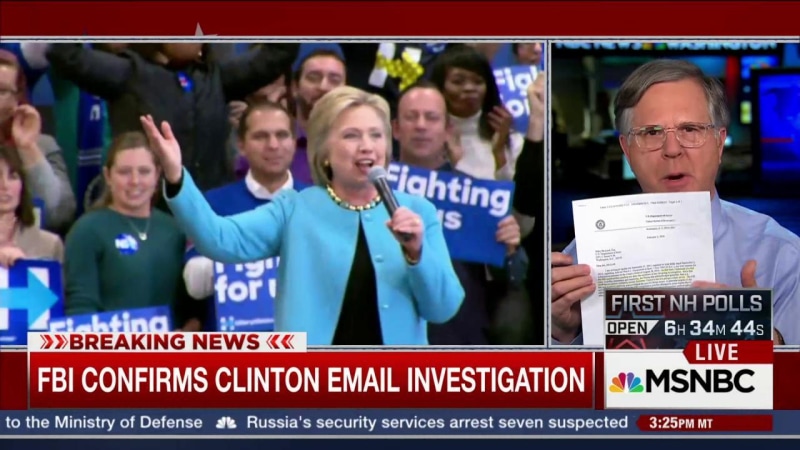
FBI formally confirms its investigation of Hillary Clinton’s email server

MSNBC | By Pete Williams | 02/08/16 05:30 PM


In a letter disclosed Monday in a federal court filing, the FBI confirms one of the world’s worst-kept secrets: It is looking into Hillary Clinton’s use of a private email server.


Why say this at all, since it was widely known to be true? Because in August in response to a judge’s direction, the State Department asked the FBI for information about what it was up to. Sorry, the FBI said at the time, we can neither confirm nor deny the existence of any investigation.

Now, in a letter dated February 2 and filed in court Monday, the FBI’s general counsel, James Baker, notes that in public statements and congressional testimony, the FBI “has acknowledged generally that it is working on matters related to former Secretary Clinton’s use of a private email server.”

Baker says the FBI has not, however, “publicly acknowledged the specific focus, scope or potential targets of any such proceedings.”

He ends the one-paragraph letter by saying that the FBI cannot say more “without adversely affecting on-going law enforcement efforts.”

The letter was filed in one of the Freedom of Information Act cases brought against the State Department over access to documents from Hillary Clinton’s time as secretary of state. This one was filed by Judicial Watch.

Monday, February 8, 2016

Russian Hackers Moved Currency Rate With Malware, Group-IB Says

Bloomberg | Jake Rudnitsky & Ilya Khrennikov | February 8, 2016 — 5:42 AM EST


Hackers used malware to penetrate the defenses of a Russian regional bank and move the ruble-dollar rate more than 15 percent in minutes, according to a Moscow-based cyber-security firm hired to investigate the attack.


Russian-language hackers deployed a virus known as the Corkow Trojan to infect Kazan-based Energobank and place more than $500 million in orders at non-market rates in February 2015, Group-IB told Bloomberg, without identifying individuals behind the attack. The resulting rate swing prompted a Russian central bank investigation last year into potential market manipulation.

Malicious software of the type used in the attack can open a back door into computers via seemingly legitimate websites or files and then force them to carry out hackers’ orders. Corkow, which regularly updates itself to evade detection by anti-virus programs, has infiltrated 250,000 computers worldwide and infected more than 100 financial institutions, according to Group-IB, which investigated the attack on behalf of Energobank.

“This is the first documented attack using this virus and it has potential to do much more damage,” Dmitry Volkov, the head of Group-IB’s cyber intelligence department, said by phone. “Once the malware has penetrated a local network, it is sophisticated enough to infect computers that are even not connected to the Internet.”

The Moscow Exchange has said its systems were not hacked in the incident on Feb. 27, 2015. In a separate investigation, the central bank said it found no evidence of currency market manipulation, noting the fluctuations could have been caused by traders’ mistakes.

The volatility lasted 14 minutes and caused the exchange rate to swing between 55 and 66 rubles per dollar, which “significantly differed from the prevailing market rate,” the central bank said in a statement on Dec. 17.

The bank claimed losses of 244 million rubles ($3.2 million) due to the trades, Vedomosti newspaper reported last year, citing a suit filed by Energobank in a Kazan court. There is no evidence that the hackers profited from the operation and it may have been a test to prepare for future attacks, according to Group-IB.

Energobank, the exchange and the central bank did not respond to e-mailed queries.

The virus was also used in an attack on a Russian bank card system that resulted in hundreds of millions of rubles being stolen via ATMs in August, Group-IB said.

Thursday, February 4, 2016

Clinton’s Security Clearance Is Under Scrutiny

Bloomberg | By Eli Lake & Josh Rogin | FEB 4, 2016 6:00 AM EST

SHE'S USED TO SCRUTINY. PHOTOGRAPHER: SAUL LOEB/AFP/GETTY IMAGES

Now that several e-mails on Hillary Clinton's private server have been classified, there is a more immediate question than the outcome of the investigation: Should the former secretary of state retain her security clearance during the inquiry? Congressional Republicans and Democrats offer predictably different answers.


The State Department announced Friday that it would not release 22 e-mails from Clinton’s private server after a review found they contained information designated as top secret. U.S. officials who reviewed the e-mails tell us they contain the names of U.S. intelligence officers overseas, but not the identities of undercover spies; summaries of sensitive meetings with foreign officials; and information on classified programs like drone strikes and intelligence-collection efforts in North Korea.

The FBI is investigating the use of Clinton’s home server when she was secretary of state, which the bureau now has. The New York Times reported in August that Clinton is not a target of that investigation. We reported in September that one goal is to discover whether a foreign intelligence service hacked in.

Representative Adam Schiff, the ranking Democrat on the House Intelligence Committee, said Clinton should not lose her security clearance for receiving information that was not marked classified at the time. "I'm sure she does hold a clearance, and she should," he told us.

Representative Mike Pompeo, a Republican member of that committee who also has read the e-mails, told us, "It's important, given all the information we now know, that the House of Representatives work alongside the executive branch to determine whether it's appropriate for Secretary Clinton to continue to hold her security clearances."

Senate Intelligence Chairman Richard Burr told us the decision lies with the White House. “I think that’s up to what the National Security Council is comfortable with,” he said.

Burr, who has also read all 22 e-mails, said Clinton should have known to better protect the information they contain. “They are definitely sensitive," he said. "Anybody in the intelligence world would know that the content was sensitive.”

His Democratic counterpart, Senator Dianne Feinstein, who also read them, told us that Clinton didn’t originally send any of the e-mails and that they were largely from her staff, although she did sometimes reply. Feinstein said the intelligence community is being overly cautious by designating the e-mails as top secret.

“There’s no question that they are over-classifying this stuff,” she said.

Clinton’s discussion of classified programs on an unclassified e-mail system is hardly rare. The issue, called “spillage,” has plagued the government for years. It can apply to anything from a spoken conversation about intelligence programs outside of a secure facility, to printing out a document with classified information on an insecure printer.

Still, it is forbidden. The State Department's Foreign Affairs Manual says "transmitting classified information over a communication channel that is unauthorized for the level of information being transmitted" is a "security violation." Such violations must be investigated by the State Department's own bureaus of human resources and diplomatic security. Punishment can vary from a letter of reprimand to loss of security clearance, according to the manual.

When asked about the status of Clinton's security clearance, State Department spokesman John Kirby said: "The State Department does not comment on individuals’ security clearance status. We will say, however, that generally speaking there is a long tradition of secretaries of state making themselves available to future secretaries and presidents. Secretaries are typically allowed to maintain their security clearance and access to their own records for use in writing their memoirs and the like.”

The Clinton campaign declined to comment.

During the Obama administration, it has not been automatic for officials to lose their security clearance while an investigation is underway. Just last week, the Washington Post reported that the chief of naval intelligence, Vice Adm. Ted Branch, had his security clearance suspended because he is wrapped up in a Justice Department investigation into contracting corruption. He has not been able to read, see, or hear classified information since November 2013. Branch has not been charged with any crime and continues to serve in that post.

But when then-CIA director David Petraeus came under FBI investigation at the end of 2012, his security clearance was not formally revoked. After he resigned, his access to classified information was suspended, according to U.S. officials. In that case, Petraeus had provided notebooks with highly classified information to his biographer and mistress Paula Broadwell, whose security clearances did not permit her to receive it.

Unlike Broadwell, officials familiar with the e-mails tell us that Clinton and her e-mail correspondents were cleared to receive the information that has been classified after the fact. Steven Aftergood, who heads the project on government secrecy for the Federation of American Scientists, told us, "It's entirely possible for information to start out as unclassified and to be classified only when the question of public disclosure arises."

William Leonard, who oversaw the government's security classification process between 2002 and 2008 as the director of the Information Security Oversight Office, told us this kind of "spillage" was common. "The bottom line is this, if you have the opportunity to pore through any cleared individual's unclassified e-mail account, it's almost inevitable you would find material that someone, some way would point out should be classified." He also said that in Clinton's case, "there is no indication that she deliberately disregarded the rules for handling classified information so I see no reason why she should not remain eligible for a security clearance."

Nonetheless, Leonard added that Clinton's decision to use the private e-mail server as secretary of state "reflected exceedingly poor judgment, and those that advised her on this did not serve her well."

The FBI investigation may determine that neither Clinton nor her aides broke the law, but Clinton herself has said she used poor judgment. It's an open question how that poor judgment will affect her access to state secrets, during and after the FBI's investigation.

Wednesday, February 3, 2016

JOHN KERRY USED PERSONAL ACCOUNT TO SEND HILLARY ‘SECRET’ EMAIL

Mikael Thalen | Infowars | FEBRUARY 2, 2016


Secretary of State John Kerry used a personal email account to discuss “secret” information with Hillary Clinton during his time as a senator, the State Department confirmed Tuesday.


The heavily-redacted email, according to State Department spokesman John Kirby, was undoubtedly “sent from a non-official account.”

“The one that we talked about being upgraded to ‘Secret’ was sent from a non-official account, and the account from which it was sent is no longer active,” Kirby said.

Sent from Kerry’s iPad in May of 2011, the email was classified as “secret” before being released Friday over its mention of sensitive U.S. foreign relations.

The few unredacted sections reveal the discussion to be centered around policy in Pakistan, Afghanistan and India.

“We all know this will be a troubled relationship because that is it’s [sic] nature,” Kerry wrote. “But there are real possibilities at this moment to put options to the test.”

The discovery of yet another high-ranking Obama administration official using a private email to discuss sensitive information hints at an even larger disregard for national security than previously known.

Friday’s release of new Clinton emails also revealed that the State Department had suggested creating a “stand-alone” computer for Clinton in 2009 that would operate outside of the department’s network.

“Days after Clinton was sworn in as secretary of State, department official Lewis Lukens offered to give her a computer that would be ‘connected to the internet (but not through our system) to enable her to check emails from her desk,'” writes The Hill.

Clinton also received more than 18 emails from President Obama despite claims from the commander-in-chief that he had learned of the private email account from the “media.”

According to former Secret Service Agent Dan Bongino, who joined the Alex Jones Show earlier this month, Clinton continued using her private email despite knowing that her server had been hacked.

Monday, February 1, 2016

HACKERS ALLEGEDLY HIJACK DRONE AFTER MASSIVE BREACH AT NASA

Mikael Thalen | Infowars | JANUARY 31, 2016

IMAGE CREDIT: INFOWARS.COM


Members of the AnonSec hacking group have released more than 276GB of data after allegedly spending months inside NASA’s internal network.


The collection of files, provided to Infowars by AnonSec admin Dêfãult Vírüsa prior to being made public Sunday, include 631 videos from aircraft and weather radars, 2,143 flight logs as well as the names, email addresses and phone numbers of 2,414 NASA employees.

A “zine,” or self-published paper detailing the hack, dubbed “OpNasaDrones,” reveals everything from AnonSec’s motives to the specific technical vulnerabilities that enabled the extensive breach.


“NASA has been breached more times than most people can honestly remember… However, this hack into NASA wasn’t initially focused on drones [sic] data and upper atmosphere chemical samples. In fact the original breach into NASA systems wasn’t even planned, it was caught up in a gozi virus spread,” the hackers write, referring to an infamous Trojanthat has infected more than 1 million computers to date.

The Hack


After purchasing an “initial foothold” from a hacker with knowledge of NASA servers over two years ago, the group says it began testing how many machines it could “break into” and “root” – a term referring to an account with complete control over a computer or network.

Brute forcing an administrator’s SSH password, which reportedly only took “0.32” seconds due to the credentials being left as default, AnonSec gained further access inside – allowing them to grab even more login data with a hidden packet sniffer (tcpdump).

The hackers say while some members mapped the network, others analyzed the “different missions, airbases and aircraft” listed by the agency. Public missions like “OIB – Operation Ice Bridge” and drones such as the “Global Hawk“ were among those mentioned.

Deleting records of their presence as they hacked deeper into the agency’s system, AnonSec, who even hacked security cameras and uncovered the schematics to one base’s camera layout, then infiltrated the networks at “Glenn Research Center, Goddard Space Flight Center and Dryden Flight Research Center.”

Once inside, the group says it began noticing numerous systems and networked devices “popping up in scans that were not previously visible…”

After sniffing a password belonging to the system administrator, the hackers say they were eventually able to gain full root access to three network-attached storage (NAS) devices tasked with compiling backups of aircraft flight logs.

“Now we had all 3 NAS devices automatically making copies of the logs as they are uploaded from the drones and renaming them to look like semi ordinary index files,” the group writes, mocking the system administrator responsible for protecting the data.

Hackers Attempt to Crash Drone into Pacific Ocean

As the information began flowing unsuspectingly to an AnonSec-controlled server outside of the NASA network, analysis of the data yielded what the hackers described as “weird traffic.”

According to the group, the traffic consisted of “pre-planned route option” files which allow NASA to upload specific flight paths prior to take off.

After protest from several hackers, the group says it decided to carry out a man-in-the-middle (MiTM) attack several months later that replaced the drone route file with one of their own in an attempt to crash the aircraft into the ocean.

“Several members were in disagreement on this because if it worked, we would be labeled terrorists for possibly crashing a $222.7 million US Drone… but we continued anyways lol,” the zine states.

A screenshot from the hackers shows their intended flight path, which they say was cut short after drone pilots on the ground likely noticed the aircraft’s unusual behavior, forcing NASA to restore manual control.


“This recreated flight is from our attempt to crash the GlobalHawk [sic] into the Pacific Ocean but seemed to have been taken off of the malicious pre-planned route and was controlled via SatCom [sic] by a pilot once GroundControl [sic] realized,” the hackers write.

Soon after the alleged drone episode, the group says it was completely shut out from NASA’s networks.

“Whether it was the high amount of traffic sending drone logs across their compromised network or the attempted crashing of a GlowbalHawk [sic] that caused them to FINALLY inspect their networks, we don’t know. But it went down for a while soon after.”

“When they came back up several days later, we had completely lost access.”


Despite NASA’s ability to boot the hackers by changing passwords and patching critical vulnerabilities, vast amounts of information had already been exfiltrated.

“People might find this lack of security surprising but its [sic] pretty standard from our experience,” the group says. “Once you get past the main lines of defense, its [sic] pretty much smooth sailing propagating through a network as long as you can maintain access.”

Aircraft Footage & Flight Logs


The 631 videos siphoned out, filmed during 2012 and 2013, feature footage of weather radar readings as well as both manned and unmanned aircraft in multiple stages of flight.

One 59-minute video from May of 2012 shows one such drone taking off from a NASA runway before cutting out 30 minutes into its mission.


Other videos appear to be above large bodies of ice, likely related to the agency’s climate studies.


Flight logs which seem to coincide with some of the video files include the location of take off, aircraft model, mission name, sensor readings and GPS coordinates.

A screenshot showing a small portion of one log file, possibly from 2014, details the flight of a DC-8 involved in the public “Alternative-Fuel Effects on Contrails and Cruise EmiSSions” project.


The Dox


After examining the list of 2,414 employee names, emails and phone numbers, Infowars was able to confirm the legitimacy of several entries.


Although no calls were answered, names mentioned on each answering machine matched those listed in the hack.

At the time of publishing, Infowars did not receive calls back from any employees on the list or representatives at the Glenn Research Center, Goddard Space Flight Center, Dryden Flight Research Center and the NASA Media Room.

Infowars briefly spoke to NASA’s IT Security Division but did not receive a call back for comment.

Infowars did not receive comment from the FBI after both calling and emailing the agency.

Method Behind the Madness


AnonSec’s zine specifically cites climate engineering methods such as cloud seeding and geoengineering as the main driver behind the hack.

“One of the main purposes of the Operation was to bring awareness to the reality of Chemtrails/CloudSeeding/Geoengineering/WeatherModification, whatever you want to call it, they all represent the same thing. NASA even has several missions dedicated to studying Aerosols [sic] and their affects on the environment and weather, so we targeted their systems.”

Cloud seeding, a weather modification method that uses silver iodide to create precipitation in clouds, was most famously used by the U.S. military under “Operation Popeye” during the Vietnam war. After seeding clouds in the northern part of the country, U.S. forces were able to thwart Viet Cong supply lines by creating heavy rain over the Ho Chi Minh Trail.

Geoengineering, according to NASA’s Erik Conway, involves “injecting sulfate particles into the upper atmosphere – essentially mimicking a large volcanic eruption,” in an attempt to reflect sunlight away from the planet.

A poll conducted by the Independent in 2009, outlined in the article “Climate scientists: it’s time for ‘Plan B,'” states that more than 50 percent of climate scientists support looking into geoengineering.

“Just over half – 54 per cent – of the 80 international specialists in climate science who took part in our survey agreed that the situation is now so dire that we need a backup plan that involves the artificial manipulation of the global climate to counter the effects of man-made emissions of greenhouse gases.”

The hackers link to several mainstream reports and patents as evidence of current weather modification programs.

A 2013 article from Slate entitled, “Climate Intelligence Agency: The CIA is now funding research into manipulating the climate,” examines a 21-month, $630,000 project carried out by The National Academy of Sciences.

“The goal of the CIA-backed NAS study is to conduct a ‘technical evaluation of a limited number of proposed geoengineering techniques,’ according to the NAS website,” the article reads. “Scientists will attempt to determine which geoengineering techniques are feasible and try to evaluate the impacts and risks of each (including ‘national security concerns’).”

Another article from The Telegraph listed by the hackers mentions how “The Chinese government covered Beijing in snow… after meteorologists seeded clouds to bring winter weather to the capital in an effort to combat a lingering drought.”

The hackers argue that if cloud seeding, geoengineering and weather modification “are all publicly acknowledged as real, why are Chemtrails [sic] discredited when its [sic] literally the same exact thing just with a different name?”

“We find it staggering how many people still dont [sic] believe the federal government is doing this when its [sic] already public knowledge that the CIA is funding studies, certain states and countries already have WeatherModification [sic] programs in place for the past several years, not to mention all the government whistleblowers,” the zine says.

AnonSec’s Dêfãult Vírüsa, who spoke with Infowars over encrypted communications, stated that no one involved in the NASA breach has been apprehended by law enforcement.

Friday, January 29, 2016

State to release some Clinton emails on Friday; thousands still delayed

The Hill | By Julian Hattem - 01/29/16 09:14 AM EST

IMAGE SOURCE: WIKIPEDIA

The State Department on Friday will release roughly 2,000 pages of Hillary Clinton’s emails, but will delay the final batch of messages until after voters go to the polls in early primary states.


In a court filing late on Thursday evening, the department insisted that it “regrets” its inability to publish the final 7,000 pages on Friday, as a federal court ordered it to do last year.

Yet it defended the delay, blaming an internal oversight and the snowstorm that crippled Washington in the past week.

As part of the process of making the emails public, the State Department is required to have other agencies review Clinton’s emails to check if any information should be redacted or marked as classified.

According to the department, it simply “missed” sending roughly 7,000 pages of emails to other agencies, and did not notice the oversight until earlier this month. Its efforts to correct the problem were further delayed by the snowstorm, which closed the federal government through Wednesday.

The department has not even sent out documents to 12 agencies to review, it said.

Last week, the department pushed to delay the final deadline until Feb. 29.

As the journalist who sued the department to force the emails’ release pointed out, however, that would be after voters in the first four primary states have gone to the polls.

“[I]f the Court allows State to delay release of thousands of pages of Democratic presidential candidate Hillary Clinton’s official work emails, a substantial portion of the electorate will be forced to vote without the benefit of important information to which it is entitled about the performance of one of the candidates for U.S. President while serving as Secretary of State,” lawyers opposing the department’s schedule claimed earlier this week.

The Obama administration was unmoved.

“Upcoming electoral events, while admittedly important to the public, do not change the fact that State needs this reasonable amount of additional time to complete the final stage of this enormous and complex undertaking,” lawyers representing the State Department wrote.

Critics have warned that the final tranche of emails could contain scandalous or scintillating nuggets about Clinton’s time in the State Department. Administration lawyers this week attempted to dismiss those allegations.

The 7,000 pages of emails that won’t be out for another month needed to go through “multiple” other agencies for review, they claimed.

“But that does not mean that these emails are more ‘controversial’ than other emails, or that the oversight that led to them not being sent to all the necessary agencies was related to their substance," they wrote.

Friday, January 22, 2016

EVERYONE BUT HILLARY THINKS HER EMAILS WERE HACKED

Infowars.com | Rob Dew | JANUARY 22, 2016

Presidential candidate Hillary Clinton denied reports that her private email server had been hacked after being confronted by an Infowars correspondent at a campaign stop in Iowa on Thursday.

BREAKING: HILLARY DENIES EMAIL HACK

Mikael Thalen | Infowars.com - JANUARY 22, 2016

IMAGE CREDIT: INFOWARS.COM

Presidential candidate Hillary Clinton denied reports that her private email server had been hacked Thursday after being confronted by an Infowars correspondent at a campaign stop in Iowa.


“Secretary Clinton, last week it was reported on Infowars.com that your email server was hacked and you knowingly continued to use your email server,” Infowars’ Richard Reeves said. “Can you comment on that?”

“It’s totally untrue. Totally untrue,” Clinton replied.

The question stems from an exclusive Infowars interview earlier this month in which former Secret Service agent Dan Bongino reported that Clinton continued using her private email to discuss classified information despite knowing her server had been compromised.

“A source fed to me… and by the way Alex, an unimpeachable source by any measure… This is an unimpeachable source who said, ‘Not only was the email server hacked,’ which is breaking news… but not only was it hacked Alex, but the Clintons knew it was hacked and they kept using it,” he said.


Clinton’s denial came only hours after former Secretary of Defense Robert Gates agreed that the “odds are pretty high” that Russia, China, and Iran accessed the presidential candidate’s server.

“Well, given the fact that the Pentagon acknowledges that they get attacked about 100,000 times a day, I think the odds are pretty high,” Gates told radio host Hugh Hewitt.

Just last Tuesday a letter written by Intelligence Community Inspector General I. Charles McCullough III. obtained exclusively by Fox News revealed that a comprehensive review of Clinton’s email by intelligence agencies found not only dozens of additional classified messages but emails classified above the top secret level.

“To date, I have received two sworn declarations from one [intelligence community] element. These declarations cover several dozen emails containing classified information determined by the IC element to be at the confidential, secret, and top secret/sap levels,” the letter, written to both lawmakers and the State Department, said.

In response, the Clinton campaign accused investigators of working with Republicans to politicize the issue in order to damage the former first lady’s run for the presidency.

The latest release of emails from the State Department also found that Clinton instructed an aide to remove classification markings from sensitive documents before having them sent in an insecure manner.

Facebook: https://www.facebook.com/mt.examiner
Twitter: https://twitter.com/MikaelThalen
Email: Mikael@infowars.com (PGP Key)
OTR: Mikaelthalen@dukgo.com

Former Defense Secretary Gates: ‘Odds Are Pretty High’ Iran and Russia Accessed Hillary’s Email

Mediaite | by Alex Griswold | 7:50 am, January 22nd, 2016

IMAGE CREDITS: R. D. WARD, WIKIMEDIA COMMONS.


Former Bush and Obama Secretary of Defense Robert Gates said Thursday that “the odds were pretty high” that governments hostile to the United States accessed Hillary Clinton‘s private server.

Gates said on The Hugh Hewitt Show that the Clinton email controversy was “a concern for me. I never used email when I was head of CIA or head of the Department of Defense… I preferred dealing with people face to face and putting a signature on a piece of paper on matters of real national security and importance.”

“One of your colleagues, Mike Morell, said on this program, or actually agreed with my assertion that almost certainly, Russians, Chinese and Iranians had compromised the home brew server of the former Secretary of State…” Hugh Hewitt noted. “Do you agree with his assessment of my assessment?”

Gates said he did. “Well, given the fact that the Pentagon acknowledges that they get attacked about 100,000 times a day, I think the odds are pretty high.”


He wasn’t willing to say that those hacks undermined national security, however. “It would depend entirely on what she put on there. And I just, I haven’t read any of these emails, so I don’t know what was on those servers.

Listen above, via The Hugh Hewitt Show.