Showing posts with label email. Show all posts

Thursday, February 11, 2016

Clinton Foundation received subpoena from State Department investigators

The Washington Post | By Tom Hamburger and Rosalind S. Helderman February 11 at 12:18 PM

Hillary Clinton, accompanied by Huma Abedin, stops at a Dunkin’ Donuts in Manchester, N.H., on Feb. 7. (Melina Mara/The Washington Post)


Investigators with the State Department issued a subpoena to the Bill, Hillary and Chelsea Clinton Foundation last fall seeking documents about the charity’s projects that may have required approval from the federal government during Hillary Clinton’s term as secretary of state, according to people familiar with the subpoena and written correspondence about it.


The subpoena also asked for records related to Huma Abedin, a longtime Clinton aide who for six months in 2012 was employed simultaneously by the State Department, the foundation, Clinton’s personal office, and a private consulting firm with ties to the Clintons.

The full scope and status of the inquiry, conducted by the State Department’s inspector general, were not clear from the material correspondence reviewed by The Washington Post.

A foundation representative, who spoke on the condition of anonymity to discuss an ongoing inquiry, said the initial document request had been narrowed by investigators and that the foundation is not the focus of the probe.

A State IG spokesman declined to comment on that assessment or on the subpoena.

Representatives for Hillary Clinton’s presidential campaign and Abedin also declined comment.

There is no indication that the watchdog is looking at Clinton. But as she runs for president in part by promoting her leadership of the State Department, an inquiry involving a top aide and the relationship between her agency and her family’s charity could further complicate her campaign.

For months, Clinton has wrangled with controversy over her use of a private email server, which has sparked a separate investigation by the same State Department inspector general’s office. There is also an FBI investigation into whether her system compromised national security.

Clinton was asked about the FBI investigation at a debate last week and said she was “100 percent confident” nothing would come of it. Last month, Clinton denied a Fox News report that the FBI had expanded its probe to include ties between the foundation and the State Department. She called that report “an unsourced, irresponsible” claim with “no basis.”

During the years Clinton served as secretary of state, the foundation was led by her husband, former president Bill Clinton. She joined its board after leaving office in February 2013 and helped run it until launching her White House bid in April.

Abedin served as deputy chief of staff at State starting in 2009. For the second half of 2012, she participated in the “special government employee” program that enabled her to work simultaneously in the State Department, the foundation, Hillary Clinton’s personal office and Teneo, a private consultancy with close ties to the Clintons.

Abedin has been a visible part of Hillary Clinton’s world since she served as an intern in the 1990s for the then-first lady while attending George Washington University. On the campaign trail, Clinton is rarely seen in public without Abedin somewhere nearby.


Republican lawmakers have alleged that foreign officials and other powerful interests with business before the U.S. government gave large donations to the Clinton Foundation to curry favor with a sitting secretary of state and a potential future president.

Both Clintons have dismissed those accusations, saying donors contributed to the $2 billion foundation to support its core missions: improving health care, education and environmental work around the world.

Sen. Bernie Sanders (Vt.), Clinton’s opponent in the Democratic primary, has largely avoided raising either issue in his campaign. Last spring, Sanders expressed concerns about the Clinton Foundation being part of a political system “dominated by money.”

Sanders has batted away questions about the email scandal, famously saying at a debate last fall that, “The American people are sick and tired of hearing about your damn emails.”

The potential consequences of the IG investigation are unclear. Unlike federal prosecutors, inspectors general have the authority to subpoena documents without seeking approval from a grand jury or a judge.

But their power is limited. They are able to obtain documents, but they cannot compel testimony. At times, IG inquiries result in criminal charges, but sometimes they lead to administrative review, civil penalties or reports that have no legal consequences.


The IG has investigated Abedin before. Last year, the watchdog concluded she was overpaid nearly $10,000 because of violations of sick leave and vacation policies, a finding that Abedin and her attorneys have contested.

Republican lawmakers, led by Senate Judiciary Committee Chairman Charles E. Grassley (R-Iowa), have alleged that Abedin’s role at the center of overlapping public and private Clinton worlds created the potential for conflicts of interest.

Wednesday, February 10, 2016

Reporter Took Orders from Hillary Clinton’s Staff, Down to Specific Adjective

Breitbart | by JOHN SEXTON | 9 Feb 2016

AP PHOTO


A newly revealed email exchange shows a reporter for a major political magazine agreeing to use the exact word suggested by a member of Hillary’s staff to write positive coverage of her speech.


The email exchange between the Atlantic‘s Marc Ambinder and Hillary Clinton’s aide at the State Department, Philippe Reines, took place in 2009. It was published Tuesday byGawker.

Ambinder wrote to Reines asking for an advance copy of a speech Hillary was set to deliver to the Council on Foreign Relations (CFR). Reines replied that he would make the speech available on three conditions:

1) You in your own voice describe them as “muscular” 
2) You note that a look at the CFR seating plan shows that all the envoys — from Holbrooke to Mitchell to Ross — will be arrayed in front of her, which in your own clever way you can say certainly not a coincidence and meant to convey something 
3) You don’t say you were blackmailed!

Ambinder immediately responded, “got it.” As promised, Ambinder wrote coverage of the CFR speech which opened:

When you think of President Obama’s foreign policy, think of Secretary of State Hillary Clinton. That’s the message behind a muscular speech that Clinton is set to deliver today to the Council on Foreign Relations. The staging gives a clue to its purpose: seated in front of Clinton, subordinate to Clinton, in the first row, will be three potentially rival power centers: envoys Richard Holbrooke and George Mitchell, and National Security Council senior director Rep. Dennis Ross.

Asked about having Hillary’s PR people write his columns, Ambinder now claims he does not remember the exchange and adds that he is not interested in defending it. “It made me uncomfortable then, and it makes me uncomfortable today,” he tells Gawker.

The Atlantic is not the only news site which covered Clinton’s CFR speech exactly as her staff wanted it covered. In an amazing coincidence, Mike Allen of Politico wrote about the speech in a piece that opened, “In a muscular first major address as secretary of state….” And midway through the story Allen writes, “A look at the CFR’s guest seating chart shows that arrayed in the front row will be top members of her team — the envoys she has called her “force multipliers”: Richard Holbrooke, George Mitchell, Dennis Ross, Philip Goldberg and Stephen Bosworth.”

Similarly, the New York Times’ Mark Landler seemed to be working from the same script. In his second paragraph he writes, “But with its muscular tone and sweeping scope, it was also an effort to recapture the limelight….” And in his fourth paragraph, he mentions the attendees, “She even marshaled a cheering section of special envoys and other senior American diplomats in the first few rows at the Council on Foreign Relations.” Neither of these details appeared in the Associated Press story about the speech which the New York Times linked.

There’s no proof that Allen or the Landler spoke with Reines or anyone else working for Clinton before filing their stories, but the details are remarkably similar. And, in the case of Politico‘s Mike Allen, other emails show he has willing to offer a guaranteed “no risk” interview of Chelsea Clinton, seemingly as a way to ingratiate himself with Hillary Clinton.

Tuesday, February 9, 2016

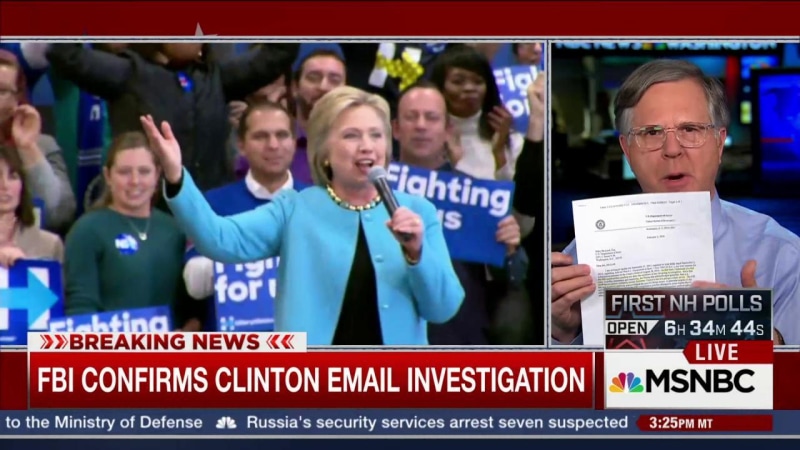
FBI formally confirms its investigation of Hillary Clinton’s email server

MSNBC | By Pete Williams | 02/08/16 05:30 PM


In a letter disclosed Monday in a federal court filing, the FBI confirms one of the world’s worst-kept secrets: It is looking into Hillary Clinton’s use of a private email server.


Why say this at all, since it was widely known to be true? Because in August in response to a judge’s direction, the State Department asked the FBI for information about what it was up to. Sorry, the FBI said at the time, we can neither confirm nor deny the existence of any investigation.

Now, in a letter dated February 2 and filed in court Monday, the FBI’s general counsel, James Baker, notes that in public statements and congressional testimony, the FBI “has acknowledged generally that it is working on matters related to former Secretary Clinton’s use of a private email server.”

Baker says the FBI has not, however, “publicly acknowledged the specific focus, scope or potential targets of any such proceedings.”

He ends the one-paragraph letter by saying that the FBI cannot say more “without adversely affecting on-going law enforcement efforts.”

The letter was filed in one of the Freedom of Information Act cases brought against the State Department over access to documents from Hillary Clinton’s time as secretary of state. This one was filed by Judicial Watch.

Thursday, February 4, 2016

Condoleezza Rice Aides, Colin Powell Also Got Classified Info on Personal Emails

NBC | by KEN DILANIAN | FEB 4 2016, 11:48 AM ET

Former Secretary of State Colin Powell speaks at the International Rescue Committee Freedom Award Dinner at The Waldorf Astoria Hotel in New York on Wednesday Nov. 9, 2011. Eric Reichbaum / AP file


The State Department's Inspector General has found classified information sent to the personal email accounts of former Secretary of State Colin Powell and the senior staff of former Secretary of State Condoleezza Rice, NBC News has learned.


In a letter to Undersecretary of State Patrick Kennedy dated Feb. 3, State Department Inspector General Steve Linick said that the State Department has determined that 12 emails examined from State's archives contained national security information now classified "Secret" or "Confidential." The letter was read to NBC News.

Two of the messages were sent to Powell's personal account, and 10 were sent to personal accounts of Rice's senior aides, the letter said.

None of the messages were marked classified when originally sent, and none were determined to include information from the intelligence community, Linick said in the document.

Colin Powell told NBC News he strongly disputed that the information in the messages was classified, and characterized the contents as innocuous. Said Powell, "I wish they would release them so that a normal, air-breathing mammal would look at them and say, 'What's the issue?'"

Linick said his initial findings suggest there could be a lot more classified material in State's unclassified archives. He recommended that State take steps to find and remove it.

Hillary Clinton on FBI Email Investigation: 'Not Concerned' 1:27
The IG came upon the material during the course of a review of how current and past secretaries of state deal with classified material and with email. The review was prompted by the current controversy over Democratic presidential candidate Hillary Clinton's use of a personal computer server to conduct government business while secretary of state.

Linick's findings will be seen as helpful to Clinton, because they show that past secretaries of state and senior officials used personal accounts to conduct government business and occasionally allowed secrets to spill into the insecure traffic.

Clinton’s Security Clearance Is Under Scrutiny

Bloomberg | By Eli Lake & Josh Rogin | FEB 4, 2016 6:00 AM EST

SHE'S USED TO SCRUTINY. PHOTOGRAPHER: SAUL LOEB/AFP/GETTY IMAGES

Now that several e-mails on Hillary Clinton's private server have been classified, there is a more immediate question than the outcome of the investigation: Should the former secretary of state retain her security clearance during the inquiry? Congressional Republicans and Democrats offer predictably different answers.


The State Department announced Friday that it would not release 22 e-mails from Clinton’s private server after a review found they contained information designated as top secret. U.S. officials who reviewed the e-mails tell us they contain the names of U.S. intelligence officers overseas, but not the identities of undercover spies; summaries of sensitive meetings with foreign officials; and information on classified programs like drone strikes and intelligence-collection efforts in North Korea.

The FBI is investigating the use of Clinton’s home server when she was secretary of state, which the bureau now has. The New York Times reported in August that Clinton is not a target of that investigation. We reported in September that one goal is to discover whether a foreign intelligence service hacked in.

Representative Adam Schiff, the ranking Democrat on the House Intelligence Committee, said Clinton should not lose her security clearance for receiving information that was not marked classified at the time. "I'm sure she does hold a clearance, and she should," he told us.

Representative Mike Pompeo, a Republican member of that committee who also has read the e-mails, told us, "It's important, given all the information we now know, that the House of Representatives work alongside the executive branch to determine whether it's appropriate for Secretary Clinton to continue to hold her security clearances."

Senate Intelligence Chairman Richard Burr told us the decision lies with the White House. “I think that’s up to what the National Security Council is comfortable with,” he said.

Burr, who has also read all 22 e-mails, said Clinton should have known to better protect the information they contain. “They are definitely sensitive," he said. "Anybody in the intelligence world would know that the content was sensitive.”

His Democratic counterpart, Senator Dianne Feinstein, who also read them, told us that Clinton didn’t originally send any of the e-mails and that they were largely from her staff, although she did sometimes reply. Feinstein said the intelligence community is being overly cautious by designating the e-mails as top secret.

“There’s no question that they are over-classifying this stuff,” she said.

Clinton’s discussion of classified programs on an unclassified e-mail system is hardly rare. The issue, called “spillage,” has plagued the government for years. It can apply to anything from a spoken conversation about intelligence programs outside of a secure facility, to printing out a document with classified information on an insecure printer.

Still, it is forbidden. The State Department's Foreign Affairs Manual says "transmitting classified information over a communication channel that is unauthorized for the level of information being transmitted" is a "security violation." Such violations must be investigated by the State Department's own bureaus of human resources and diplomatic security. Punishment can vary from a letter of reprimand to loss of security clearance, according to the manual.

When asked about the status of Clinton's security clearance, State Department spokesman John Kirby said: "The State Department does not comment on individuals’ security clearance status. We will say, however, that generally speaking there is a long tradition of secretaries of state making themselves available to future secretaries and presidents. Secretaries are typically allowed to maintain their security clearance and access to their own records for use in writing their memoirs and the like.”

The Clinton campaign declined to comment.

During the Obama administration, it has not been automatic for officials to lose their security clearance while an investigation is underway. Just last week, the Washington Post reported that the chief of naval intelligence, Vice Adm. Ted Branch, had his security clearance suspended because he is wrapped up in a Justice Department investigation into contracting corruption. He has not been able to read, see, or hear classified information since November 2013. Branch has not been charged with any crime and continues to serve in that post.

But when then-CIA director David Petraeus came under FBI investigation at the end of 2012, his security clearance was not formally revoked. After he resigned, his access to classified information was suspended, according to U.S. officials. In that case, Petraeus had provided notebooks with highly classified information to his biographer and mistress Paula Broadwell, whose security clearances did not permit her to receive it.

Unlike Broadwell, officials familiar with the e-mails tell us that Clinton and her e-mail correspondents were cleared to receive the information that has been classified after the fact. Steven Aftergood, who heads the project on government secrecy for the Federation of American Scientists, told us, "It's entirely possible for information to start out as unclassified and to be classified only when the question of public disclosure arises."

William Leonard, who oversaw the government's security classification process between 2002 and 2008 as the director of the Information Security Oversight Office, told us this kind of "spillage" was common. "The bottom line is this, if you have the opportunity to pore through any cleared individual's unclassified e-mail account, it's almost inevitable you would find material that someone, some way would point out should be classified." He also said that in Clinton's case, "there is no indication that she deliberately disregarded the rules for handling classified information so I see no reason why she should not remain eligible for a security clearance."

Nonetheless, Leonard added that Clinton's decision to use the private e-mail server as secretary of state "reflected exceedingly poor judgment, and those that advised her on this did not serve her well."

The FBI investigation may determine that neither Clinton nor her aides broke the law, but Clinton herself has said she used poor judgment. It's an open question how that poor judgment will affect her access to state secrets, during and after the FBI's investigation.

Wednesday, February 3, 2016

JOHN KERRY USED PERSONAL ACCOUNT TO SEND HILLARY ‘SECRET’ EMAIL

Mikael Thalen | Infowars | FEBRUARY 2, 2016


Secretary of State John Kerry used a personal email account to discuss “secret” information with Hillary Clinton during his time as a senator, the State Department confirmed Tuesday.


The heavily-redacted email, according to State Department spokesman John Kirby, was undoubtedly “sent from a non-official account.”

“The one that we talked about being upgraded to ‘Secret’ was sent from a non-official account, and the account from which it was sent is no longer active,” Kirby said.

Sent from Kerry’s iPad in May of 2011, the email was classified as “secret” before being released Friday over its mention of sensitive U.S. foreign relations.

The few unredacted sections reveal the discussion to be centered around policy in Pakistan, Afghanistan and India.

“We all know this will be a troubled relationship because that is it’s [sic] nature,” Kerry wrote. “But there are real possibilities at this moment to put options to the test.”

The discovery of yet another high-ranking Obama administration official using a private email to discuss sensitive information hints at an even larger disregard for national security than previously known.

Friday’s release of new Clinton emails also revealed that the State Department had suggested creating a “stand-alone” computer for Clinton in 2009 that would operate outside of the department’s network.

“Days after Clinton was sworn in as secretary of State, department official Lewis Lukens offered to give her a computer that would be ‘connected to the internet (but not through our system) to enable her to check emails from her desk,'” writes The Hill.

Clinton also received more than 18 emails from President Obama despite claims from the commander-in-chief that he had learned of the private email account from the “media.”

According to former Secret Service Agent Dan Bongino, who joined the Alex Jones Show earlier this month, Clinton continued using her private email despite knowing that her server had been hacked.

Friday, January 29, 2016

State to release some Clinton emails on Friday; thousands still delayed

The Hill | By Julian Hattem - 01/29/16 09:14 AM EST

IMAGE SOURCE: WIKIPEDIA

The State Department on Friday will release roughly 2,000 pages of Hillary Clinton’s emails, but will delay the final batch of messages until after voters go to the polls in early primary states.


In a court filing late on Thursday evening, the department insisted that it “regrets” its inability to publish the final 7,000 pages on Friday, as a federal court ordered it to do last year.

Yet it defended the delay, blaming an internal oversight and the snowstorm that crippled Washington in the past week.

As part of the process of making the emails public, the State Department is required to have other agencies review Clinton’s emails to check if any information should be redacted or marked as classified.

According to the department, it simply “missed” sending roughly 7,000 pages of emails to other agencies, and did not notice the oversight until earlier this month. Its efforts to correct the problem were further delayed by the snowstorm, which closed the federal government through Wednesday.

The department has not even sent out documents to 12 agencies to review, it said.

Last week, the department pushed to delay the final deadline until Feb. 29.

As the journalist who sued the department to force the emails’ release pointed out, however, that would be after voters in the first four primary states have gone to the polls.

“[I]f the Court allows State to delay release of thousands of pages of Democratic presidential candidate Hillary Clinton’s official work emails, a substantial portion of the electorate will be forced to vote without the benefit of important information to which it is entitled about the performance of one of the candidates for U.S. President while serving as Secretary of State,” lawyers opposing the department’s schedule claimed earlier this week.

The Obama administration was unmoved.

“Upcoming electoral events, while admittedly important to the public, do not change the fact that State needs this reasonable amount of additional time to complete the final stage of this enormous and complex undertaking,” lawyers representing the State Department wrote.

Critics have warned that the final tranche of emails could contain scandalous or scintillating nuggets about Clinton’s time in the State Department. Administration lawyers this week attempted to dismiss those allegations.

The 7,000 pages of emails that won’t be out for another month needed to go through “multiple” other agencies for review, they claimed.

“But that does not mean that these emails are more ‘controversial’ than other emails, or that the oversight that led to them not being sent to all the necessary agencies was related to their substance," they wrote.