Showing posts with label security. Show all posts

Wednesday, February 17, 2016

FBI Prompts Apple to Issue Privacy Letter to Customers After San Bernadino Shooter Request

Apple | February 17, 2016


A Message to Our Customers


The United States government has demanded that Apple take an unprecedented step which threatens the security of our customers. We oppose this order, which has implications far beyond the legal case at hand.

This moment calls for public discussion, and we want our customers and people around the country to understand what is at stake.

The Need for Encryption


Smartphones, led by iPhone, have become an essential part of our lives. People use them to store an incredible amount of personal information, from our private conversations to our photos, our music, our notes, our calendars and contacts, our financial information and health data, even where we have been and where we are going.

All that information needs to be protected from hackers and criminals who want to access it, steal it, and use it without our knowledge or permission. Customers expect Apple and other technology companies to do everything in our power to protect their personal information, and at Apple we are deeply committed to safeguarding their data.

Compromising the security of our personal information can ultimately put our personal safety at risk. That is why encryption has become so important to all of us.

For many years, we have used encryption to protect our customers’ personal data because we believe it’s the only way to keep their information safe. We have even put that data out of our own reach, because we believe the contents of your iPhone are none of our business.

The San Bernardino Case


We were shocked and outraged by the deadly act of terrorism in San Bernardino last December. We mourn the loss of life and want justice for all those whose lives were affected. The FBI asked us for help in the days following the attack, and we have worked hard to support the government’s efforts to solve this horrible crime. We have no sympathy for terrorists.

When the FBI has requested data that’s in our possession, we have provided it. Apple complies with valid subpoenas and search warrants, as we have in the San Bernardino case. We have also made Apple engineers available to advise the FBI, and we’ve offered our best ideas on a number of investigative options at their disposal.

We have great respect for the professionals at the FBI, and we believe their intentions are good. Up to this point, we have done everything that is both within our power and within the law to help them. But now the U.S. government has asked us for something we simply do not have, and something we consider too dangerous to create. They have asked us to build a backdoor to the iPhone.

Specifically, the FBI wants us to make a new version of the iPhone operating system, circumventing several important security features, and install it on an iPhone recovered during the investigation. In the wrong hands, this software — which does not exist today — would have the potential to unlock any iPhone in someone’s physical possession.

The FBI may use different words to describe this tool, but make no mistake: Building a version of iOS that bypasses security in this way would undeniably create a backdoor. And while the government may argue that its use would be limited to this case, there is no way to guarantee such control.

The Threat to Data Security


Some would argue that building a backdoor for just one iPhone is a simple, clean-cut solution. But it ignores both the basics of digital security and the significance of what the government is demanding in this case.

In today’s digital world, the “key” to an encrypted system is a piece of information that unlocks the data, and it is only as secure as the protections around it. Once the information is known, or a way to bypass the code is revealed, the encryption can be defeated by anyone with that knowledge.

The government suggests this tool could only be used once, on one phone. But that’s simply not true. Once created, the technique could be used over and over again, on any number of devices. In the physical world, it would be the equivalent of a master key, capable of opening hundreds of millions of locks — from restaurants and banks to stores and homes. No reasonable person would find that acceptable.

The government is asking Apple to hack our own users and undermine decades of security advancements that protect our customers — including tens of millions of American citizens — from sophisticated hackers and cybercriminals. The same engineers who built strong encryption into the iPhone to protect our users would, ironically, be ordered to weaken those protections and make our users less safe.

We can find no precedent for an American company being forced to expose its customers to a greater risk of attack. For years, cryptologists and national security experts have been warning against weakening encryption. Doing so would hurt only the well-meaning and law-abiding citizens who rely on companies like Apple to protect their data. Criminals and bad actors will still encrypt, using tools that are readily available to them.

A Dangerous Precedent


Rather than asking for legislative action through Congress, the FBI is proposing an unprecedented use of the All Writs Act of 1789 to justify an expansion of its authority.

The government would have us remove security features and add new capabilities to the operating system, allowing a passcode to be input electronically. This would make it easier to unlock an iPhone by “brute force,” trying thousands or millions of combinations with the speed of a modern computer.

The implications of the government’s demands are chilling. If the government can use the All Writs Act to make it easier to unlock your iPhone, it would have the power to reach into anyone’s device to capture their data. The government could extend this breach of privacy and demand that Apple build surveillance software to intercept your messages, access your health records or financial data, track your location, or even access your phone’s microphone or camera without your knowledge.

Opposing this order is not something we take lightly. We feel we must speak up in the face of what we see as an overreach by the U.S. government.

We are challenging the FBI’s demands with the deepest respect for American democracy and a love of our country. We believe it would be in the best interest of everyone to step back and consider the implications.

While we believe the FBI’s intentions are good, it would be wrong for the government to force us to build a backdoor into our products. And ultimately, we fear that this demand would undermine the very freedoms and liberty our government is meant to protect.


Tim Cook

Friday, February 5, 2016

OBAMA SETTING UP AN INVASION HAVEN

Jon Bowne | Infowars | FEBRUARY 5, 2016


Recently, Obama stirred the pot of intolerance at a Baltimore Mosque.

The Obama administration would have us all believe his speech is a needed effort to assure Muslim Americans that they will not be subjected to bigotry, while he shepherds in Syrian refugees into small towns to fuel sharia no go areas akin to the rape and murder invasion being waged on Europe.

Wednesday, February 3, 2016

So it begins here: U.S. city 'overrun' with criminal refugees

WND News | LEO HOHMANN | FEBRUARY 3, 2016

IMAGE CREDITS: FLICKR, SYRIAFREEDOM.

More than 120 people braved the snow and ice Monday to rally in front of the Missoula County Courthouse, protesting an effort by the Obama administration and its army of community organizers to plant foreign “refugees” into small cities in western Montana.


One of the speakers was a woman who moved recently to Montana from Amarillo, Texas, which has been inundated with thousands of refugees over the past 15 years.

“Amarillo is overrun with refugees,” said Karen Sherman, who stood and spoke to the crowd amid blowing wind and falling snowflakes. Sherman just moved to Missoula, a college town that serves as home to the University of Montana.

Like the reporting you see here? Sign up for free news alerts from WND.com, America’s independent news network.

It’s a far cry from Amarillo, which she described as a city of rampant crime and cracking social fabric, thanks to the heavy influx of refugees sent there by the U.S. State Department in cooperation with the United Nations.

“Our city is failing because of the refugees. We have 22 different languages spoken in our schools. We’ve got 42 languages being fielded by our 9-1-1 call centers, and crime is just through the roof. We need to exercise caution, especially for the sake of our children,” she said.

The protesters carried signs that read, “Christian Refugees 2 Christian Nations, Muslim Refugees 2 Muslim Nations, That’s Only Fair,” and “Refugee Resettlement Means Big $$$ – No Accountability.”

Sherman said Amarillo, a city of just more than 200,000 people, has gang violence that has surpassed that of much larger Texas cities such as Fort Worth. She fears U.S. cities like Amarillo and Minneapolis, Minnesota, could be in line to become the next Rotherham, England, or Cologne, Germany, or Stockholm, Sweden, where mass rapes by Muslim men have gained much attention in Europe.

Touching off a rape epidemic

Amarillo was recently named the fifth most dangerous city in Texas, according to FBI crime statistics, up from sixth last year. And it has been nationally recognized as having one of the highest rates of rape in the nation.

That’s a dubious distinction that Sherman believes is tied to the high number of Muslim refugees shipped there by the U.S. government.

“The rape epidemic in this world is becoming pandemic. It’s not confined to one location. Fifteen years ago in Norway, rape was unheard of. Now it’s an epidemic,” Sherman said. “The perpetrators are 100 percent Muslim males. In Sweden, rape has gone up by 500 percent. Stockholm recently had the dubious honor of opening their very first rape center for men and boys.”

In the northern U.K. city of Rotherham, more than 1,400 children have been beaten, raped and trafficked in a well-documented turn of events that has gone largely unreported in the U.S.

“It was covered up by the local government for fear of being viewed as racist. This only came to light because a journalist decided we needed to know about that, not the government,” she said, referring to the rape scandal that unraveled in England in 2014, when it was revealed by media that gangs of mostly Pakistani men had been sexually assaulting English girls for years while police covered it up for fear of being perceived as “anti-Muslim.”

“You can have female equality, or you can have refugees. You cannot have both,” Sherman said.

Pamela Geller wrote the field manual for activists seeking to protect their community from Islamic supremacy encroachment in “Stop the Islamization of America: A Practical Guide to the Resistance.”

Too late to save Texas?

Texas Gov. Greg Abbot has called for a stop to the influx of refugees, but it’s too late, she said. The program continues unabated because, if even one refugee is present in the U.S., he is entitled under current law to bring in his entire extended family.

“It’s called family reunification,” Sherman said.
Texas' GOP Gov. Greg Abbott has tried to turn off the refugee spigot but it may be too late.
Texas’ GOP Gov. Greg Abbott has tried to turn off the refugee spigot but it may be too late.


She said America, founded on Judeo-Christian principles of tolerance and respect for one’s fellow man, should not expect people from Third World cultures to share those values.

“If people don’t choose to follow the law, you cannot hire enough police officers,” she said.

“Whether you believe (in the Judeo-Christian God) or not, your values and your principles were influenced by that. Now we’re asking that these people come here, who have been taught for thousands of years of violence and hatred, and we’re expecting them to come here and assimilate to our way of life,” Sherman told the crowd gathered in Missoula. “This is a dangerous and foolish expectation.”

Watch video of Karen Sherman describing the life she left behind in Amarillo, Texas.


Amarillo has received 5,251 foreign refugees since January 2002, according to the federal refugee database. That's more than half of the nearly 8,000 refugees sent to Texas during that period.

President Obama has increased the number of foreign refugees bound for American soil in fiscal 2016 to 85,000. That's a 20 percent increase over the previous year, and 10,000 will come from the jihadist hotbed of Syria.

WND reported last week that two groups are working to resettle Syrian refugees in Montana. One group, WorldMontana, is working in Helena and the other, Soft Landing Missoula, is working in Missoula.

Caroline Solomon drove more than 100 miles to Missoula Monday from her home in Big Fork, Montana, to participate in the rally.

"About four people (from her group) didn't make it because of weather, but we think there were about 125 people on our side and about six with signs calling us 'racists,'" she said.

Softening up the soil

Soft Landing Missoula is working with city and county officials to bring Third World refugees to Montana while the state's Act For America chapter and other activists are trying to stop that from happening. Soft Landing, like most of the non-governmental organizations working with the government to plant refugees into U.S. cities, is working with churches and faith-based groups behind the scenes to create an atmosphere that is more "welcoming" of refugees.
David Lubell of Welcoming America works closely with the White House to soften up the soil in cities targeted to receive an influx refugees.
David Lubell of Welcoming America works closely with the White House to soften up the soil in cities targeted to receive an influx Muslim refugees.


Many of the community organizers have received training or consultation from David Lubell's Welcoming America organization, which was started with seed money from billionaire George Soros. Lubell is a close adviser to President Obama's "New Americans" initiative, which seeks to convert millions of refugees and recent immigrants into U.S. citizens with full voting privileges.

The modus operandi used by resettlement agencies usually involves sending a handful of refugees at first and then gradually increasing the influx to hundreds per year.

Mary Poole, who represents Soft Landing, Missoula, told KGVO News Radio that many immigrants have settled in Missoula over the past 30 years. She compared the mostly Middle Eastern migrants from Muslim countries like Syria, Afghanistan and Iraq to the Hmong refugees fleeing communist Vietnam in the late 1970s and early '80s.

"We’ve successfully resettled a Hmong community, as well as Belorussians and Ukrainians, who are now members of our community and part of the fabric of Missoula," Poole told KGVO. "We’re just working on revamping the infrastructure that has already existed here."

But according to the federal database, the state of Montana has not received any refugees since 2008, and only 61 have been sent there since the Sept. 11, 2001, terrorist attacks.

Montana resistance follows backlash in Idaho

Other small towns in the West have similarly struggled to oppose the plans of urban elites to import what they see as the problems of the Third World into their communities.

In Sandpoint, Idaho, City Council members voted last Wednesday to withdraw a resolution supporting refugee resettlement, bringing an end to a heated, month-long debate over whether that was a wise move. It had the full backing of Sandpoint Mayor Shelby Rognstad.

Cheers erupted from the audience when the newly elected Sandpoint mayor capitulated, asking the council to withdraw his resolution from consideration. His resolution was meant to counter statements from county commissioners and the local sheriff opposing the refugees. Rognstad said his resolution was intended to restate Sandpoint's commitments to "human rights."

"This resolution has only served to divide us and this community,” said Rognstad, as he requested the withdrawal. "That saddens me."

But others see the situation in reverse. They see nonprofits and NGOs, often flush with government grant money, coming in and stirring up controversy within their once-peaceful communities.

In Twin Falls, Idaho, Chobani opened the world's largest yogurt factory and gave 30 percent of the 600 jobs to foreign refugees, and the federal government has plans to send 300 more refugees, this time from Syria, to the Twin Falls area. That touched off a backlash from a group called 3 Percent of Idaho, which organized a protest at the Idaho Statehouse in late November that attracted more than 1,000 people from both sides of the issue.

If the past record is any indication, the groups seeking to bring Third World refugees to small town America will not be easily chased off by people with signs.

In fact, the pro-refugee Hebrew Immigrant Aid Society, put together a field manual in 2013 on how to deal with "pockets of resistance" in the American heartland. One of the strategies in that manual is to research the backgrounds of resistors and identify them as "anti-Muslim" racists.

A WND report from May 2015 exposed the HIAS strategy to deride and intimidate any politician or activist who opposes the refuge industry's agenda to change the demographics of a town.

The HIAS report, titled “Resettlement at Risk: Meeting Emerging Challenges to Refugee Resettlement in Local Communities," calls for "new tools to fight back against a determined legislator or governor who has decided to challenge resettlement for political or other reasons."

Tuesday, February 2, 2016

As Feds Plan to Cut Border Monitoring, Texas Officials Ask Why

The Texas Tribune | by Julián Aguilar | Feb. 1, 2016

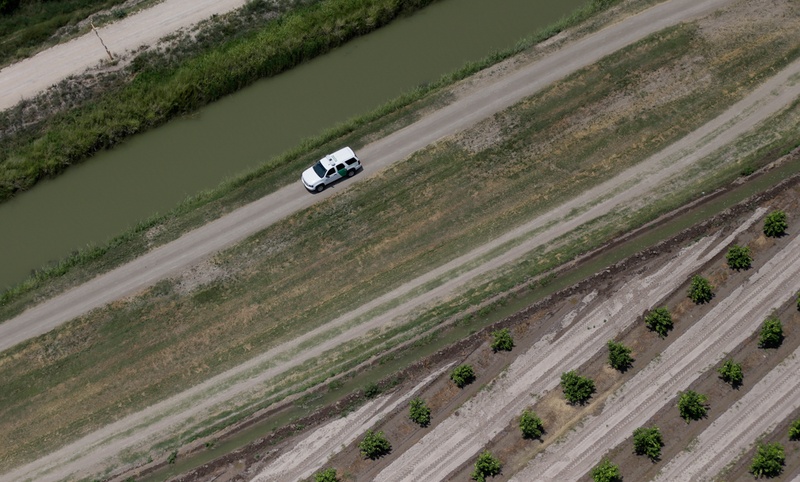
A Customs and Border Protection vehicle patrols on the Texas border near the Rio Grande, Thursday, July 24, 2014, in Mission, Texas. Texas is spending $1.3 million a week for a bigger DPS presence along the border.


Gov. Greg Abbott and U.S. Rep. Henry Cuellar, a Laredo Democrat, pressed the U.S. Department of Homeland Security on Monday to explain why the agency plans to reduce its aerial surveillance on the Texas-Mexico border.


In a letter to DHS Secretary Jeh Johnson, the lawmakers said the cut to a requested 3,850 hours of aerial detection and monitoring in 2016 amounts to 50 percent less coverage than recent years.

“Given the recent surge of migrants from Central America and Cuba along the southern border, we believe DHS should request more surveillance and security resources, not fewer,” Abbott and Cuellar wrote in a letter.

The pair also reminded Johnson that in September, Abbott’s office asked the DHS for more aerial resources and U.S. Border Patrol agents but that the request was never acknowledged.

A DHS spokesperson said the agency would respond "directly" to the governor and the congressman.

Monday’s request comes as CBP is reporting a new surge in the number of undocumented immigrants crossing the Rio Grande. From October to December of 2015, about 10,560 unaccompanied minors entered Texas illegally through the Rio Grande Valley sector of the U.S. Border Patrol. That marks a 115 percent increase over the same time frame in 2014. The amount of family units, defined as at least one child and adult guardian or parent, has increased by 170 percent to 14,336 in the Rio Grande Valley.

The El Paso sector also saw 1,030 unaccompanied minors, an increase of almost 300 percent.

In Monday’s letter, the pair also requested a detailed breakdown of how the DHS determined the reduction in aerial surveillance was warranted and information on how staffing and operation levels would be affected.

While Abbott has spoken extensively about illegal immigration from Mexico and Central America, the letter marked the first time Abbott has referenced a recent surge of Cubans coming into Texas.

Abbott visited the island nation last year to explore expanding trade between Cuba and Texas. During that trip, he spoke about the current trade embargo but not the migrant issue.

During the 2015 fiscal year, about 28,400 Cubans entered Texas through U.S. Customs and Border Protection's Laredo field office, which extends from Del Rio to Brownsville. That’s compared to about 15,600 in 2014.

The surge came after the Obama administration announced in 2014 its plans to re-establish ties with Cuba, leaving many Cubans fearing they will lose a special designation that allows them to apply for legal residency status, or a “green card,” after living in the country for a year. Cuellar and U.S. Sen. John Cornyn, R-Texas, have called for the repeal of that designation.