Showing posts with label DHS. Show all posts

Wednesday, February 17, 2016

FBI Prompts Apple to Issue Privacy Letter to Customers After San Bernadino Shooter Request

Apple | February 17, 2016


A Message to Our Customers


The United States government has demanded that Apple take an unprecedented step which threatens the security of our customers. We oppose this order, which has implications far beyond the legal case at hand.

This moment calls for public discussion, and we want our customers and people around the country to understand what is at stake.

The Need for Encryption


Smartphones, led by iPhone, have become an essential part of our lives. People use them to store an incredible amount of personal information, from our private conversations to our photos, our music, our notes, our calendars and contacts, our financial information and health data, even where we have been and where we are going.

All that information needs to be protected from hackers and criminals who want to access it, steal it, and use it without our knowledge or permission. Customers expect Apple and other technology companies to do everything in our power to protect their personal information, and at Apple we are deeply committed to safeguarding their data.

Compromising the security of our personal information can ultimately put our personal safety at risk. That is why encryption has become so important to all of us.

For many years, we have used encryption to protect our customers’ personal data because we believe it’s the only way to keep their information safe. We have even put that data out of our own reach, because we believe the contents of your iPhone are none of our business.

The San Bernardino Case


We were shocked and outraged by the deadly act of terrorism in San Bernardino last December. We mourn the loss of life and want justice for all those whose lives were affected. The FBI asked us for help in the days following the attack, and we have worked hard to support the government’s efforts to solve this horrible crime. We have no sympathy for terrorists.

When the FBI has requested data that’s in our possession, we have provided it. Apple complies with valid subpoenas and search warrants, as we have in the San Bernardino case. We have also made Apple engineers available to advise the FBI, and we’ve offered our best ideas on a number of investigative options at their disposal.

We have great respect for the professionals at the FBI, and we believe their intentions are good. Up to this point, we have done everything that is both within our power and within the law to help them. But now the U.S. government has asked us for something we simply do not have, and something we consider too dangerous to create. They have asked us to build a backdoor to the iPhone.

Specifically, the FBI wants us to make a new version of the iPhone operating system, circumventing several important security features, and install it on an iPhone recovered during the investigation. In the wrong hands, this software — which does not exist today — would have the potential to unlock any iPhone in someone’s physical possession.

The FBI may use different words to describe this tool, but make no mistake: Building a version of iOS that bypasses security in this way would undeniably create a backdoor. And while the government may argue that its use would be limited to this case, there is no way to guarantee such control.

The Threat to Data Security


Some would argue that building a backdoor for just one iPhone is a simple, clean-cut solution. But it ignores both the basics of digital security and the significance of what the government is demanding in this case.

In today’s digital world, the “key” to an encrypted system is a piece of information that unlocks the data, and it is only as secure as the protections around it. Once the information is known, or a way to bypass the code is revealed, the encryption can be defeated by anyone with that knowledge.

The government suggests this tool could only be used once, on one phone. But that’s simply not true. Once created, the technique could be used over and over again, on any number of devices. In the physical world, it would be the equivalent of a master key, capable of opening hundreds of millions of locks — from restaurants and banks to stores and homes. No reasonable person would find that acceptable.

The government is asking Apple to hack our own users and undermine decades of security advancements that protect our customers — including tens of millions of American citizens — from sophisticated hackers and cybercriminals. The same engineers who built strong encryption into the iPhone to protect our users would, ironically, be ordered to weaken those protections and make our users less safe.

We can find no precedent for an American company being forced to expose its customers to a greater risk of attack. For years, cryptologists and national security experts have been warning against weakening encryption. Doing so would hurt only the well-meaning and law-abiding citizens who rely on companies like Apple to protect their data. Criminals and bad actors will still encrypt, using tools that are readily available to them.

A Dangerous Precedent


Rather than asking for legislative action through Congress, the FBI is proposing an unprecedented use of the All Writs Act of 1789 to justify an expansion of its authority.

The government would have us remove security features and add new capabilities to the operating system, allowing a passcode to be input electronically. This would make it easier to unlock an iPhone by “brute force,” trying thousands or millions of combinations with the speed of a modern computer.

The implications of the government’s demands are chilling. If the government can use the All Writs Act to make it easier to unlock your iPhone, it would have the power to reach into anyone’s device to capture their data. The government could extend this breach of privacy and demand that Apple build surveillance software to intercept your messages, access your health records or financial data, track your location, or even access your phone’s microphone or camera without your knowledge.

Opposing this order is not something we take lightly. We feel we must speak up in the face of what we see as an overreach by the U.S. government.

We are challenging the FBI’s demands with the deepest respect for American democracy and a love of our country. We believe it would be in the best interest of everyone to step back and consider the implications.

While we believe the FBI’s intentions are good, it would be wrong for the government to force us to build a backdoor into our products. And ultimately, we fear that this demand would undermine the very freedoms and liberty our government is meant to protect.


Tim Cook

Thursday, February 4, 2016

U.S. eyes ways to toughen fight against domestic extremists

Reuters | By Julia Harte, Julia Edwards and Andy Sullivan | February 4, 2016
Department of Justice


WASHINGTON (Reuters) - The U.S. Justice Department is considering legal changes to combat what it sees as a rising threat from domestic anti-government extremists, senior officials told Reuters, even as it steps up efforts to stop Islamic State-inspired attacks at home.

Extremist groups motivated by a range of U.S.-born philosophies present a "clear and present danger," John Carlin, the Justice Department's chief of national security, told Reuters in an interview. “Based on recent reports and the cases we are seeing, it seems like we’re in a heightened environment.”

Over the past year, the Justice Department has brought charges against domestic extremist suspects accused of attempting to bomb U.S. military bases, kill police officers and fire bomb a school and other buildings in a predominantly Muslim town in New York state.

But federal prosecutors tackling domestic extremists still lack an important legal tool they have used extensively in dozens of prosecutions against Islamic State-inspired suspects: a law that prohibits supporting designated terrorist groups.

Carlin and other Justice Department officials declined to say if they would ask Congress for a comparable domestic extremist statute, or comment on what other changes they might pursue to toughen the fight against anti-government extremists.

The U.S. State Department designates international terrorist organizations to which it is illegal to provide "material support." No domestic groups have that designation, helping to create a disparity in charges faced by international extremist suspects compared to domestic ones.

A Reuters analysis of more than 100 federal cases found that domestic terrorism suspects collectively have faced less severe charges than those accused of acting on behalf of Islamic State since prosecutors began targeting that group in early 2014.

Over the past two years, 27 defendants have been charged with plotting or inciting attacks within the United States in the name of Islamic State. They have faced charges that carried a median prison sentence of 53 years - half of the defendants faced more, and half faced less.

In the same period, 27 adherents of U.S.-based anti-government ideologies have been charged with similar activity. They faced charges that carried a median prison sentence of 20 years.

Carlin said his counter-terrorism team, including a recently hired counsel, is taking a “thoughtful look at the nature and scope of the domestic terrorism threat” and helping to analyze “potential legal improvements and enhancements to better combat those threats.”

The counsel, who was appointed last October and has not been named publicly, will identify cases being prosecuted at the state level that “could arguably meet the federal definition of domestic terrorism," a Justice Department official said.

That would give the department a direct role in more domestic extremism cases.

Recognizing that domestic threats were “rapidly evolving, and had the potential to grow,” the department in March 2015 rated disrupting such terrorists as a key component of its broader counter-terrorism efforts, officials said.

THE THREAT PENDULUM


The Justice Department aggressively pursued domestic extremists after Timothy McVeigh bombed a federal building in Oklahoma City in 1995, killing 168 people.

The government shifted its focus to international terrorism after al Qaeda killed nearly 3,000 Americans on Sept. 11, 2001.

But in recent years anti-government activists, like those who occupied a wildlife preserve in eastern Oregon last month, have regained prominence.

As law enforcement experts confront domestic militia groups, "sovereign citizens" who do not recognize government authority, and other anti-government extremists, they also face a heightened threat from Islamic extremists like the couple who carried out the Dec. 2 shootings in San Bernardino, California.

"A new development we're seeing is that when it comes to ISIL investigations, the flash-to-bang time from radicalization to action appears to be happening faster than with other types of terrorists," said Michael Steinbach, the head of the FBI’s Counterterrorism Division.

As a result, government agents are quick to investigate people who appear sympathetic toward Islamic State, current and former officials say. But some say the government has been overzealous in its pursuit of Islamic State suspects.

Similar actions by extremist suspects have yielded sharply disparate sentences.

Eight Islamic State-related defendants have been sentenced so far, to prison terms that range from three to 20 years, the Reuters review found. Over the same period, 18 domestic extremists have been sentenced to terms from one day to 12 years.

Prosecutors say Harlem Suarez, 23, of Key West, Florida, tried to buy a bomb last year from an undercover FBI agent as he plotted attacks on behalf of Islamic State. He faces a possible sentence of life in prison and has pleaded not guilty.

Michael Sibley, 67, left two unexploded pipe bombs and a Koran in a park in Roswell, Georgia in 2014 in what he later told police was an attempt to highlight the danger of Islamic terrorism. He pleaded guilty and faces a maximum of five years in prison.

"A different standard is being applied to Muslims than to other people," said Daryl Johnson, a former counterterrorism expert at the Department of Homeland Security who now works as a law enforcement consultant.

"SPRING-LOADED"


Steinbach said that the FBI can never open up any type of investigation “just on the basis of race, creed, or religion,”

But he added that federal agents are "spring-loaded" to open investigations into Americans who support groups on the State Department list of designated terrorist organizations.

The maximum penalty for supporting one of these groups has been raised from 10 years to 20 years in prison since 2001.

It has been applied in 58 of the government's 79 Islamic State cases since 2014 against defendants who engaged in a wide range of activity, from traveling to Syria to fight alongside Islamic State to raising money for a friend who wished to do so.

Judges usually issue sentences below the maximum, but some charges trigger sentencing "enhancements" that raise the baseline sentence a judge can issue – and the material support charge raises it more than most.

Domestic groups enjoy greater constitutional protections because being a member of those groups, no matter how extreme their rhetoric, is not a crime.

Prosecutors can bring “material support” terrorism charges against defendants who aren't linked to groups on the State Department's list, but they have only done so twice against non-jihadist suspects since the law was enacted in 1994. The law, which prohibits supporting people who have been deemed to be terrorists by their actions, carries a maximum sentence of 15 years in prison.

Current and former federal prosecutors say they rarely consider that statute in domestic terrorism cases because it is often hard to convince a jury that someone who is not affiliated with a foreign group can be guilty of terrorism.

William Wilmoth, a former federal prosecutor who invoked that law in a 1996 case against a West Virginia militia member, said he was surprised to hear that it isn't used more often.

"These guys have every right to have off-center political views," he said. "But when they made affirmative steps to blow up an actual federal facility... we thought it was an important place for us to go and prosecute."


(Reporting by Julia Harte, Julia Edwards and Andy Sullivan; editing by Stuart Grudgings)

Tuesday, February 2, 2016

As Feds Plan to Cut Border Monitoring, Texas Officials Ask Why

The Texas Tribune | by Julián Aguilar | Feb. 1, 2016

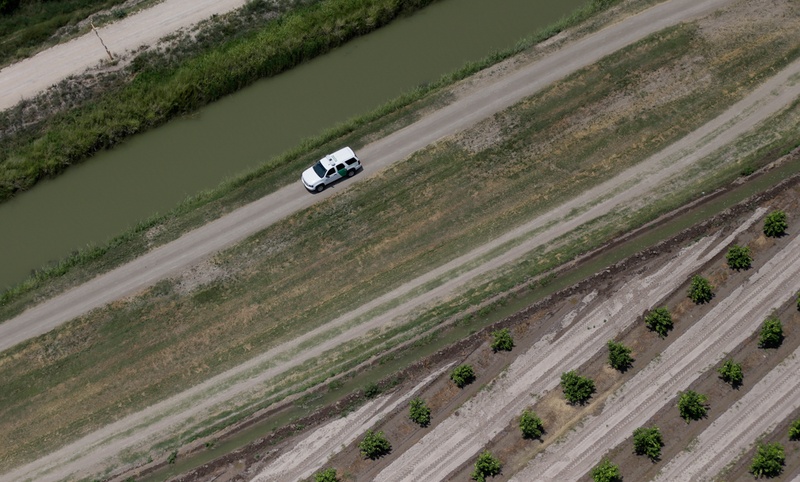
A Customs and Border Protection vehicle patrols on the Texas border near the Rio Grande, Thursday, July 24, 2014, in Mission, Texas. Texas is spending $1.3 million a week for a bigger DPS presence along the border.


Gov. Greg Abbott and U.S. Rep. Henry Cuellar, a Laredo Democrat, pressed the U.S. Department of Homeland Security on Monday to explain why the agency plans to reduce its aerial surveillance on the Texas-Mexico border.


In a letter to DHS Secretary Jeh Johnson, the lawmakers said the cut to a requested 3,850 hours of aerial detection and monitoring in 2016 amounts to 50 percent less coverage than recent years.

“Given the recent surge of migrants from Central America and Cuba along the southern border, we believe DHS should request more surveillance and security resources, not fewer,” Abbott and Cuellar wrote in a letter.

The pair also reminded Johnson that in September, Abbott’s office asked the DHS for more aerial resources and U.S. Border Patrol agents but that the request was never acknowledged.

A DHS spokesperson said the agency would respond "directly" to the governor and the congressman.

Monday’s request comes as CBP is reporting a new surge in the number of undocumented immigrants crossing the Rio Grande. From October to December of 2015, about 10,560 unaccompanied minors entered Texas illegally through the Rio Grande Valley sector of the U.S. Border Patrol. That marks a 115 percent increase over the same time frame in 2014. The amount of family units, defined as at least one child and adult guardian or parent, has increased by 170 percent to 14,336 in the Rio Grande Valley.

The El Paso sector also saw 1,030 unaccompanied minors, an increase of almost 300 percent.

In Monday’s letter, the pair also requested a detailed breakdown of how the DHS determined the reduction in aerial surveillance was warranted and information on how staffing and operation levels would be affected.

While Abbott has spoken extensively about illegal immigration from Mexico and Central America, the letter marked the first time Abbott has referenced a recent surge of Cubans coming into Texas.

Abbott visited the island nation last year to explore expanding trade between Cuba and Texas. During that trip, he spoke about the current trade embargo but not the migrant issue.

During the 2015 fiscal year, about 28,400 Cubans entered Texas through U.S. Customs and Border Protection's Laredo field office, which extends from Del Rio to Brownsville. That’s compared to about 15,600 in 2014.

The surge came after the Obama administration announced in 2014 its plans to re-establish ties with Cuba, leaving many Cubans fearing they will lose a special designation that allows them to apply for legal residency status, or a “green card,” after living in the country for a year. Cuellar and U.S. Sen. John Cornyn, R-Texas, have called for the repeal of that designation.

Wednesday, January 27, 2016

DHS WANTS BETTER SOCIAL MEDIA SCREENING TECHNOLOGY

Nextgov | By Mohana Ravindranath | January 26, 2016

IMAGE CREDITS: Pixelkult

The Department of Homeland Security wants businesses to present their cutting-edge social media analytics services next month -- especially technology that could enhance criminal investigations, traveler screenings and situational awareness.

In a new request for information, DHS said it is looking for open source analytics tools that can make internal operations more efficient and reduce costs through "advanced analytic automation,” across the department, all while using “privacy, civil rights and civil liberties-protecting analytic methods.”

Respondents have until Feb. 9 to submit descriptions of their analytics capabilities, including geospatial processing, foreign and spoken language processing, and keyword, image and video analysis, among other elements.

DHS plans to ask 30 “exemplars of social media analytics capabilities in the market place” to present technology that could help analysts find patterns “in the context of homeland security investigative, screening and/or homeland security mission related situation awareness missions.”

Those groups will be asked to present on Feb. 26, the RFI said.

The solicitation also asked respondents to describe the way they “protect the privacy, civil rights and civil liberties of individuals involved in open source and social media communications,” including factors such as data removal methods, “role based access to information, user audit, system logging, policy enforcing mechanisms, encryption, etc.”

The announcement comes weeks after federal social media screening policies came under fire, especially in light of the San Bernardino shootings, when it was widely reported that one of the shooters had posted public pro-ISIS messages on Facebook. (Federal Bureau of Investigation director James Comey subsequently said those were private, direct communications.)

DHS policies in particular were criticized last month when Congress blasted the department for not examining immigrants' social media accounts closely and routinely when granting visas, The Hill reported.

DHS officials said they do occasionally look at social media accounts, according to The Hill. But a DHS memo obtained by MSNBC last month found that the department had rejected a policy to screen foreign visa applicants’ social media accounts in 2011, after a year of revisions.

According to a spokesperson, DHS does not comment on open solicitations and declined Nextgov's request for comment.