Showing posts with label collapse. Show all posts

Wednesday, February 17, 2016

Iran snubs Doha proposal, won't freeze oil output

AP | By ALI AKBAR DAREINI | February 17, 2016


TEHRAN, Iran (AP) - Iran appeared Wednesday to back a plan laid out by four influential oil producers to cap their crude output if others do the same, though it offered no indication that it has any plans to follow suit itself.


The agreement reached in Doha the day before by Qatar, Saudi Arabia, Russia and Venezuela is aimed at stabilizing global oil prices, which recently plunged to less than $30 a barrel, a 13-year low. But Iran is keen to ramp up exports to regain market share now that sanctions related to its nuclear program have been lifted under a landmark agreement.

"Iran supports any measure to boost oil prices," Oil Minister Bijan Namdar Zanganeh said after talks with his counterparts from Iraq, Venezuela and Qatar.

"The decision taken to freeze the production ceiling of OPEC and non-OPEC members to stabilize and boost prices is also supported by us," he added, in comments posted on the ministry's website late Wednesday.

Iran's envoy to OPEC, Mahdi Asali, had earlier blamed the fall in prices on oversupply, and said it was up to Saudi Arabia and others to cut production. He said the four nations that participated at the Doha gathering could stabilize oil prices on their own -- if they cut their production by 2 million barrels a day.

"These countries increased their production by 4 million barrels when Iran was under sanctions," Asali was quoted as saying by the Shargh daily. "Now it's primarily their responsibility to help restore balance on the market. There is no reason for Iran to do so."

The four countries made their announcement following an unexpected meeting in the Qatari capital that pointedly did not include Iran. They agreed to act only if other producers made similar freezes.

Iran has previously said it hopes to put another 500,000 barrels a day on the market. Figures from the International Energy Agency show it pumped 2.9 million barrels daily in December, before sanctions were lifted.

Iran used to export 2.3 million barrels per day, but its crude exports fell to 1 million in 2012, when sanctions were tightened.

On Tuesday, Iran's oil minister said it had no intention of giving up its share of the market. Zanganeh acknowledged that global markets are "oversupplied," but said Iran "will not overlook its quota," according to comments carried by his ministry's Shana news service.

Even with Iran's cooperation, it was unclear if the Doha plan would be enough to put a floor under prices.

The United Arab Emirates' energy minister, Suhail Mohamed al-Mazrouei, refused on Wednesday to discuss the Doha proposal after giving a keynote address at a Dubai conference in which he mentioned low oil prices only in passing.

"I will only talk about this conference," he said, before smiling and walking away from reporters' shouted questions.

He later took to Twitter to say his country's oil policy "is open to cooperate with all producers toward mutual interest of the market stability and we are optimistic on the future."

Kuwait, another Gulf OPEC member, signaled it was willing to go along with the Doha plan.

Anas al-Saleh, who is Kuwait's deputy premier, finance minister and acting oil minister, said in a statement that his country was committed to the proposal if others join in.

"Kuwait hopes the agreement would provide a positive atmosphere for oil prices, and for the market to regain balance, and calls on all to support stability of markets," he said.

___

Associated Press writers Jon Gambrell and Adam Schreck in Dubai, United Arab Emirates, contributed to this report.

Tuesday, February 16, 2016

SYRIAN REFUGEES ADMITTED TO US SINCE PARIS ATTACK: 602 MUSLIMS, 2 CHRISTIANS

Patrick Goodenough | CNS News - FEBRUARY 16, 2016

IMAGE CREDITS: FLICKR, SYRIAFREEDOM.


The government has admitted 605 Syrian refugees for resettlement in the United States since last November’s Paris terrorist attack, two of whom are Christians.


The rest are 589 Sunni Muslims, 10 Shia Muslims, three other Muslims, and one refugee identified in State Department Refugee Processing Center data as “other religion.”

At the same time, the proportion of Christians among the total cohort of Syrian refugees admitted into the U.S. since the conflict began five years ago has now dropped below two percent.

Just 55 Christians (1.9 percent) are among the 2,769 Syrian refugees admitted since March 2011, while a large majority – 2,594 (93.6 percent) – has been Sunni Muslims.

Christians accounted for about 10 percent of Syria’s population when the civil war began and Sunni Muslims for an estimated 74 percent.

Christians and other non-Muslim minorities have been targeted specifically by ISIS and other radical groups, and monitoring group estimate that more than 700,000 Christians have fled Syria since then.

Other non-Muslims among the Syrian refugees admitted to the U.S. since the war began include small numbers of Baha’i (2), Yazidis (1), Jehovah’s Witnesses (8), Zoroastrians (6), atheists (3) and Syrians who have self-identified as having no religion (7).

The administration has rejected calls by some Republican lawmakers, andsome GOP presidential candidates, for Syrian Christians to be prioritized in the refugee admission process.

The ISIS terrorist attack in Paris on November 13 fueled concerns that the terrorist group was exploiting the flow of refugees and migrants as cover to send jihadists into the West to carry out attacks.

French authorities said two of the attackers had been carrying fake Syrian passports and warned European Union partners that “some terrorists are trying to get into our countries and commit criminal acts by mixing in with the flow of migrants and refugees.”

Last Tuesday, Director of National Intelligence James Clapper affirmed during a Senate Armed Services Committee hearing that ISIS has done so.

“Isn’t it already proven that Mr. Baghdadi is sending people with this flow of refugees that are terrorists that – in order to inflict further attacks on Europe and the United States?” Sen. John McCain (R-Ariz.) asked him, referring to ISIS leader Abu Bakr al-Baghdadi.

“That’s correct,” Clapper replied. “That’s one technique they’ve used is taking advantage of the torrent of migrants to insert operatives into that flow.”

In addition, he continued, ISIS has become “pretty skilled at [producing] phony passports, so they can travel ostensibly as legitimate travelers as well.”

In December, House Homeland Security Committee chairman Rep. Michael McCaul (R-Texas) said the U.S. intelligence community “has identified already individuals tied to terrorist organizations in Syria that want to exploit and get into the United States through the refugee process.”

Thursday, February 11, 2016

The Telegraph Fears a Populist Uprising

Brushfyre | James Menendez | February 11, 2016


Allister Heath, deputy Editor for the Telegraph, penned an article in today's Telegraph warning those who ally with globalism that a populist uprising of right-leaning affiliation could be disastrous for the left, the global banks and their ilk.


I literally read each tantalizing word of this article this morning with my mouth agape. I couldn't believe the admissions that one by one were being exposed via the ranting of this globalist. Let's run through them, shall we?

'We' can survive another collapse


We are too fragile, fiscally as well as psychologically. Our economies, cultures and polities are still paying a heavy price for the Great Recession; another collapse, especially were it to be accompanied by a fresh banking bailout by the taxpayer, would trigger a cataclysmic, uncontrollable backlash.

The public, whose faith in elites and the private sector was rattled after 2007-09, would simply not wear it. Its anger would be so explosive, so-all encompassing that it would threaten the very survival of free trade, of globalisation and of the market-based economy. There would be calls for wage and price controls, punitive, ultra-progressive taxes, a war on the City and arbitrary jail sentences.
Emphasis mine. By 'We' he means 'them', that is: the globalists. It is extremely apparent in the article that the author does not see himself as one of 'us'. He speaks as if he is talking to his bankster globalist masters, supplicating himself prostrate before them saying 'your way is the best'.

Politicians would become 'Extremist' and 'Populist'

Trump wants to make America Great again.

The fact that Donald Trump and Bernie Sanders both won their respective New Hampshire primaries is certainly one remarkable indication of the state of mind of many US political activists

The key thing here is that the author is not interested in making America great again. He wants the Fed to continue it globalised central bank policy of managing inflation by printing vast sums of cash for the banks (not you). 

More of the Status Quo

More from the article:

History never repeats itself exactly, but the last time a recession was met by pure, unadulterated populism was in the Thirties, when the Americans turned a stock market crash and a series of monetary policy blunders into a depression. President Herbert Hoover signed into law the Smoot-Hawley Tariff Act, dreamt up by two economically illiterate Republican senators, slapping massive taxes on the imports of 20,000 goods and triggering a global trade war. It was perhaps the most economically destructive piece of legislation ever devised, and it took until the Nineties before the damage was finally erased.
Emphasis mine. Let's make sure the banks keep getting their way. He uses the example of the Smoot-Hawley Tariff Act of 1930. This Act of Congress was great for America but really bad for the globalists. The author mentions that this disaster wasn't fixed until the 1990's. What happened in 1990's that would have bolstered globalism and consequently the destruction of American jobs? That's right: NAFTA and GATT. The 'giant sucking sound' Ross Perot warned us about.

If it is not working, why continue failed policies?


The question one has to ask is: why, if the current policies that this author is defending have failed would he continue to argue for the same policies? Make no mistake these policies will lead to the systematic downfall of every country that adopts them. Perhaps then this is the plan: the destruction of every world economy so that one economy can rise above them and take over all the broken countries. A one-world government for instance. That is what globalism is after all, isn't it? One world the central bankers in charge?


Markets Around The World Are Crashing; Gold Soars

Zero Hedge | by Tyler Durden | 02/11/201


Yesterday morning, when musing on the day's key event namely Yellen's congressional testimony, we dismissed the most recent bout of European bank euphoria which we said "will be brief if not validated by concrete actions, because while central banks have the luxury of jawboning, commercial banks are actually burning through funds - rapidly at that - and don't have the luxury of hoping for the best while doing nothing." This morning DB has wiped out all of yesterday's gain.

As for Yellen's testimony, we said that "she can send stocks reeling with one word out of place" - the word in question being not what she said but what she didn't say, in this case not being dovish enough and thus supportive enough of risk. And the consequence is there for all to see as soon as their trading terminal boots up: everything is crashing (with the exception of China which is on holiday, and Japan which was mercifully closed yesterday). Here are the highlights:
  • S&P 500 futures down 1.8% to 1814
  • Stoxx 600 down 3.4% to 304
  • FTSE 100 down 2.6% to 5525
  • DAX down 2.9% to 8760
  • German 10Yr yield down 7bps to 0.18%
  • MSCI Asia Pacific up 0.1% to 117
  • Hang Seng down 3.8% to 18546
  • S&P/ASX 200 up 1% to 4821
  • US 10-yr yield down 5bps to 1.62%
  • Dollar Index down 0.42% to 95.49
  • WTI Crude futures down 2.9% to $26.65
  • Brent Futures down 1.7% to $30.31
  • Gold spot up 1.9% to $1,220
  • Silver spot up 1.5% to $15.50
It all started in Hong Kong where as we reported last night, the Hang Seng Index plunged 3.9%, catching up with the week’s selloff as the market reopened from a holiday, and capping its worst Lunar New Year start since 1994.

Japan’s Nikkei Stock Average and China’s Shanghai Composite Index were both closed, but investors continued to pile into the yen, as virtually every carry trade has fallen apart in the past month. As a result, the dollar was down 1.8% against the yen at ¥111.28 after sliding below 111 briefly, a massive gain of nearly 300 pips in the past 24 hours, sending the Yen to the lowest level since October 2014 when Kuroda expanded QE.


In the first 9 days of this month, the Yen has risen 985 pips: That is biggest advance, in pip terms, since Oct. 1998; that month, the currency rose 1,563 pips from 130.03 to 114.40 over nine trading days ended Oct. 19. Elsewhere, the euro was up 0.4% against the dollar at $1.1325, its highest since October.

It wasn't just FX: European stocks slid toward their lowest since September 2013 and U.S. futures indicated equities will open nearly 2% and put the recent support level of 1812 in danger of being breached.

Among the key European movers was Societe Generale which tumbled 12% after reporting that quarterly profit missed estimates as earnings at the investment bank fell and it set aside provisions for potential legal costs. Elsewhere, Rio Tinto Group slipped 4.1% as it scrapped its progressive dividend policy and set out new spending cuts.

“Financial markets are repricing for a global growth slowdown,” said Tim Condon, head of Asian research at ING Groep NV in Singapore. "Expectations that monetary policy would be able to do much have diminished considerably.”

Just as troubling is that Swedish shares slid and the OMX Stockholm 30 Index dropped 3.% despite Sweden’s central bank going even deeper into NIRP, cutting its interest rate from -0.35% to -0.5%, lower than the expected -0.45%. The yen leaped to its highest in more than a year. Major sovereign bond markets rallied, pushing U.K. gilt yields to a record low. Gold rose beyond $1,200 an ounce, while U.S. oil traded below $27 a barrel.

This is troubling, because as Bloomberg notes, "signals by central banks from Europe to Japan that additional stimulus is at the ready are failing to ease investor concern that global growth will keep slowing." This means that it is no longer just a joke that central banks are losing credibility: judging by the markets' reaction it is all too real. To this point, yesterday we wondered if Yellen will make bad news good news again. She has failed:

“Over the last few years when we got bad news, equity markets would rally because they would interpret this as potential for central banks to go more dovish,” said Mohit Kumar, head of rates strategy at Credit Agricole SA’s corporate and investment bank unit in London. “Now that correlation is shifting to bad news is actually bad news. Investors are concerned over central banks’ policy options given the market is driven by factors over which they have little or no control over.”

Imagine that: investors investing without a central bank to hold their hand.

Among other things crashing: bond yields - the 10Year plunged to 1.62%, the lowest level since May 2013 as the entire treasury complex prepares for NIRP.

Not everything was crashing however: as central planners lost control, the dull, boring yellow metal known as gold was up about 4% overnight and was trading at $1240 moments ago, well above the level it hit when the Fed ended QE3, and outperforming every asset class in that time period.

Also surging are peripheral European yields, most notably in Portugal and Greece both overf 30 bps wider, as suddenly 7 years of financial dirt kicked under the rug thanks to central bank jawboning and futile actions, re-emerges for all to see, and to be reminded that nothing was ever fixed!

In short, the market is threatening Yellen with a crash ahead of her 2nd testimony today this time before the Senate. We doubt she will comply, so the market will just have to try harder.
Here are the top news from overnight:
  • Yellen Suggests Fed May Delay Rate Rises, Not Abandon Them: Fed chair non-committal on possible use of negative rates
  • Assessing Yellen’s Warning That Markets Pose a Threat to Economy: Bear markets usually come ~9 months before recessions
  • Mylan Slumps, Meda Soars on $7.2 Billion ‘Wealth Destroying’ Bid: Price represents a 92% premium to Meda’s close on Wednesday
  • Sanders Raises $7.1 Million After New Hampshire Win: comes after Tuesday’s victory speech declaration that he was “going to hold a fundraiser right here, right now, across America”
  • Clinton Reassesses Campaign With Thursday Debate Next Test: New Hampshire margin for Sanders puts Clinton on defensive
  • Twitter Troubles Deepen as Lack of User Growth Threatens Sales: Dorsey says making product easier to use is top priority
  • Amazon to Repurchase as Much as $5 Billion of Its Own Shares: co. commented in filing yday
  • U.K. Bond Yield Drops to Record-Low as Investors Seek Safety: U.K. plans to auction 30-year securities later Thursday
  • Swedish Central Bank Unleashes More Stimulus After Krona Warning: Sees scope to cut repo rate further
  • ‘Brexit’ Vote Is Clouding U.K.’s Growth Outlook, CBI Says: Business lobby downgrades 2016 growth forecast to 2.3%
  • Gold Soars Above $1,200 as Fed Chief Signals Go-Slow on Rates: set for 9th gain in 10 days on Fed chief’s remarks
  • Oil Above $55 Is a Long-Term Inevitability, Maersk CEO Says: sees global demand pushing oil price higher over time
  • Worst Still Ahead for Mining Industry After Losing $1.4 Trillion: This year looks even worse for an industry decimated by the commodities slump
  • SocGen Slumps as Quarterly Profit Hurt by Securities Drop: Bank says ROE target for this year of 10% is ‘unconfirmed’
  • As Zika Spreads, an Unexpected Winner in Brazil’s Mosquito War: Scandal-plagued leader Rousseff seeks unity to fight virus
In today's closer look at regional markets, we start in Asia, where equities traded broadly in negative territory amid the soft lead on Wall Street, coupled with the persistent credit risk fears adding to the risk-off sentiment. As such, the iTraxx Asia index ex Japan, an index tracking the value of CDS's in Asia, widened by 6bps to the highest level since Aug'13. The Hang Seng (-3.9%) returned from its elongated break to play catch up with the recent global equity and oil rout, consequently energy names were the notable laggard. While South Korea had also entered the fray as the Kospi (-2.5%) slipped amid the rising geopolitical tensions with North Korea after launching a satellite into space. ASX 200 (+1.0%) bucked the trend with stocks supported by a slew of strong earnings. As a reminder, Japanese markets were closed due to National Foundation Day.

Top Asian News
  • Hong Kong Stocks Fall in Worst Start to Lunar New Year Since ’94: Global equity rout deepens during 3-day trading break
  • Bass Says China Bank Losses May Top 400% of Subprime Crisis: Hedge fund manager says 10% asset loss would cut equity by $3.5t
  • Rio Will Cut Dividend After Metals Rout Sees Profit Tumble: World’s 2nd-biggest mining co. to reduce spending by another $3b
  • Billionaire’s Fund Sees India Extending Bear-Market Losses: Hedge fund awaits further 10% drop in values to turn bullish
  • SBI’s Profit Growth Slows to Four-Year Low on Bad Loan Surge: Provisions for bad loans almost double in the December quarter
  • North Korea to Shut Industrial Park, Freeze South Korean Assets: To expel South Korean personnel from Gaeseong complex
In Europe we have so far seen the most volatile day of what has been a very rocky 2016. Risk off sentiment is extremely apparent across asset class, with equities seeing a significant sell off so far today. Euro Stoxx 50 is lower by around 3.0% this morning, with financials and energy names the most significant underperformers as has been the case throughout the last 6 weeks. Financials have been weighed on by SocGen (-12.4%) who have suffered significantly in the wake of their earnings, while Deutsche Bank's woes have not been forgotten (-5.7%), with the iTraxx Sub Financials index widening this morning by around 36bps, suggesting a rise in financials' CDS. The heightened fear has also seen significant gains in fixed income, with Bunds higher by around 100 ticks so far today, while UK 10-year Gilt yields dropped to a record low this morning.
European Top News
  • Glencore Copper Production Falls as Franco to Buy Metals Stream: 4Q zinc production fell 18%, coal declined 17%
  • Zurich Insurance Quarterly Loss Misses Estimates on Claims: Company expects to miss its return-on-equity target for year
  • Total’s Earnings Beat Estimates on Oil Production, Refining: Co. maintains dividend, offers payout in new stock
  • Adidas Sees Higher Profit After 2015 Earnings Beat Estimates: Raises sales, profit outlook for this year
  • BG Group Trades Final Time Before Merger: To delist from exchanges on Feb. 15 as Shell takes over; BG’s value has grown ninefold since company’s creation in 1997
  • Mediobanca Second-Quarter Profit Declines on One-Time Charges: Fiscal 2Q profit falls 24%
  • Nokia Earnings Increase on Cost Focus as Sales Fall Short: Projects 2016 “headwinds” as demand slows
  • Publicis Sales Rise on Digital, North American Business: CEO Maurice Levy forecasts ‘modest’ growth this year
  • Rio Will Cut Dividend After Metals Rout Sees Profit Tumble: To reduce spending by another $3 billion
  • Natixis Buys Stake in U.S. Boutique as CEO Seeks Advisory Growth: To acquire 51% of Peter J. Solomon
In FX, the dominant move as noted above was the USD/JPY sell off, which has impacted on all the major currency pairs. This has contributed to the risk off theme, with stock markets in Europe in the red again and US futures pointing to a 5th consecutive day of losses. From the mid 112.00's, the spot JPY rate was slammed through the 111.00's to print 110.99, with no sign of the MoF or BoJ.
Cross/JPY rates were dragged lower, with EUR/JPY trading through the key 126.00 level, but with limited momentum through here as EUR/USD rallied to new recent highs just above 1.1350. No such tempering in GBP and AUD, though the former JPY rate held 160.00 despite a heavy turnaround in Cable. EUR/GBP posted new highs through .7850. AUD/USD losses through .7000 contributed to sub 80.00 (and 79.00) in AUD/JPY. USD/CAD has tested 1.4000, but holds off the figure as yet.

WTI and Brent crude futures have ticked lower in European trade with WTI Mar'16 futures notably breaking below the USD 27.00 level, near 12 year lows despite the headline figure released in yesterday's DoE inventories showing a surprise drawdown . However, some analysts have noted that Cushing OK crude inventories showed a surprise build, and the market is ready to pounce on any signs that the glut is expanding.

Gold has benefited from safe haven bids in Asian and European trade and is over USD 25.00/oz higher on the session, at its highest level since May 2015. The World Gold Council have noted that the upward trend in gold looks set to continue as buying by central banks and Chinese investors will bolster prices. Analysts have noted that the following year could see a surge of M&A activity, as gold miners have plenty of liquidity with surging gold prices and diversified miners look to offload assets, due to softness in industrial metals.

Turning to the day ahead, we get the latest weekly initial jobless claims data due in the US. The focus will again be on Fed Chair Yellen when she is due to speak in front of the Senate at 10am. Her prepared remarks will mirror what she said yesterday so the focus will be on the Q&A: for the sake of the market she better be much more dovish.

Bulletin Headline Summary from Bloomberg and RanSquawk
  • Today has seen the most volatile day of what has been a very rocky 2016, risk off sentiment is extremely apparent across asset class
  • The FX markets have been dominated by the USD/JPY sell off, which has impacted on all the major currency pairs
  • Looking ahead: highlights include: Fed's Yellen appear before Senate, weekly jobs data and earnings from PepsiCo
  • Treasuries higher in overnight trading as European equity markets plunge, WIT oil drops below $27 a barrel; Treasury to sell $15b U.S. 30Y notes, WI 2.465% vs 2.905% in January, lowest 30Y auction stop since 2.880% in August 2015.
  • Financial markets are signaling that investors have lost faith in policy makers’ ability to support the global economy. European stocks slid toward their lowest since September 2013 and U.S. futures indicated equities will open lower
  • Sweden’s central bank lowered its key interest rate even further below zero to -0.5% and said it’s prepared to use its full toolbox of measures as it battles to revive inflation and keep the krona from appreciating
  • European banks and insurers’ subordinated credit risk rose to the highest since March 2013 after disappointing earnings at Societe Generale and Zurich Insurance Group renewed concerns about financial companies’ profits; Societe Generale, France’s second-largest bank by market value, posted fourth-quarter profit that missed analysts’ estimates as earnings at the investment bank dropped and it set aside provisions for potential legal costs. The shares plunged
  • With populist and anti-EU forces surging across the region, should David Cameron leave next week’s European Union summit with a deal to overhaul the terms of Britain’s membership, many of his counterparts will dig out their own wishlists
  • Kyle Bass, the hedge fund manager who successfully bet against mortgages during the subprime crisis, said China’s banking system may see losses of more than four times those suffered by U.S. banks during the last crisis
  • The world is so awash with crude, the boss of BP Plc said people will be filling their “swimming pools” with it by the end of the year
  • Sovereign 10Y bond yields mostly lower, Greece (+31bp), Portugal (+31bp) higher; European stocks plunge, Asian markets mostly closed for holiday, Hang Seng drops; U.S. equity-index futures fall. Crude oil drops, copper, gold rise
US Event Calendar
  • 8:30am: Initial Jobless Claims, Feb. 6., est. 280k (prior 285k); Continuing Claims, Jan. 30, est. 2.245m (prior 2.255m)
  • 8:45am: Bloomberg Feb. United States Economic Survey
  • 9:45am: Bloomberg Consumer Comfort, Feb. 7 (prior 44.2)
  • 1:00pm: U.S. to sell $15b 30Y bonds
  • Central Banks
  • 10:00am: Fed’s Yellen testifies to Senate committee
  • 5:30pm: Reserve Bank of Australia’s Stevens testifies in Parliament
DB's Jim Reid concludes the overnight wrap
Looking at the latest in Asia this morning, markets in Korea and Hong Kong are open for the first time this week, although are largely playing catch up with the big falls that we’ve seen for risk assets in that time. The Hang Seng is currently down a steep -4.03% while the Kospi has dropped -2.97%. Mainland China exchanges are still closed although the Hang Seng China Enterprises Index (HSCEI) is down nearly 5%. Markets in Japan are closed for a public holiday. There’s better news in Australia where the ASX is currently +0.95%, although the Aus iTraxx index is 4bps wider as we go to print. US equity market futures are weaker while Gold has surged above $1,200.

Moving on. As we highlighted at the top, yesterday saw the 2s10s Treasury yield curve go below 100bps for first time since December 2007. After spiking as high as 1.772% in early trading, the benchmark 10y yield tumbled into the close, eventually finishing over 5bps lower on the day at 1.668% and just off the 12-month lows. 2y yields finished unchanged at 0.686% meaning the spread of 98bps is the lowest since the 6th December 2007. This is one of our favourite lead indicators of the business and default cycle and the flattening that has occurred in recent years is one of the reasons we think credit conditions have been tightening for a few quarters now and why our default models have been showing a continued pick-up in defaults into 2017-2018. To be fair the last four recessions have not started until the yield curve (2s10s) has inverted. We're still some way off that but the fact that we're at the flattest for over 8 years is a warning sign.

There was finally some good news to report for European equity markets yesterday as the Stoxx 600 (+1.87%) benefited from a financials-led (Banks +4.42%) rebound to close up for the first time this month. Having been heavily hit in recent days the IBEX (+2.73%) and FTSE MIB (+5.03%) finally got some much needed relief. European credit indices also had a better day although did finish well off their tights. The iTraxx senior and sub-financials indices ended up 5bps and 13bps tighter respectively which helped Main in particular close nearly 2.5bps tighter, although the index had been closer to 8bps tighter pre-Yellen.

Staying with credit, our US credit strategists published their latest note earlier this week (Chickens Come Home to Roost, 8 Feb 2016) wherein they construct a proprietary dataset to forecast expected US default rates. The team uses index transition data to capture all forms of default – bankruptcies, out-of-court restructurings and distressed exchanges – to build a robust market-based dataset that is more detailed, precise and timely than that available from ratings agencies. The most striking revelation of the data is that DM HY commodity names appear to already be in a full cycle, with issuer-weighted default rates at 15.9% (14.9% par).

Assuming that commodity defaults rise to 20% for the year ahead and that ex-commodity defaults hold steady at 4% as they forecast, the overall default rate for DM USD HY (Commodity weight: ~20%) would hit 7.2% - magnitudes higher than the 1.85% default rate seen last year! Rising credit pressures across a spectrum of non-commodity industries and downward pressure on recovery rates in energy bonds should only serve to further compound already apparent risks.

Wrapping up, yesterday’s economic data was focused on what was a pretty soft set of industrial production reports in Europe. Data for France (-1.6% mom vs. +0.3% expected), Italy (-0.7% mom vs. +0.3% expected) and the UK (-1.1% mom vs. -0.1% expected) all missed relative to expectations, while manufacturing reports for France and the UK were also soft for the month of December.

Turning to the day ahead, there’s not alot for us to report with no economic data of note due out in Europe and just the latest weekly initial jobless claims data due in the US this afternoon. Instead the focus will again be on Fed Chair Yellen when she is due to speak in front of the Senate at 3pm GMT. Her prepared remarks could mirror what she said yesterday so the focus will be on the Q&A. Away from this we’ll also get the Riksbank’s latest monetary policy announcement where current economist expectations are for another cut in the main policy rate deeper into negative territory (10bps cut to -0.45%). Earnings wise today we have 20 S&P 500 companies set to report including AIG and PepsiCo.

Tuesday, February 9, 2016

Deutsche Bank Stock Crashes To Record Low

Zero Hedge | February 9, 2016


Deutsche Bank's stock is crashing and signs point to the same issues that caused Lehman Brother's to crash in 2008 which was the beginning of the 2008 financial collapse in the US. 

Robots will force experts to find other routes to the top

FT | Andrew Hill | February 8, 2016


There is a point in any talk about the automated future of the professions when the audience visibly relaxes.


It comes when futurists concede that a few expert lawyers, consultants or accountants will still be needed, even after cheaper, more efficient computer systems have taken over many of their juniors’ tasks.


It happened last week at a lecture by Richard and Daniel Susskind, which the organisers claimed was the largest ever gathering of senior managers in UK professional services firms.

The father-and-son authors of The Future of the Professions predicted radical change in the sector. But the tense scepticism in the room dissipated as each senior partner or director quietly acknowledged he or she would be a survivor, even if algorithms and artificial intelligence swept away the consultant or solicitor in the next seat.

This cohort may well reach retirement unscathed — and without much incentive to alter how they work. As Richard Susskind told me afterwards, “it’s hard to convince a room full of millionaires that they have got their model wrong”. But change is coming. The main difference of opinion is over its pace and extent.

You can already ask Kim, a legal “virtual assistant” launched by Riverview Law, for help managing your caseload, or get Ross, IBM Watson’s “super intelligent attorney”, to research the entire body of law in seconds. But a crystal-ball-gazing report by The Law Society, the trade body for solicitors in England and Wales, expects the impact of this type of automation to level off by 2020.

The society’s Stephen Denyer told last week’s gathering that clients were not only looking for practical counsel, but for “negotiating skills, judgment, ethical standards, and reassurance about the direction they’re taking”.

Fine. But how will the senior partners of the future achieve that level of wisdom when machines are doing the tasks that allow them to build and hone their expertise?

Take financial journalism. I spent three years as a trainee building confidence and skill by churning out news about corporate earnings. This is precisely the type of report that, quite rightly, Associated Press now produces automatically, in partnership with a company called — ominously for all columnists — Automated Insights.

Another parallel is aviation, where crashes often trigger fears that autopilots are undermining human skills. Interviewed last year about the 2009 Air France crash, Delmar Fadden, Boeing’s former chief of cockpit technology, told Vanity Fair that, having automated 98 per cent of pilots’ routine work, “we really worry about the tasks we ask them to do just occasionally”.

The answer is not to halt the march of the robots. Indeed, technology is part of the solution. Novice astronauts are not trained by sending them on repeated costly moonshots. They practise the tasks and challenges they will face in carefully designed simulations, until they are finally ready for the launch pad.

As Prof Susskind points out, law students at the University of Strathclyde play out real-world legal problems in a fictional virtual community called “Ardcalloch”.

In the real world, professionals must recognise much of the work they hand to juniors is repetitive servitude, often imposed on the tacit assumption that, if they had to do it, so should the new generation. Clients may still prefer dealing with human experts but they do not much like paying for their juniors’ billable training.

Knowledge can be imparted in other ways, including simply by working closely, apprentice-style, with senior colleagues. I still value the guidance I received as a beginner from experienced editors and writers but I am not sure I needed to write five similar corporate earnings stories a day to achieve mastery. Newbies can acquire specific skills through working, under close supervision, on a sample of the basic tasks they once spent years slogging through.

Meanwhile, new roles will evolve. The Susskinds suggest that one could be the “empathiser”. A sympathetic human may eventually act as assistant to Kim or Ross or their more cognitively capable descendants.

This prospect causes conniptions among some consultants and accountants. It may not happen at the top for years — or ever, in complex lawsuits or tax audits. But aspiring partners should start honing their listening skills, just in case.

California grants driver's licenses to 605,000 undocumented

Yahoo News | February 9, 2016

(AFP Photo/David McNew)


Los Angeles (AFP) - Some 605,000 undocumented immigrants who live in California were granted driver's licenses in 2015, the first year they have been able to enjoy that benefit, officials said Monday.


The law known as AB60 took effect on January 2, 2015. The California Department of Motor Vehicles (DMV) expects a total of about 1.4 million people will get their license under the law by late 2017.

Governor Jerry Brown, a Democrat, signed the law in October 2013 to give a legal document to the 2.5 million undocumented immigrants in California alone -- most from Latin America and particularly neighboring Mexico.

California officials believe the program -- which does not give license holders any US federal benefits -- does make roads in the most populous US state safer, several state sources said.

It does not allow license holders, for example, the right to fly on airplanes inside the United States, nor does it give anyone legal residency status, the right to work or to seek a US passport.

But among the upsides are that California drivers with the document can drive legally across the entire vast United States, without being fined or facing fear of having their vehicle impounded.

"If you can approve policies that integrate immigrants, I think it's a win-win for all people in a big state like California," said Luis Alejo, a California Assembly Member and author of the bill.

A total of 12 of the 50 US states plus the federal capital Washington have similar driver's license laws for undocumented immigrants.

Monday, February 8, 2016

Greek stock market falls sharply on banking sector meltdown

Yahoo News | February 8, 2016


Athens (AFP) - Bank shares crashed on the Athens stock exchange Monday, losing a fifth of their value within hours, as the government was seen facing an impossible choice between further austerity and social unrest.


Related Stories

Skirmishes in Athens as general strike sweeps Greece AFP
Greek police turn to teargas as tempers flare over pensions Reuters
Greek professionals stage 'necktie protest' over pensions AFP
Thousands of Greek farmers protest against pension reform AFP
Protests, EU demands add pressure on Greece's Tsipras Associated Press
$70/Month Is Too Much For Auto Insurance Sponsored

The FTSEB index of financial stocks was down over 20 percent in midday trading, helping pull the overall market index more than 7 percent lower.

The Athens stock exchange had already lost 8.89 percent of its value last week, with the banking index taking a beating with a drop of 24.3 percent.

The main banks had gained a little ground after receiving a recapitalisation boost in December, six months after a disastrous tug-of-war between the leftist government of Prime Minister Alexis Tsipras and Greece's EU-IMF creditors forced the imposition of capital controls and nearly wiped out the value of their shares.

Greece last week wrapped the first phase of a fiscal review by its EU-IMF international creditors, with no agreement in sight on a controversial pension reform that has caused a social backlash against Tsipras' fragile coalition.

German business daily Handelsblatt over the weekend cited a source close to the talks saying that "Greece was doing a lot on paper" but less on the application front.

Leftist daily Avgi, which is close to the government, on Sunday said there were "many and significant" difficulties in reaching an agreement on Greece's fiscal targets for 2017 and 2018.

These include a gap of 800 million euros ($872 million) and disagreements over how to handle the mountain of bad loans weighing down Greek banks.

Protests are mounting against Tsipras's government -- which aims to slash maximum pensions -- with a general strike held last week and farmers intermittently blocking national highways and border crossings for the past three weeks.

The prime minister has a majority of just 153 deputies in the 300-seat parliament with which to secure passage of the pension bill later this month.

Friday, February 5, 2016

Citi: World economy trapped in ‘death spiral’

NBC | Katy Barnato | February 5, 2016

Ivan Bliznetsov | Getty Images


The global economy seems trapped in a "death spiral" that could lead to further weakness in oil prices, recession and a serious equity bear market, Citi strategists have warned.


Some analysts — including those at Citi — have turned bearish on the world economy this year, following an equity rout in January and weaker economic data out of China and the U.S.

"The world appears to be trapped in a circular reference death spiral," Citi strategists led by Jonathan Stubbs said in a report on Thursday.

"Stronger U.S. dollar, weaker oil/commodity prices, weaker world trade/petrodollar liquidity, weaker EM (and global growth)... and repeat. Ad infinitum, this would lead to Oilmageddon, a 'significant and synchronized' global recession and a proper modern-day equity bear market."

Stubbs said that macro strategists at Citi forecast that the dollar would weaken in 2016 and that oil prices were likely bottoming, potentially providing some light at the end of the tunnel.

"The death spiral is in nobody's interest. Rational behavior, most likely, will prevail," he said in the report.

Crude oil prices have tumbled by around 70 percent since the middle of 2014, during which time the U.S. dollar has risen by around 20 percent against a basket of currencies.

The world economy grew by 3.1 percent in 2015 and is projected to accelerate to expand by 3.4 percent in 2016 and 3.6 percent in 2017, according to the International Monetary Fund. The forecast reflects expectations of gradual improvement in countries currently in economic distress, notably Brazil, Russia and some in the Middle East.

By contrast, Citi forecasts the world economy will grow by only 2.7 percent in 2016 having cut its outlook last month.

Overall, advanced economies are mostly making a modest recovery, while many emerging market and developing economies are under strain from the rebalancing of the Chinese economy, lower commodity prices and capital outflows.

Stubbs added that policymakers would likely attempt to "regain credibility" in the coming weeks and months.

"This is fundamental to avoiding a proper/full global recession and dangerous disorder across financial markets. The stakes are high, perhaps higher than they have ever been in the post-World War II era," he said.

Just 151,000 new jobs were created in January in the U.S., in the latest sign that the world's biggest economy is slowing. Economists are concerned about an industrial or manufacturing recession in the country, following some warnings from companies in earnings seasons and recent weak manufacturing activity and durable goods orders data.

However, some analysts say markets are overegging the prospect of a global slump.

"Many markets are now pricing in a significant probability of recession and when we talk about recession, we're talking particularly about a U.S. recession. Do you think that is likely or not? To me, the odds are too high; the market is pricing too high a probability," Myles Bradshaw, the head of global aggregate fixed income at Amundi, told CNBC this week.


OBAMA SETTING UP AN INVASION HAVEN

Jon Bowne | Infowars | FEBRUARY 5, 2016


Recently, Obama stirred the pot of intolerance at a Baltimore Mosque.

The Obama administration would have us all believe his speech is a needed effort to assure Muslim Americans that they will not be subjected to bigotry, while he shepherds in Syrian refugees into small towns to fuel sharia no go areas akin to the rape and murder invasion being waged on Europe.

Thursday, February 4, 2016

Obama Urges Congress to Approve TPP ‘This Year’; Leading Presidential Candidates Oppose It

CNS News | By Patrick Goodenough | February 4, 2016 | 4:17 AM EST


After trade ministers from the U.S. and 11 other countries on either side of the Pacific on Thursday signed one of the biggest trade deals in history, President Obama called on Republicans and Democrats to approve it “this year.”


Obama said in a statement he would “continue working with Democrats and Republicans in Congress to enact it [the Trans-Pacific Partnership] into law as soon as possible so our economy can immediately start benefiting from the tens of billions of dollars in new export opportunities.”

“We should get TPP done this year and give more American workers the shot at success they deserve and help more American businesses compete and win around the world,” he said.

Obama clearly has the November election in mind: Leading candidates in both parties oppose the TPP while the deal has supporters and critics on both sides of the aisle in Congress.

America’s 11 partners in the TPP, which has been under negotiation for five years, are Australia, Brunei, Canada, Chile, Japan, Malaysia, Mexico, New Zealand, Peru, Singapore, and Vietnam. All 12 countries must now ratify it.

At the signing ceremony in Auckland, New Zealand, U.S. Trade Representative Michael Froman expressed confidence that Congress would approve the deal.

“We are working with members of Congress, working with the leadership of Congress, educating everybody as to what’s in the agreement, addressing their questions and concerns,” he said.

“And I’m confident that at the end of the day, because of the strong benefits to the U.S. economy – which have been estimated to be over $130 billion a year in GDP growth, as well as more than $350 billion in additional exports – that members of Congress will see the benefits for their constituents and we’ll have the necessary bipartisan support to be approved,” Froman said.


Democratic primary frontrunner Hillary Clinton moved from backing the TPP while secretary of state – saying in 2012 that it set “the gold standard in trade agreements” – to rejecting it last July.

Her socialist opponent, Sen. Bernie Sanders of Vermont, pledged last October to “lead the effort to defeat” the TPP.

Republican frontrunner Donald Trump has called the TPP “a horrible deal,”charging during a Fox Business Network debate last November that it was “designed for China to come in, as they always do, through the back door and totally take advantage of everyone.”

(Sen. Rand Paul accused Trump of mistakenly saying China was a TPP member although Trump did not exactly do so; TPP critics have warned that China may later join the original 12 members. Nonetheless, Politifact ratedTrump’s statement untrue.)

Among the other GOP candidates, former Florida Gov. Jeb Bush has been most supportive of the trade deal.

Sen. Marco Rubio of Florida voted last June in favor of Trade Promotion Authority (TPA), giving the president “fast track” authority to negotiate agreements like the TPP. Later in the year he declared himself “generally very much in favor of free trade” but said he would need to understand the details of the TPP “before we can commit to voting for something. But generally, it’s very positive.”

Sen. Ted Cruz of Texas voted against the TPA. After not taking a position in favor or against the TPP for months, he said in Iowa in November that he would vote against the trade pact.

Among others in the GOP pack, the TPP has the support of neurosurgeonBen Carson (“with reservations”) and of Ohio Gov. John Kasich, who has called it “critical.”

Former Hewlett-Packard CEO Carly Fiorina last June voiced skepticism about the TPP, and also cited concerns that China could join later.

New Jersey Gov. Chris Christie is on the record as saying he generally believes in free trade but that he has “real concerns about this president’s ability to negotiate anything that represents a great deal for America.”

Wells Fargo Insider Says Bank Is Preparing For Emergency Scenario

Investment Watch | by Sean Adl-Tabatabai | February 4, 2016


A Wells Fargo bank insider, who claims to be a teller, has said that the bank are training their staff to deal with an imminent “emergency scenario”.


The insider reports:

I am a teller at Wells Fargo here in the US this is also my first time using this proxy.

They started training us today for a bank holiday. They didnt mention the word bank holiday, but they did train us for an “emergency scenario”. They told us it’s just a drill. Ive been working here for 3 years, and we never had a drill before..

They said that during an emergency, they would close the doors and only allow 3 people at a time inside of the branch. Also, my branch manager said that we would have armed guards during the emergency.

The last thing they mentioned is that they wont store alot of cash in the vault, since it will be a safety issue….

just wanted to share this with you guys.

Superstation95.com reports:

A call by SuperStation95 to Wells Fargo Corporate Headquarters in San Francisco to verify these claims was met with a terse “no comment.”

Interpretation


If taken at face value and believed, why would Wells Fargo be doing this? What “emergency” could take place that might cause people to swarm to a bank in such numbers that they would have to lock the bank and only allow three customers in at a time?

A bank collapse? An economic collapse? a Currency collapse?

None of these things would be good and if the claims above are true, it is a dangerous signal to the rest of us to get some money out to tie-us-over for a month or so in the event everything shuts down.

In a banking emergency, CREDIT AND DEBIT CARDS WILL NOT WORK. ATM’s will not work. Banks will be closed so that you cannot even enter your own safe deposit box.

Do you have enough cash money on-hand to get through for a couple weeks operating solely on cash? If not, you’d better get that taken care of — fast.

We’re not even talking about making payments on your debts during that time, but rather only using the cash to get food, fuel and such to live! Could you make-it for a month without access to any financial tools or bank cash?

Do you have spare food in the house if stores stop taking credit cards- or the cards don’t work? How will you eat if everything remains cash-only for a month?

These are legitimate questions you should be asking yourself right now. Time may be very short. An economic collapse would take place with lightning speed and by the time you realize what’s happening, people will already be storming the banks and supermarkets trying to stock-up. Waiting until it actually happens is waiting too long; you’ll be too late.

A word to the wise: Prepare.


$19 Trillion and Counting: The Dangers of Unlimited Debt

Veronique de Rugy | Reason - FEBRUARY 4, 2016


The statutory limit on how much debt the federal government can accumulate is back in the news, but this time it's not because Washington is close to breaching it. That's not a present concern thanks to the year-end bipartisan spending spree that included a suspension of the debt limit until March 2017. The news is that a report from the House Financial Services Committee found that the Obama administration's Treasury Department has been repeatedly misleading the American public on the matter.


Treasury has routinely rejected the idea that once the government reaches the debt limit, federal spending could be prioritized to avoid a default. During a previous debate over the debt limit in 2011, my colleague Jason Fichtner and I wrote a paper explaining that even if Treasury is unable to issue more debt, it can still avoid a default and thus give policymakers more time to implement reforms that would put the government on a more sustainable fiscal path.

Contrary to Treasury's claims, we argued that it has several financial management options to continue paying the government's primary obligations. Specifically, Treasury could use incoming tax receipts to cover high priority claims including the interest on existing debt, the principal on that debt, Social Security benefits, and more. Government assets could also be liquidated to pay bills.

Treasury claimed that such options were neither acceptable nor feasible, and thus the only choice was for Congress to promptly agree to increase the debt limit. Then-Treasury Secretary Timothy Geithner claimed that prioritizing was out of the question and that failing to pay any of the government's bills would be the equivalent of defaulting on the debt. The same thing happened again during the administration's 2013 showdown with Congress over lifting the debt limit. This time it was Geithner's replacement, Jacob Lew, claiming that prioritization was not an option.

We now know that the administration's claims were untrue. As it turns out, documents subpoenaed by the House Financial Services Committee reveal that during the 2013 debt ceiling debate the Obama administration knew it was actually capable of prioritizing payments. Indeed, the Federal Reserve Bank of New York was conducting "tabletop exercises" in preparation for what the administration was publicly stating couldn't be done. The documents show that while Treasury was helping the administration scare the public, its behind-the-scenes actions proved otherwise.

While Treasury and the administration's deceptive behavior is disturbing, it's good news for the next battle over lifting the debt limit early next year. I have repeatedly made it clear in the past that I believe defaulting on the debt is not an acceptable option. However, continuing to raise the debt limit without making any substantive changes to the unsustainable financial path we are on is just as irresponsible. Under the watch of both Republicans and Democrats, the debt limit has been raised 20 times since 1993. The result is that the federal debt has ballooned from less than $5 trillion in 1993 to $19 trillion and counting today.

Deficits are also going back up thanks to a bipartisan inability to get spending under control. According to the Congressional Budget Office's latest projections, cumulative annual budget deficits will add another $9.4 trillion in debt to the federal government's mountain of red ink. That figure is $1.5 trillion higher than the CBO projected less than six months ago.

Will Rogers once said, "If you find yourself in a hole, stop digging." Policymakers need to stop digging and instead implement institutional reforms that constrain government spending, which is the underlying cause of the mounting debt. Indeed, that should be a precondition to raising the debt limit next year. And this time we will know that Treasury has the means to give Congress the time to finally get it done.

COPYRIGHT 2016 CREATORS.COM

Border agent: 'We might as well abolish our immigration laws altogether'

Washington Examiner | By PAUL BEDARD (@SECRETSBEDARD) | 2/4/16 10:40 AM


(AP Photo/Russell Contreras)


In a shocking reversal of policy, U.S. Customs and Border Protection agents are being told to release illegal immigrants and no longer order them to appear at deportation hearings, essentially a license to stay in the United States, a key agent testified Thursday.


What's more, the stand down order includes a requirement that the whereabouts of illegals released are not to be tracked.

"We might as well abolish our immigration laws altogether,"suggested agent Brandon Judd, president of the National Border Patrol Council.

Testifying on the two-year border surge of immigrant youths, Judd said the policy shift was prompted by Obama administration "embarrassment" that just over half of illegals ordered to appear in court actually do.

"The willful failure to show up for court appearances by persons that were arrested and released by the Border Patrol has become an extreme embarrassment for the Department of Homeland Security. It has been so embarrassing that DHS and the U.S. Attorney's office has come up with a new policy," he testified before the immigration subcommittee of the House Judiciary Committee.

The biggest change: Undocumented immigrants are no longer given a "notice to appear" order, because they simply ignore them. Judd said that Border agents jokingly refer to the NTAs as "notices to disappear."

He said the the new policy "makes mandatory the release, without an NTA, of any person arrested by the Border Patrol for being in the country illegally, as long as they do not have a previous felony arrest conviction and as long as they claim to have been continuously in the United States since January of 2014. The operative word in this policy is 'claim.' The policy does not require the person to prove they have been here which is the same burden placed on them during deportation proceedings. Instead, it simply requires them to claim to have been here since January of 2014."

But even then, he added, the agency has been told not to track the illegals.

"Not only do we release these individuals that by law are subject to removal proceedings, we do it without any means of tracking their whereabouts. Agents believe this exploitable policy was set in place because DHS was embarrassed at the sheer number of those who choose not to follow the law by showing up for their court appearances. In essence, we pull these persons out of the shadows and into the light just to release them right back to those same shadows from whence they came," he said.

The go free policy, he said, has prompted thousands of Latinos to cross the border, and among them are hundreds of criminal foot soldiers, according to other testimony.

"Immigration laws today appear to be mere suggestions. There are little or no consequences for

breaking the laws and that fact is well known in other countries. If government agencies like

DHS or CBP are allowed to bypass Congress by legislating through policy, we might as well abolish our immigration laws altogether," Judd concluded.

Paul Bedard, the Washington Examiner's "Washington Secrets" columnist, can be contacted at pbedard@washingtonexaminer.com.

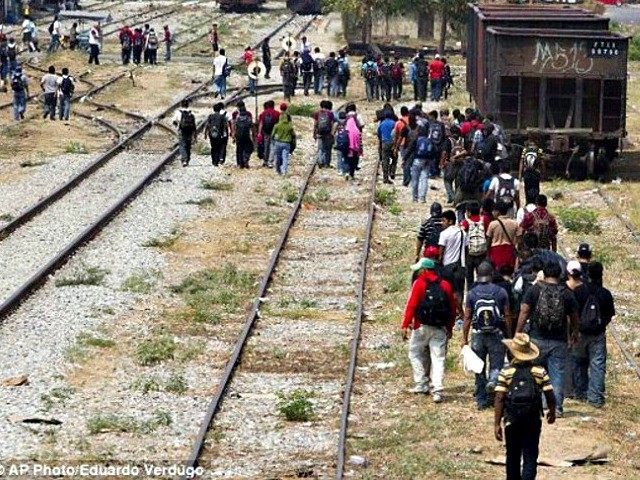
Border Surge: Apprehensions Decline with 23,767 Illegals Caught at Border Last Month

Breitbart | by CAROLINE MAY | 3 Feb 2016


Eduardo Verdugo/AP

While the level of border apprehensions of unaccompanied minors and adults traveling with children this fiscal year has dwarfed years past, the month of January saw fewer migrants detained illegally entering the U.S. than months prior.


In January, Customs and Border Patrol apprehended 3,113 unaccompanied minors and 3,145 adults with children, according to new Customs and Border Protection data. There were 23,767 overall apprehensions at the border.

The level of apprehensions represents a decline compared to earlier months. Total apprehensions were down nearly a third compared to December and apprehensions of unaccompanied minors and so-called family units dropped by more than 50 percent.

Department of Homeland Security Sec. Jeh Johnson highlighted the new numbers as representing a decline in attempts to illegally cross the U.S.-Mexico border. The decline in apprehensions follows last month’s DHS enforcement actions to remove 121 illegal immigrant family units in the U.S. who crossed the border illegally after May 2014 and had been issued final orders of removal.

The DHS secretary indicated such immigration enforcement actions — though minor compared to the hundreds of thousands of illegal immigrant arrivals since 2014 — would continue.

“While the one-month decline in January is encouraging, this does not mean we can dial back our border security efforts. Recent enforcement actions, which focus on those apprehended at the border on or after January 1, 2014, will continue,” Johnson said in a statement.

While minor compared to the overall number of illegal immigrants who remain in the U.S., immigration activists and Democrats have decried the enforcement actions, claiming the largely Central American migrants who have illegally immigrated to the U.S. deserve protection.

Johnson acknowledged those concerns, saying that DHS would ignore large swaths of illegal immigrants who are in the U.S. and only take action against those who recently arrived and have committed serious crimes.

“Our borders are not open to illegal migration. If someone was apprehended at the border, has been ordered deported by an immigration court, has no pending appeal, and does not qualify for asylum or other relief from removal under our laws, he or she must be sent home. We must enforce the law in accordance with our enforcement priorities,” he said.

While there was a decline in apprehensions last month, the level of illegal immigration so far this fiscal year — which began on October 1, 2015 — is 102 percent higher than the level recorded last year for unaccompanied minors, with 20,455 apprehensions, and 171 percent higher for family units with 124,616 apprehensions.

Democrats have argued that violence in Central America is fueling the migration north. Republicans point to the Obama administration’s amnesty programs and lax enforcement polices as enticements for illegal immigration.

The Secretive Hedge Fund That's Generating Huge Profits for Yale

Bloomberg | By Sabrina Willmer & Tom Moroney | February 4, 2016 — 5:00 AM EST

Yale University. IMAGE CREDIT: Flickr


In a year when titans Bill Ackman and David Einhorn each lost more than 20 percent for their investors, David Swensen’s bet on a little-known hedge fund kept making him money.


Nancy Zimmerman’s Bracebridge Capital has gone from $5.8 billion in assets four years ago to $10.3 billion today with a return of about 10 percent a year since its inception. That makes it the largest hedge fund in the world run by a woman. Zimmerman, who survived a 1990s scandal involving Russia, her husband and Harvard University, is so successful at avoiding the limelight that Leda Braga’s $9.5 billion Systematica Investments Ltd. is often cited as the top woman-led firm by assets.

David Swensen 
Photographer: Peter Foley/Bloomberg
Swensen, who runs Yale University’s $25.6 billion endowment, and Thomas Steyer of Farallon Capital Management originally staked Zimmerman in 1994 with about $50 million. Yale’s investment now is valued at around $1 billion, making it one of the endowment’s most profitable.


“She’s employing this leveraged strategy to exploit pricing differentials in the fixed-income world with an obsessive focus on risk,” Swensen said in an interview.

Bracebridge has had only eight losing months since 2009. The fund’s 2 percent gain last year eclipsed the industry, which was up 0.6 percent on average, according to data compiled by Bloomberg. Hedge funds had trouble navigating unexpected market events, including a devaluation in the Chinese currency in August, a rally in European government bonds and a steep drop in oil prices.

Ackman’s Pershing Square Holdings, the publicly traded part of his activist hedge fund, lost 20.5 percent last year, hurt in part by a drop in the shares of drugmaker Valeant Pharmaceuticals International Inc. Einhorn’s Greenlight Capital suffered the second losing year in its history, with its main fund falling 20.4 percent due to wrong-way stock picks.

“There were a lot of gopher holes that you could step in,” said Gabriel Sunshine, Zimmerman’s partner at Bracebridge. “We managed to miss most of them.’’

Heavyweight Network


Zimmerman, 52, has a powerful network of allies, including former New Jersey Governor Jon Corzine, who was Zimmerman’s boss at Goldman Sachs Group Inc., where he was co-chief executive officer. Among her top investors is Princeton University’s endowment, run by Swensen protege Andrew Golden.

Corzine said he remembers Zimmerman as a brilliant trader who attracted the brightest of co-workers.

Bracebridge is a relative-value fixed-income fund that exploits small pricing differences in the credit market and hedges against those bets.

Zimmerman offered a typical scenario: Bracebridge buys a corporate bond it considers cheap while at the same time purchasing a credit-default swap on the bond in order to make money even if the company goes bankrupt. Leverage boosts returns.

The strategy hasn’t always come up roses. Long-Term Capital Management, a highly leveraged hedge fund run by John Meriwether, pursued a similar investment approach. In 1998, after Russia stiffed lenders including LTCM, the fund failed and was bailed out by its Wall Street competitors. The demise of LTCM hit other hedge funds, including Bracebridge, which held some of the same assets. Bracebridge lost about 26 percent, making it the worst year in its history.
Russian Economy

A few years prior, in 1992, Zimmerman’s husband, Harvard economist Andrei Shleifer, signed on to help privatize the Russian economy under the auspices of the university and the U.S. government. Zimmerman bought up beleaguered Russian debt, betting its value would rise, court filings show.

Complaints arose about Shleifer and his business partner allegedly using their position and influence for personal gain, according to court documents. Harvard, Shleifer and the U.S. Justice Department eventually reached an agreement in which the university paid $26.5 million to settle a civil lawsuit and Shleifer paid $2 million. Zimmerman’s company paid $1.5 million to resolve civil claims that it improperly used resources and staff from the government-funded project.

Neither Zimmerman nor her husband admitted wrongdoing in connection with their Russia dealings.

Zimmerman was born and raised just north of Chicago in Skokie, Illinois, the youngest of two girls. While attending Brown University in Providence, Rhode Island, she worked summers at O’Connor & Associates, a Chicago derivatives-trading firm. She stayed with them for three years after graduation, on the raucous floor of the Chicago Mercantile Exchange. Her first job was buying Japanese yen options, she said.

She stands a few inches over five feet with brown hair that she sometimes tucks behind her ears. Though her roots are in the Midwest, she’s a Bostonian now, relishing Red Sox games and working behind the scenes for a number of the city’s philanthropies.

Zimmerman downplays the challenges faced by women in a male-dominated industry: “The bonds don’t know who owns them.”
Cashed Out

Initially, Zimmerman and Sunshine partnered with Steyer’s Farallon, which bought a minority stake in the new management company they called Farallon Fixed Income Associates. They had one employee.

Steyer cashed out after the Russia episode, but Swensen stuck with Bracebridge. “We took a hard look and found no reason to modify our relationship,” said Swensen, who describes himself as a close friend of Zimmerman’s.

After cutting ties with Farallon and changing its name, Bracebridge ended 1999 with $600 million under management.

Bracebridge’s biggest turnaround came in 2009. After losing 18 percent in the global financial crisis, it posted a 35 percent gain. That surpassed the 25.8 percent return on the HFRI Relative Value index.

Zimmerman owns most of Bracebridge, according to a 2015 filing with the U.S. Securities and Exchange Commission. As for the value, the document only says she and Sunshine control 12.6 percent of the assets. Of the $10.3 billion, that’s about $1.3 billion. It’s split between her and Sunshine and their partners, Zimmerman said, declining to be more specific.

Zimmerman credited her more than 100 employees for the firm’s success. “I’m very proud of the people who come to work here,” she said. “They are focused, intellectually honest and they love to collaborate.”


Wednesday, February 3, 2016

So it begins here: U.S. city 'overrun' with criminal refugees

WND News | LEO HOHMANN | FEBRUARY 3, 2016

IMAGE CREDITS: FLICKR, SYRIAFREEDOM.

More than 120 people braved the snow and ice Monday to rally in front of the Missoula County Courthouse, protesting an effort by the Obama administration and its army of community organizers to plant foreign “refugees” into small cities in western Montana.


One of the speakers was a woman who moved recently to Montana from Amarillo, Texas, which has been inundated with thousands of refugees over the past 15 years.

“Amarillo is overrun with refugees,” said Karen Sherman, who stood and spoke to the crowd amid blowing wind and falling snowflakes. Sherman just moved to Missoula, a college town that serves as home to the University of Montana.

Like the reporting you see here? Sign up for free news alerts from WND.com, America’s independent news network.

It’s a far cry from Amarillo, which she described as a city of rampant crime and cracking social fabric, thanks to the heavy influx of refugees sent there by the U.S. State Department in cooperation with the United Nations.

“Our city is failing because of the refugees. We have 22 different languages spoken in our schools. We’ve got 42 languages being fielded by our 9-1-1 call centers, and crime is just through the roof. We need to exercise caution, especially for the sake of our children,” she said.

The protesters carried signs that read, “Christian Refugees 2 Christian Nations, Muslim Refugees 2 Muslim Nations, That’s Only Fair,” and “Refugee Resettlement Means Big $$$ – No Accountability.”

Sherman said Amarillo, a city of just more than 200,000 people, has gang violence that has surpassed that of much larger Texas cities such as Fort Worth. She fears U.S. cities like Amarillo and Minneapolis, Minnesota, could be in line to become the next Rotherham, England, or Cologne, Germany, or Stockholm, Sweden, where mass rapes by Muslim men have gained much attention in Europe.

Touching off a rape epidemic

Amarillo was recently named the fifth most dangerous city in Texas, according to FBI crime statistics, up from sixth last year. And it has been nationally recognized as having one of the highest rates of rape in the nation.

That’s a dubious distinction that Sherman believes is tied to the high number of Muslim refugees shipped there by the U.S. government.

“The rape epidemic in this world is becoming pandemic. It’s not confined to one location. Fifteen years ago in Norway, rape was unheard of. Now it’s an epidemic,” Sherman said. “The perpetrators are 100 percent Muslim males. In Sweden, rape has gone up by 500 percent. Stockholm recently had the dubious honor of opening their very first rape center for men and boys.”

In the northern U.K. city of Rotherham, more than 1,400 children have been beaten, raped and trafficked in a well-documented turn of events that has gone largely unreported in the U.S.

“It was covered up by the local government for fear of being viewed as racist. This only came to light because a journalist decided we needed to know about that, not the government,” she said, referring to the rape scandal that unraveled in England in 2014, when it was revealed by media that gangs of mostly Pakistani men had been sexually assaulting English girls for years while police covered it up for fear of being perceived as “anti-Muslim.”

“You can have female equality, or you can have refugees. You cannot have both,” Sherman said.

Pamela Geller wrote the field manual for activists seeking to protect their community from Islamic supremacy encroachment in “Stop the Islamization of America: A Practical Guide to the Resistance.”

Too late to save Texas?

Texas Gov. Greg Abbot has called for a stop to the influx of refugees, but it’s too late, she said. The program continues unabated because, if even one refugee is present in the U.S., he is entitled under current law to bring in his entire extended family.

“It’s called family reunification,” Sherman said.
Texas' GOP Gov. Greg Abbott has tried to turn off the refugee spigot but it may be too late.
Texas’ GOP Gov. Greg Abbott has tried to turn off the refugee spigot but it may be too late.


She said America, founded on Judeo-Christian principles of tolerance and respect for one’s fellow man, should not expect people from Third World cultures to share those values.

“If people don’t choose to follow the law, you cannot hire enough police officers,” she said.

“Whether you believe (in the Judeo-Christian God) or not, your values and your principles were influenced by that. Now we’re asking that these people come here, who have been taught for thousands of years of violence and hatred, and we’re expecting them to come here and assimilate to our way of life,” Sherman told the crowd gathered in Missoula. “This is a dangerous and foolish expectation.”

Watch video of Karen Sherman describing the life she left behind in Amarillo, Texas.


Amarillo has received 5,251 foreign refugees since January 2002, according to the federal refugee database. That's more than half of the nearly 8,000 refugees sent to Texas during that period.

President Obama has increased the number of foreign refugees bound for American soil in fiscal 2016 to 85,000. That's a 20 percent increase over the previous year, and 10,000 will come from the jihadist hotbed of Syria.

WND reported last week that two groups are working to resettle Syrian refugees in Montana. One group, WorldMontana, is working in Helena and the other, Soft Landing Missoula, is working in Missoula.

Caroline Solomon drove more than 100 miles to Missoula Monday from her home in Big Fork, Montana, to participate in the rally.

"About four people (from her group) didn't make it because of weather, but we think there were about 125 people on our side and about six with signs calling us 'racists,'" she said.

Softening up the soil

Soft Landing Missoula is working with city and county officials to bring Third World refugees to Montana while the state's Act For America chapter and other activists are trying to stop that from happening. Soft Landing, like most of the non-governmental organizations working with the government to plant refugees into U.S. cities, is working with churches and faith-based groups behind the scenes to create an atmosphere that is more "welcoming" of refugees.
David Lubell of Welcoming America works closely with the White House to soften up the soil in cities targeted to receive an influx refugees.
David Lubell of Welcoming America works closely with the White House to soften up the soil in cities targeted to receive an influx Muslim refugees.


Many of the community organizers have received training or consultation from David Lubell's Welcoming America organization, which was started with seed money from billionaire George Soros. Lubell is a close adviser to President Obama's "New Americans" initiative, which seeks to convert millions of refugees and recent immigrants into U.S. citizens with full voting privileges.

The modus operandi used by resettlement agencies usually involves sending a handful of refugees at first and then gradually increasing the influx to hundreds per year.

Mary Poole, who represents Soft Landing, Missoula, told KGVO News Radio that many immigrants have settled in Missoula over the past 30 years. She compared the mostly Middle Eastern migrants from Muslim countries like Syria, Afghanistan and Iraq to the Hmong refugees fleeing communist Vietnam in the late 1970s and early '80s.

"We’ve successfully resettled a Hmong community, as well as Belorussians and Ukrainians, who are now members of our community and part of the fabric of Missoula," Poole told KGVO. "We’re just working on revamping the infrastructure that has already existed here."

But according to the federal database, the state of Montana has not received any refugees since 2008, and only 61 have been sent there since the Sept. 11, 2001, terrorist attacks.

Montana resistance follows backlash in Idaho

Other small towns in the West have similarly struggled to oppose the plans of urban elites to import what they see as the problems of the Third World into their communities.

In Sandpoint, Idaho, City Council members voted last Wednesday to withdraw a resolution supporting refugee resettlement, bringing an end to a heated, month-long debate over whether that was a wise move. It had the full backing of Sandpoint Mayor Shelby Rognstad.

Cheers erupted from the audience when the newly elected Sandpoint mayor capitulated, asking the council to withdraw his resolution from consideration. His resolution was meant to counter statements from county commissioners and the local sheriff opposing the refugees. Rognstad said his resolution was intended to restate Sandpoint's commitments to "human rights."

"This resolution has only served to divide us and this community,” said Rognstad, as he requested the withdrawal. "That saddens me."

But others see the situation in reverse. They see nonprofits and NGOs, often flush with government grant money, coming in and stirring up controversy within their once-peaceful communities.

In Twin Falls, Idaho, Chobani opened the world's largest yogurt factory and gave 30 percent of the 600 jobs to foreign refugees, and the federal government has plans to send 300 more refugees, this time from Syria, to the Twin Falls area. That touched off a backlash from a group called 3 Percent of Idaho, which organized a protest at the Idaho Statehouse in late November that attracted more than 1,000 people from both sides of the issue.

If the past record is any indication, the groups seeking to bring Third World refugees to small town America will not be easily chased off by people with signs.

In fact, the pro-refugee Hebrew Immigrant Aid Society, put together a field manual in 2013 on how to deal with "pockets of resistance" in the American heartland. One of the strategies in that manual is to research the backgrounds of resistors and identify them as "anti-Muslim" racists.

A WND report from May 2015 exposed the HIAS strategy to deride and intimidate any politician or activist who opposes the refuge industry's agenda to change the demographics of a town.

The HIAS report, titled “Resettlement at Risk: Meeting Emerging Challenges to Refugee Resettlement in Local Communities," calls for "new tools to fight back against a determined legislator or governor who has decided to challenge resettlement for political or other reasons."