Showing posts with label stimulus. Show all posts

Monday, February 1, 2016

RETAIL APOCALYPSE: 2016 BRINGS EMPTY SHELVES AND STORE CLOSINGS ALL ACROSS AMERICA

Michael Snyder | End Of The American Dream - FEBRUARY 1, 2016

IMAGE CREDITS: TWITTER, EZLEEINFAMOUS.


Major retailers in the United States are shutting down hundreds of stores, and shoppers are reporting alarmingly bare shelves in many retail locations that are still open all over the country.


It appears that the retail apocalypse that made so many headlines in 2015 has gone to an entirely new level as we enter 2016. As economic activityslows down and Internet retailers capture more of the market, brick and mortar retailers are cutting their losses. This is especially true in areas that are on the lower portion of the income scale. In impoverished urban centers all over the nation, it is not uncommon to find entire malls that have now been completely abandoned. It has been estimated that there is about a billion square feet of retail space sitting empty in this country, and this crisis is only going to get worse as the retail apocalypse accelerates.

We always get a wave of store closings after the holiday shopping season, but this year has been particularly active. The following are just a few of the big retailers that have already made major announcements…

-Wal-Mart is closing 269 stores, including 154 inside the United States.

-K-Mart is closing down more than two dozen stores over the next several months.

-J.C. Penney will be permanently shutting down 47 more stores after closing a total of 40 stores in 2015.

-Macy’s has decided that it needs to shutter 36 stores and lay offapproximately 2,500 employees.

-The Gap is in the process of closing 175 stores in North America.

-Aeropostale is in the process of closing 84 stores all across America.

-Finish Line has announced that 150 stores will be shutting down over the next few years.

-Sears has shut down about 600 stores over the past year or so, but sales at the stores that remain open continue to fall precipitously.

But these store closings are only part of the story.

All over the country, shoppers are noticing bare shelves and alarmingly low inventory levels. This is happening even at the largest and most prominent retailers.

I want to share with you an excerpt from a recent article by Jeremiah Johnson. The anecdotes that he shares definitely set off alarm bells with me. Read them for yourself and see what you think…

*****

I came across two excellent comments upon Steve Quayle’s website that bear reading, as these are two people with experience in retail marketing, inventory, ordering, and purchases. Take a look at these:

#1 (From DJ, January 24, 2016)
“Steve-
[Regarding the] alerts about the current state of the RR industry. This is in line with what I’ve been noticing as I visited our local/regional grocery store, Walmart, and Target this week in WI. I worked in big box retail for 20 years specializing in Inventory Management. These stores are all using computerized inventory management systems that monitor and automatically replenish inventory when levels/shelf stock get low. This prevents “out of stocks” and lost sales. These companies rely on the ability to replenish inventory quickly from regional warehouses.
As I shopped this week and looked at inventory levels I was shocked. There were numerous (above and beyond acceptable levels) out of stocks across category lines at all three retailers. And even where inventory was on the shelf, the overall levels were noticeably reduced. Based on my experience, working for two of these three organizations in store management, they have drastically/intentionally reduced their inventory levels. This is either due to financial stresses/poor sales effecting their ability to acquire new inventory, or it could be the result of what was mentioned earlier regarding the transporting of goods to these regional warehouses. Either way this doesn’t bode well for the what’s to come. Stock up now while you can!”

#2 (From a Commenter following up #1 who didn’t provide a name, January 26, 2016)

“I’d like to tailgate on the SQ Alert “based on my experience…” regarding stock levels in big box stores. This weekend we were in two such stores, each in fairly isolated communities which are easily the communities’ best source for acquiring grocery items in quantity.
I myself worked in retail (meat) for thirty years so I know exactly what a well-stocked store looks like, understand the key categories and category drivers, and how shelves are stocked and displays are built to drive sales and profits. I also understand supply chain and distribution methodologies quite well.
Each of the stores we were in were woefully under-stocked.This time of year-the few weeks following the holidays-is usually big business in groceries and low stock levels suggest either poor ordering at the store level, poor purchasing at the distribution level or a purposeful desire to be under-stocked.

Anyone familiar with the retail grocery industry is also familiar with how highly touted “the big box store’s” infrastructure is. They know exactly when demand is high and for what items and in what quantities. It is very unlikely that both stores somehow got “surprised” by unusually high demand. It is reasonable then to imagine that low stock levels in rural areas with few options is a purposed endeavor to assure that both the budget conscious and the folks in more remote areas are not fully able to load up their pantries.

Simply put I believe the major retailer in question is doing their part to limit the ability of rural America to be sufficiently prepared. Nevertheless, we are wise to do our best to keep ahead of the curve. God bless your efforts, Steve.”

*****

Yes, this is just anecdotal evidence, but it lines up perfectly with hard numbers that I have been discussing on The Economic Collapse Blog.

Exports are plummeting all over the globe, and the Baltic Dry Index just plunged to another new all-time record low. The amount of stuff being shipped around by air, truck and rail inside this country has been dropping significantly, and this tells us that real economic activity is really slowing down.

If you currently work in the retail industry, your job is not secure, and you may want to start evaluating your options.

We have entered the initial phases of a major economic downturn, and it is going to be especially cruel to those on the low end of the income spectrum. Do what you can to get prepared now, because the economy is not going to be getting better any time soon.

Friday, January 29, 2016

And The Biggest Contributor To U.S. Growth in 2015 Was...

Zero Hedge | By Tyler Durden | January 29, 2016


By now, not even CNBC's cheerleading permabulls can deny that the US is in a manufacturing recession: in fact, it is so bad that even the staunchest defenders of Keynesian dogma admit what we said in late 2014, namely that crashing oil is bad for the economy.

And yet, the "services" part of the US economy continues to hum right along, leading to such surprising outcomes as a stronger than expected print in Personal Consumption Expenditures. How can this be?

Simple: one look at the chart below should explain not only how the "services" half of the US economy continues to grow, but just which tax, because that is how the Supreme Court defined Obamacare, is responsible for healthcare "spending" amounting to a quarter of the growth in US personal consumption expenditures, almost 100% higher than the second highest spending category which was... Recreational goods and vehicles?

And that, ladies and gentlemen, is how you convert a tax into a source of economic progress.

Cracks in America's economy are growing

CNN Money | by Patrick Gillespie @CNNMoney | January 29, 2016: 5:12 AM ET


America's economy hit the brakes during the holidays.


Some recent economic data even raises fears that we might be heading towards a possible U.S. recession in 2016. Big banks like Morgan Stanley (MS) estimate there's a 20% chance of recession this year.

On Friday, the government will release data that show how the U.S. economy fared in the last three months of the year. Many experts forecast that the U.S. economy barely grew -- about 1% or less -- between October and December of 2015 compared to a year ago.

Even the Federal Reserve admitted Wednesday that the economy "slowed" at the end of last year.

On Thursday, the bad news continued. A key sign of confidence is orders for new products and equipment -- known as "durable goods" -- placed by companies to power their business. Orders for durable goods fell 5% between November and December, according to the Commerce Department. That was a lot below expectations that orders would be flat.

It shows that some companies are delaying or deciding not to purchase any new piece of equipment they need.

The news on durable goods caused Barclays (BCS) to lower its GDP forecast to 0.4% on Thursday. Capital Economics, a research firm, admitted the new data posed risks "firmly to the downside" for its estimate of 1%.

Related: Apple CEO: 'extreme conditions' in global slowdown

Here are 3 more warning signs that the U.S. economy is heading in the wrong direction:

1. Americans are not spending much


U.S. economic growth depends on shoppers. Consumer spending makes up two-thirds of the nation's economic engine. Yet they're sending mixed signals: U.S. retail sales declined a bit in December and they were negative or flat seven times last year.

Consumer confidence has wavered too. It peaked at 98% in January 2015 but has since drifted down in general. Consumer confidence is currently 93%. While it's a lot better than what it was just a few years ago, any downward movement is still a cause for concern.

2. U.S. manufacturing already in recession


American factories are suffering from the global economic slowdown. Manufacturing makes up 10% of the U.S. economy, according to Morgan Stanley.

The key ISM manufacturing index has declined for six straight months, and its been negative -- below 50% -- for the last two months.

The strong dollar is making products manufactured in the U.S. more expensive overseas, lowering demand for American made goods. The slowdown in emerging market economies isn't helping trade either.

Related: U.S. economy: recession fears are growing

3. Corporate America is hurting


Earnings season isn't over yet but one thing is clear: American companies are making less money than a year ago. Put together, when America's biggest companies -- and employers -- suffer, the economy follows suit.

The S&P 500 -- the benchmark for U.S. stocks -- is down 7% so far in January. Apple, the nation's biggest company by market size, just announced record profits with a gloomy outlook ahead. It believes iPhone sales will decline in the first quarter of this year for the first time in 13 years.

Apple CEO Tim Cook expressed serious caution about the global economy. When a major American CEO raises the warning flag that's not good for the U.S. economy.

"We're seeing extreme conditions unlike anything we have experienced before just about everywhere we look," Cook said Tuesday.

Thursday, January 28, 2016

Fed’s December hike was a major mistake, former Bank of England official says

Greg Robb | MarketWatch - JANUARY 28, 2016

IMAGE CREDITS: IMF / FLICKR.


Weak data, such as Thursday’s durable-goods-orders report, signal that the Federal Reserve made “a major macro mistake” raising interest rates in December, said Danny Blanchflower, a Dartmouth College economist.

See: Durable-goods-orders decline could mean economy shrank in fourth quarter.

In December, not only did the Fed raise rates for the first time in nine years, but they signaled there would be four more hikes this year.


Now, “there’s a 50/50 chance the next move is a cut...as with all the other rate hikes since 2009 this one will have to be reversed,” Blanchflower, who leans dovish, said in an interview.

Traders who bet on rate hikes using fed funds futures contracts are now wagering that the Fed will next hike rates in September, according to CME FedWatch.

“The Fed has seriously lost credibility. No one believes them,” Blanchflower added.

The Fed’s ‘classic” mistake has been to underestimate the negative spillovers from the slowing of China, the worlds number-two economy, he said.

The Dartmouth economist, who was a former member of the Bank of England’s monetary policy committee, said the situation reminded him of 2008 when the U.K. thought it could avoid the subprime housing slowdown in the U.S. economy.

Blanchflower cited new figures in a Bloomberg article pointing to a steep slowdown in global trade.

In addition, the U.S. central bank doesn’t yet grasp that the decline in oil prices is not a positive supply shock but a signal of weak global demand, he said.

In its dovish policy statement released Wednesday, the Fed took out any reference to the balance of risks facing the economy, after saying in December that the risks were balanced.

“That’s a big admission of a mistake,” Blanchflower said.

See: The Fed says sorry for its rate-hike forecast

In its statement, the Fed said it “is closely monitoring global economic and financial developments and is assessing their implications for the labor market and inflation, and for the balance of risks to the outlook.”

Economic indicators are now pointing in the direction of a recession, Blanchflower said.

IMF and World Bank move to forestall oil-led defaults

FT | Jack Farchy in Moscow and Shawn Donnan in Washington | January 27, 2016 6:47 pm

Secretary Kerry Holds Trilateral Meeting With Presidents of Azerbaijan and Armenia at NATO Summit in Wales | IMAGE SOURCE: WIKIPEDIA COMMONS


Officials from the International Monetary Fund and the World Bank are heading to Azerbaijan to discuss a possible $4bn emergency loan package in what risks becoming the first of a series of bailouts stemming from the tumbling oil price.

The Baku visit, which follows a currency crisis triggered by the collapse in crude, comes amid concern at the two global institutions over emerging market producers from central Asia to Latin America.

The fund and the bank have also been monitoring developments in other oil-producing countries such as Brazil, which is now mired in its worst recession in more than a century, and Ecuador. The oil-driven crisis in Venezuela has even raised the possibility of repaired relations between the fund and Caracas, a city IMF staff last visited more than a decade ago.

Azerbaijan depends on oil and gas for 95 per cent of its exports and the fallout of its currency weakness has sparked a series of protests across the country rattling the government of President Ilham Aliyev.

Last week the former Soviet republic became one of the first countries in the world to resort to capital controls in response to the collapse in oil prices, imposing a 20 per cent tax on exporting foreign currency.

The Azerbaijani currency, the manat, has fallen 35 per cent since the central bank in late December abandoned a dollar peg after spending more than half its reserves in a year.

The IMF team would be in Baku from January 28 until February 4 for “a fact-finding staff visit at the authorities’ request”, an IMF spokesperson said. It would discuss possible “technical assistance” and “assess possible financing needs”. The financing package under discussion was worth about $4bn, people familiar with the discussions said.

A World Bank spokesman said the IMF and it were discussing with the government immediate and longer-term measures “in response to the pressure on the local currency and low oil prices”.

The World Bank predicted this week crude prices would average just $37 a barrel this year and warned of long-term consequences. It also issued a caution that both producers and commodity markets still faced the significant risk of a bigger than expected slowdown in major oil-consuming emerging economies like China.

“These are bad times for oil producers and their creditors,” Oxford Economics warned clients on Wednesday. “History provides reason for extreme pessimism on the likely fortunes of commodity producers; suggesting that [emerging markets] are prone to default and that commodity slumps are possibly the biggest cause of defaults.”

Christine Lagarde, the managing director of the IMF, began the year with a visit to Nigeria when she warned that Africa’s largest economy would have to confront “tough choices” and the reality of lower oil prices for some time.

Discussions with Baku are at an early stage and the Azerbaijani government may yet opt to go without support from the IMF, people familiar with the matter said.

While Azerbaijan’s central bank reserves have fallen dramatically in the past year, the country has little debt and a sovereign wealth fund with assets of $34.7bn at the start of October, more than 60 per cent of GDP.

However, the fall in oil prices has put the Azerbaijani economy under extreme stress. Elman Rustamov, the central bank governor, said last week that over the course of 2015 the country’s balance of payments had fallen from $17bn to “practically zero”. Moody’s, the credit rating agency, said last month it expected Azerbaijan to record a budget deficit of 5.5 per cent in 2016 after a 9.2 per cent deficit last year.

Representatives of the Baku government did not respond to requests for comment on Wednesday. Samir Sharifov, finance minister, said in an interview on Azerbaijani television broadcast over the weekend that government bonds issued on the domestic market would be “one of the sources” to cover the budget deficit.

Delegations from other international financial institutions, including the European Bank for Reconstruction and Development and the Asian Development Bank, are also due to arrive in Baku in the next few days.

Friday, January 22, 2016

Goldman Sachs sends US into recession, promptly retracts report’s slide

RT | 22 Jan, 2016 09:47

© Brendan McDermid / Reuters
Despite being “too big to fail”, America’s “most important bank” Goldman Sachs may have done so this week, at least for a few minutes, when it possibly tipped off a new economic recession.

A slide in the “Markets do not ‘Take it Easy’ to start the year” report posted online showed the US in a recession according to Goldman’s Current Activity Indicator.

“Although EM assets remain in the cross-hairs – and the outlook there remains tenuous in spots – g

rowth concerns have impacted the market’s view of US and European growth as well, pushing our market-based measure of US growth risk to new post GFC lows (see Exhibit 8),” the report read.


Shortly after the financial watchdog website Zero Hedge tweeted their response, Goldman Sachs posted an altered slide, moving the dark blue line from zero to closer to two.

So if Goldman Sachs changed the chart, there’s no recession, right?

Well, that’s where we get into a gray area.

Economist Paul Samuelson once said “the stock market has predicted nine out of the last five recessions”, according to the Washington Post, which asked “Is the stock market telling us we’re headed for a recession?” on Wednesday.

Andrew Levin, a Dartmouth professor and former adviser to Federal Reserve Chair Janet Yellen, pointed out in this document posted Monday that the “jobs boom doesn't look like it will last” and “industrial production is falling as fast as it does when there's historically been a recession”, according to the Washington Post.

Art Cashin, Director of Floor Operations at UBS, told CNBC Tuesday: "If corporations start to pull back and say 'I don't want to advance anything; I don't want to hire anybody,' we could slide into a recession."

Former Treasury Secretary Larry Summers, who’s been spinning through the revolving door between Washington and Wall Street since the Clinton administration, wrote in the Financial Times earlier this month that “markets understood the gravity of the 2008 crisis well before the Federal Reserve” and cited a report by The Economist which found the International Monetary Fund (IMF) failed to recognize any of the 220 recessions in major countries in the April before the recession started.

Last week, portfolio strategist Michael Pento wrote in his CNBC commentary ominously titled “A recession worse than 2008 is coming”: “The unscrupulous individuals that dominate financial institutions and governments seldom predict a down-tick on Wall Street, so don't expect them to warn of the impending global recession and market mayhem. But a recession has occurred in the US about every five years, on average, since the end of WWII; and it has been seven years since the last one - we are overdue.”

Goldman Sachs has long been criticized, but rarely punished, for its role in the global financial crash, aka GFC.

As portrayed in the new Oscar-nominated film “The Big Short,” the $40 billion company sold investments they knew to be "crap" and "junk," and took out insurance policies against them.

“Investment banks such as Goldman Sachs were not simply market-makers, they were self-interested promoters of risky and complicated financial schemes that helped trigger the crisis”, Michigan Democrat Carl Levin from the Senate Permanent Subcommittee on Investigations said.

Despite multiple revelations published by the Subcommittee, the Obama administration announced it was ending the investigation into Goldman Sachs for its manipulation of the sub-prime mortgage market in 2012.

Ironically, Republican presidential candidate and Texas Senator Ted Cruz loves nothing more than telling Republicans how Obama brought the country to its knees, failing to mention that his wife is a managing director for Goldman Sachs and regional head of the bank’s Houston office.

The government has been able to squeeze a few bob out of Goldman Sachs. Last week, it settled a joint lawsuit for $5 billion, specifically for Goldman Sachs’ role in selling mortgage-backed securities between 2005 and 2007.

It reached a $1.2 billion settlement with the Federal Housing Finance Agency in 2014 and in 2010, Goldman Sachs paid $550 million to the Securities Exchange Commission.

In all cases, the settlements allowed them to avoid prosecution or jail time.

Barclays Rigged Its OIL ETN By Limiting New Creation Units

Zero Hedge | by Tyler Durden on 01/22/2016 09:57

Submitted by Daniel Drea via Dark-Bid.com,

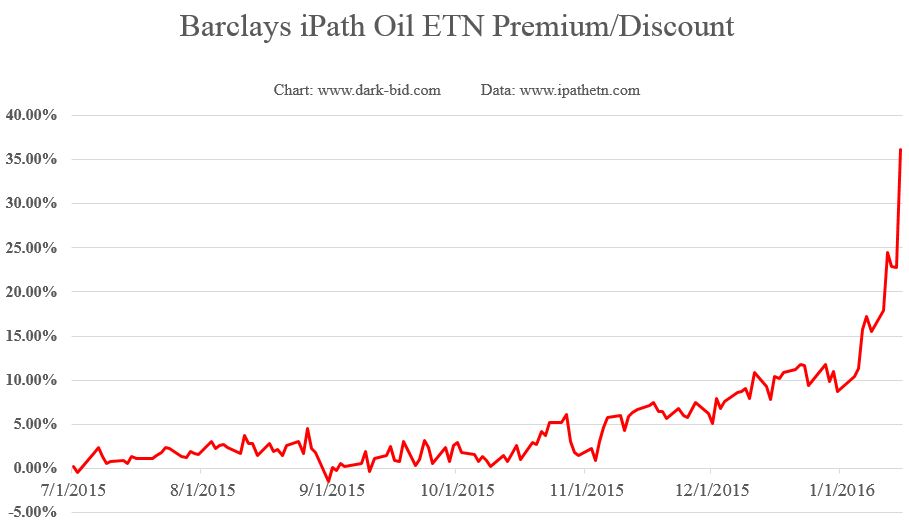
On Sunday, we warned readers that the iPath OIL ETN was trading at a 36% premium to its fair value. Today, we witnessed the brutal consequences of a two-class market where institutional traders steamroll the clueless retail investor. The OIL ETN plummeted by 17%, representing a loss of $126 million. Today's trading volume was 36.6 million vs average volume of 3.8 million, as institutional selling absolutely crushed retail investors.

Not what mom-and-pop were hoping for...


And compared to other exchange-traded instruments, it was a bloodbath...


Despite Larry Fink's relentless efforts to convince everyone how safe ETFs are, these products and their bastard offspring - ETNs - continue to demonstrate exactly how rigged financial markets have become. Barron's uncovered the cause of the huge anomaly in the OIL ETN: The wide premium developed after Barclays limited how many new shares could be created, inhibiting the normal mechanism that keeps an ETN's price in line with its index. The effect of this action appeared immediately:


Of course, Barclays dodges any responsibility for this, as their ETN disclaimer reads as follows:


Although the ETNs are listed on a U.S. national securities exchange, a trading market for the ETNs may not develop and the liquidity of the ETNs may be limited, as we are not required to maintain any listing of the ETNs.

Barclays is like a casino boss who shakes down a winning blackjack player. Plummeting oil prices sent the value of their ETN plunging. Any short sellers were sitting on massive gains. The easiest way to prop up the price of something is to limit the supply. Barclays did exactly that, artificially inflating the price of the ETN, and crushing any shorts in the process. This is similar to what happened in the mortgage market in 2007 when bearish investors bought credit default swaps on subprime mortgages. As defaults soared, their credit default swaps declined in value because the banks who sold them the insurance were also the market makers who set the prices. Well guess what? The market maker is going to finish unloading his junk before he lets you get out. Oil is the new subprime, and Barclays is rigging the price by restricting the number of OIL creation units they will sell each day.

After we brought the premium to readers' attention on Sunday, Barclays was in the spotlight, and yesterday, they issued an "investor guidance" press release warning investors that the ETN was 41% overvalued. As Barron's noted, "Most investors wouldn't have known anything was amiss." And that's exactly the problem. Why the SEC still allows ETNs to be sold to the average investor remains a mystery.

This isn't the first time an ETN has gone rogue. Last summer, a Goldman Sachs commodity ETN soared after it halted creation units.

Until the SEC gets a clue, the burden remains on financial blogs such as this one to disclose security mispricings that are now frequently exceeding $100 million.

DAVOS INSIDER: WORLD ECONOMY DOOMED, CENTRAL BANKS ‘OUT OF AMMO’

Kit Daniels | Infowars.com - JANUARY 22, 2016


A top banker and Davos insider recently admitted that an economic collapse is imminent because the central banks have lost control and are completely out of ideas.

Global Stocks Surge, Oil Soars As Hopes For Central Bank Stimulus Return

Zero Hedge | by Tyler Durden on 01/22/2016 06:53


In retrospect it appears Tom DeMark was spot on with his Wednesday prediction, made just as the Dow Jones was down some 500 points that that very day was "an interim low" to be followed by a 5-8% rebound (at which point the selling would resume). In fact, those trading Japanese stocks saw virtually the entire predicted rebound take place in just one day as the Nikkei soared by almost 6% overnight, or nearly 1000 points, the biggest jump in 4 months, while risk everywhere else around the globe has likewise exploded higher, as crude has stormed back over $31/barrel.
In other words, overnight we have seen a tremendous relief rally from historically oversold conditions in which AAII bulls hit a 10 year low: largely as most predicted, despite (actually thanks to) even more negative global macro economic data.
There was just one problem: recall what DeMark said about the market forming a bottom:
Markets bottom when the last seller has sold and markets top when the last buyer has bought. We are looking for a bottom that's a secondary bottom where you make one bottom, you rally, make a lower low and the internals of the market show that there's strength and at the same time when we make that low there's a low of negative news: we don't want to see positive news from the government; we don't want to see positive news from central banks. That interferes with the rhythm of the market.
So what drove the overnight surge? Here is a sample of "explanatory" headlines from Bloomberg:
  • Stocks Rebound on Stimulus Speculation
  • Oil Rallies in Biggest 2-Day Surge Since August on Stimulus Bets
  • Yen Investors Homeward Bound as BOJ Stimulus Seen Boosting Bonds
To be sure, it all started with Draghi's latest jawboning of risk higher, which sent oil surging above $28, pushing up all risk assets with it, on expectations that March is the date when the ECB will boost its QE, memories of the December slaughter long forgotten.

In case it is still unclear, Bloomberg lays it out: "The turnaround in sentiment came amid signs central banks may be prepared to act after $7.8 trillion was erased from the value of global equities this year on China’s slowdown and oil’s crash. Diminished inflation expectations and a strengthening yen are seen as increasing pressure on the Bank of Japan to enlarge stimulus at its meeting next week. China will keep intervening in its equity market to “look after” investors and has no intention of further devaluing the yuan, Vice President Li Yuanchao said."
And just in case, here is another explainer: "There is hope of more stimulus in March and potential for even more stimulus in Japan and China, so if we get concrete positive economic news the rebound could last into next week,” said John Plassard, senior equity- sales trader at Mirabaud Securities. “I told my clients to fasten their seatbelts and wait for better news, and this is finally happening."
In other words, more of the same that brought the market to the same unsustainable level from which we just had a crash big enough to validate half a recession. No wonder even JPM says to sell all rallies.
For now, however, enjoy the bear-market rally in which stocks rose around the world, extending Thursday’s rebound from a 2 1/2-year low. Oil surged with emerging-market currencies, while haven assets retreated. European shares headed for the best week in two months, the euro approached a two-week low and Spanish and Italian bonds rallied after European Central Bank President Mario Draghi indicated he may bolster economic support as soon as March. Crude was poised for its steepest two-day rally in five months and the Russian ruble rebounded from a record low. Asian stocks climbed the most since September on speculation Japan and China may also take steps to calm markets.
“It’s a classic oversold bounce after Draghi’s comments yesterday and the noise on Japanese stimulus overnight, the question is where do we go from here,” said Veronika Pechlaner, who helps oversee $10 billion at Ashburton Investments, part of FirstRand Group. “It’s become harder and harder for stimulus to really support the economic fundamentals so it doesn’t mean a medium- and long-term change, but at least we have a bit more stable trading environment for a couple of days.”
Summarizing where we stand:
  • S&P 500 futures up 1.4% to 1887
  • Stoxx 600 up 2.5% to 337
  • FTSE 100 up 2.1% to 5893
  • DAX up 1.8% to 9747
  • German 10Yr yield up 4bps to 0.49%
  • Italian 10Yr yield down 4bps to 1.52%
  • Spanish 10Yr yield down 5bps to 1.67%
  • MSCI Asia Pacific up 3.7% to 119
  • Nikkei 225 up 5.9% to 16959
  • Hang Seng up 2.9% to 19081
  • Shanghai Composite up 1.3% to 2917
  • S&P/ASX 200 up 1.1% to 4916
  • US 10-yr yield up 4bps to 2.07%
  • Dollar Index up 0.18% to 99.24
  • WTI Crude futures up 4.6% to $30.90
  • Brent Futures up 5.5% to $30.86
  • Gold spot down 0.4% to $1,097
  • Silver spot up 0.3% to $14.14
And just like that, we have gone from epic gloom and doom and a 560 Dow Jones plunge to sheer euphoria in about 48 hours.
* * *
Looking closer at regional markets, we start in Asia where equity markets traded mostly higher following the positive close on Wall St. in the wake of ECB President Draghi's dovish comments, while a rebound in the energy complex and hopes of BoJ easing also bolstering sentiment. Nikkei 225 (+5.9%) outperformed as the weaker JPY supported exporters, while reports that the BoJ is said to be considering further easing saw the index advance by nearly 1000 points. Elsewhere, the ASX 200 (+1.1%) was led higher by gains in energy and large mining names, while the Shanghai Comp (+1.3%) was also led by the crude recovery, despite underperforming after Shanghai margin debt fell for the 15th consecutive day which is the longest streak of declines on record. Finally 10yr JGBs traded flat initially tracked the losses in USTs, but then pared with the BoJ also in the market for JPY 1.26tr1 of government debt.
BoJ is said to be considering further easing amid economic uncertainty, with the central bank said to be mulling measures to address the impact of the slump in oil prices on its price target and is likely to extend the time frame to reach the price-goal, according to a senior official.
Top Asian News:
  • PBOC Said to Tell Lenders to Cancel Repos With Excessive Rates: Some banks are said to have been set rate caps for such loans.
  • Soros Says China Hard Landing Will Deepen the Rout in Stocks: He’s betting against Asian currencies, buying Treasuries.
  • SoftBank’s Slide Leaves It Worth Less Than Stake in Alibaba: 4-day stock slide triggered by rising pessimism about Sprint’s ability to pay down debt.
  • China Vice President Vows to ‘Look After’ Stock Market Investors: Leaders will make market dynamic while boosting regulation.
  • Japanese Stocks Jump Most in Four Months Amid Stimulus Signals: Nikkei-225 closed up 5.9%, most since Sept. 9.
  • Islamic State Threat Reaches India Before Hollande Visits: Police arrest four for plotting attack at Hindu holy site.
In Europe, risk on appetite is in full swing in Europe, following a positive close in Asia after energy held onto, and built upon gains before European participants came to their desks. Comments yesterday from ECB's Draghi that the March meeting is live in terms of policy decisions, has continued to bolster equity markets this morning. Peripheral bond yield spreads are also tighter in early trade, as Draghi's comments linger in participants ears. Comments from the ECB's survey of professional forecasters today seems to justify Draghi's comments —they downgraded the 2016 inflation forecast to 0.7% from 1.0%.
The Stoxx Europe 600 Index rose 2.6 percent at 10:53 a.m. in London. The index is heading for a 2.3 percent weekly advance -- its biggest such gain since November -- after rising the most in a month yesterday following Draghi’s indication that monetary policy will be reviewed as early as March. He reiterated his stance in Davos on Friday.
Banca Monte dei Paschi di Siena SpA surged 12 percent after saying it’s bringing forward the board meeting on its results to reassure markets. Chairman Massimo Tononi separately told Il Sole 24 Ore that the lender has no plans for a capital increase, while not ruling out the possibility of being helped by the Italian government’s plan for a bad bank.
Top European News
  • Draghi Says ECB Has ‘Plenty of Instruments’ to Revive Inflation: ECB president concerned about outlook for euro- area inflation; is determined to reach his price-stability mandate. Euro Area Hit by Market Volatility as ECB Mulls March Action
  • SAP Raises 2017 Forecasts as Cloud Business Growth Quickens: Co. raised the top end of its forecast for 2017 sales by 7% to as much as EU23.5b.
  • U.K. Retail Sales Plunge as Mild Weather Curbs Clothes Spending: volume of sales including fuel fell 1%, biggest drop since September 2014.
  • ABN Amro, Rabobank Say They Meet ECB Capital Requirements: ABN Amro required to hold CET1 capital level of 10.25% in 2016; Rabobank says it’s required to maintain CET1 ratio of 9.5%.
  • Goldman Makes U-Turn on Euro Forecast After 6 Weeks: Analysts revived their bearish call for currency to drop to 95c in next 12 months.
In FX, EUR/USD looks to be on the mend after yesterday's ECB press conference set up March as a potential month of further accommodative action. The Negative manufacturing and services data from the Eurozone this morning, showing growth in both of these sectors at 11 month lows, has been brushed aside.
Russia’s ruble jumped 3.2 percent, trimming this month’s slide to 8 percent. That’s the worst performance among 31 major currencies worldwide. Malaysia’s ringgit jumped 1.9 percent and South Korea’s won climbed 1.1 percent on Friday. A gauge of exchange rates for 20 developing nations rose 0.6 percent.
Hong Kong’s dollar gained the most in 12 years, rising as much as 0.4 percent, before trading 0.3 percent stronger to 7.7916 against the dollar. The currency, which sank to an eight-year of HK$7.8295 on Wednesday, erased the week’s loss and returned to the strong side of its HK$7.75-HK$7.85 trading range.
The yen was set for its biggest weekly drop in more than two months. The currency was down 0.4 percent, extending its weekly decline to 1 percent. The euro fell 0.3 percent against the dollar. Monetary easing tends to debase the value of currencies.
In commodities, WTI and Brent have been continuing their bullish moves during the European session, in in the wake of gains in the US/Asia sessions . Gold has weakened in early EU trade after risk on sentiment continued after ECB's Draghi's comments yesterday pushed equities higher. Industrial metals are higher across the board on the back of increased risk appetite.
Brent crude rose as much as 6.3 percent to $31.10 a barrel on the ICE
Futures Europe exchange, before trading at $30.83. Prices headed for an
11 percent two-day advance, the biggest since the end of August. In New
York, West Texas Intermediate crude climbed 4.6 percent to $30.89. U.S.
natural gas headed for a weekly gain as a snow storm approached the
eastern U.S. Futures for February rose 1.9 percent this week and were
little changed on Friday at $2.130 per million British thermal units.
Looking at the day ahead, this morning in Europe will be all about the January flash PMI indicators where we get manufacturing, services and composite readings for Germany, France and the Euro area. Also due out this morning will be the December retail sales and public sector net borrowing data for the UK. Across the pond this afternoon in the US the early print will be the Chicago Fed national activity index reading for last month, before we then get the flash January manufacturing PMI, December's existing home sales data as well as perhaps the most significant data this afternoon - the conference board’s leading indicators. First thing this morning we should also hear from ECB President Draghi again, speaking in Davos at the World Economic Forum, while Governing Council member Weidmann is also scheduled to speak later this morning. So there could be conflicting signals here. On the earnings front just 6 S&P 500 companies are due to report with General Electric being the highlight.

Bulletin Headline Summary frrom RanSquawk and Bloomberg
  • Comments yesterday from ECB's Draghi that the March meeting is live in terms of policy decisions, has continued to bolster equity markets this morning (Euro Stoxx +2.6%)
  • With oil comfortably back above USD 30.0, CAD continues its recovery to record a 5 cent retracement (through 1.4200) from multi year highs seen this week, USDRUB dipped back under 80.00 after yesterday's sharp hit to 86.00
  • Highlights today include: US Manufacturing PM! and existing home sales, comments from ECB's Nowotny and Coeure as well as BoE's Cunliffe and Forbes
  • Treasuries lower in overnight trading as oil rises and world equity markets rally on hopes of more central bank interventions to help financial markets.
  • Over the seven weeks until the March 10 gathering, ECB officials are likely to try to guide investors to avoid a repeat of last month’s meeting, when fresh stimulus fell short of predictions stoked at the previous decision
  • Fallout from slumping commodities and China’s slowdown has investors increasingly predicting that the Federal Reserve will slow its campaign to raise interest rates and that the ECB and BOJ will soon deploy more stimulus
  • The Federal Reserve’s efforts to ensure its interest rate increase filters through to the broader U.S. economy have found an unexpected counterparty: foreign central banks
  • Violent swings in global markets fretting over the Chinese economy are being exacerbated by tougher capital rules imposed on the world’s biggest banks, according to former Barclays Plc CEO Bob Diamond and Goldman Sachs President Gary Cohn
  • A secret -- just how much of America’s debt does Saudi Arabia own? -- unanswered since the 1970s under an unusual blackout by the U.S. Treasury has come to the fore as Saudi Arabia is pressured by plunging oil prices and costly wars
  • Goldman Sachs revived its bearish call for the Euro to drop to $0.95 in the next 12 months on Thursday, less than two months after changing its 2016 year-end call for the euro to $1
  • U.K. retail sales plunged 1% m/m in December, the most in more than a year, as mild weather damped clothing demand and early discounting boosted spending the previous month
  • A dangerous winter storm will bring snow by the foot to the U.S. mid-Atlantic, including Washington, threatening at least 50 million people in its path while canceling thousands of flights and closing schools and government offices
  • Sovereign 10Y bond yields mostly wider. Asian and European stocks rally; U.S. equity-index futures rise. Crude oil, copper and gold higher
US Event Calendar:
  • 8:30am: Chicago Fed Nat Activity Index, Dec., est. -0.15 (prior -0.3)
  • 9:45am: Markit US Manufacturing PMI, Jan. P, est. 51 (prior 51.2)
  • 10:00am: Existing Home Sales, Dec., est. 5.2m (prior 4.76m)
  • Existing Home Sales m/m, Dec., est. 9.2% (prior -10.5%)
  • 10:00am: Leading Economic Indicators, Dec., est. -0.2% (prior 0.4%)
Top Global News
  • Paralyzing Storm Threatens U.S. East as Washington in Bull’s-Eye: Washington, Baltimore more than a foot of snow by Saturday; New York may get buried in 6-10 inches.
  • Goldman Says Investors Overreacting to China Creates Problems: Investors tend to overstate China’s impact on world, according to new report.
  • Sprint to Report Earnings a Week Earlier Amid Investor Worries: Co. expected to post first full year of subscriber gains in 8 years on Jan. 26.
  • Starbucks Blames Paris Attacks for Hurting European Sales: “dramatic decline” in consumer, tourist activity in W. Europe following Nov. Paris attacks.
  • Google’s Android Revenue Put at $31b by Oracle Lawyer: Analysis of Google’s tightly held financial information was disclosed Jan. 14 by an Oracle attorney.
  • Google Paid Apple $1b to Keep Search Bar on IPhone: Apple received $1b from its rival in 2014, according to transcript of court proceedings from Oracle’s copyright lawsuit against Google.
  • AmEx’s Chenault Braces for ’New Reality’ as Profit Declines 38%: CEO outlined plan to cut costs by $1b by end-2017, including further restructuring.
  • SunEdison to Hand Solar Farms Right Back to the Previous Owners: Co. outlined Wednesday details of 4 Hawaii, Utah assets involved in handover.
  • Commodity Rout Spurs Moody’s to Review Dozens of Ratings: 69 U.S. E&P cos., as well as 11 mining cos., put under review for downgrade.
  • Junk Bond Market Braces for What Could Be a $117b Logjam: Securities maturing in 10 years or more could be cut to junk by end-2017, say UBS strategists.
  • Dimon’s Pay Jumps to $27m, Mostly Tied to Performance: Bankin creased CEO’s pay 35%, tying most of package to future performance.
DB's Jim Reid concludes the overnight wrap
The last time the market flirted with Mr Draghi's seductive sound bites it eventually got jilted at the easing aisle. However there was a hint of giving him a second chance yesterday with a fairly positive market reaction to pretty firm signaling that the ECB will ease again in March. Although the meeting is 7 weeks away could yesterday mark the start of another plate spinning cycle from the central banks? The market chatter is now looking towards Kuroda to signal more action when the BoJ meet this time next week. Will Yellen also signal a more cautious and dovish stance at the FOMC next Wednesday? We continue to think central bank money printing globally remains in the early stages. Such policies could go on for several years yet even if there are periodic pauses. Ultimately we continue to think monetary policy will finance fiscal spending but that will take a recession to focus policy makers’ minds. For now with inflation so low it would be strange if central banks didn't do more in the face of such market turmoil, low inflation and elevated risk factors. It won't be a major growth stimulant but any extra liquidity provided will have to go somewhere so it's too early to say the central bank era of elevating asset prices is over even if it's becoming more difficult to get the same response.
Notwithstanding another choppy session, European risk assets got the much needed ECB-stimulus boost yesterday with European equity markets finishing broadly 2% higher, although Italian equities (which have been hard hit of late) stood out after the FTSE MIB finished with a +4.20% gain. Draghi downplayed recent concerns over Italian banks which undoubtedly helped. Elsewhere the S&P 500 was up over +1.5% by the end of the European close, dragging US 10y Treasury yields back up above 2%, but hopes for a big bounce-back faded as the session wore on with the S&P 500 being pared back to close up just +0.52%. This came despite a much better day for Oil with the new WTI contract at one stage trading back up above $30/bbl. It closed just below that by the close of play ($29.53/bbl) but was still up +4.16% on the day.
The loss of momentum late in the US session hasn’t deterred bourses in Asia this morning however where we’ve seen strong gains across the region. The Nikkei (+5.65%), Hang Seng (+2.49%), Kospi (+1.94%) and ASX (+1.07%) are all up with markets in Japan in particular seemingly buoyed by a report in the Nikkei newspaper this morning suggesting that the BoJ is seriously mulling an expansion of its current QE programme. This seems to have offset a slightly lower than expected flash manufacturing PMI for Japan (52.4 vs. 52.8 expected). Markets in China had been trading with modest losses but the Shanghai Comp and CSI 300 are back in positive territory at +0.52% and +0.48% respectively, the lag perhaps reflecting the latest MNI business indicator print for China which fell to 52.3 from 52.7 in December. Meanwhile Oil has extended gains in early trading and is rallying hard as we go to print (+3%) while Asia and Australia credit indices are 2bps and 4bps tighter respectively.
In terms of Draghi’s comments yesterday then, the ECB President highlighted that officials will review and possibly reconsider its policy stance at the next meeting. Importantly he made reference to the fact that while ‘the measures we decided in December were entirely appropriate at that time’, ‘since then these circumstances have changed’. In a strong signal of defiance Draghi said that ‘we are not surrendering in front of these global factors’ - namely plummeting oil prices and the slowdown in China. Draghi added that ‘we are adapting our instruments to the changing conditions’ and that ‘the credibility of the ECB would be harmed if we weren’t ready to revise the monetary-policy stance’ while also adamantly stating that the ECB has the ‘power, the willingness, the determination to act, and the fact that there are no limits to our action’.
The signal was also strong enough for our European economists to revise their call to an easing at the March meeting. The question instead becomes how and their baseline expectation is for a 10bp cut in the deposit rate and a change to the asset purchase programme. Absent a major euro crisis, they see the latter going no further than a front-loading of purchases, i.e. a temporary acceleration in the pace of QE and may be less than this if the global risks recede by March.
The market was clearly disappointed with the outcome in December after expectations had been set so high. So with seven weeks to go, expect a lot of focus and close scrutiny around all of Draghi’s comments and other ECB policy makers now. Given the possibility of a second chance, it’s hard to imagine Draghi letting expectations climb as high as they did last time round without being convinced of action.
In terms of the remainder of the price action yesterday, the rally for European risk assets didn’t end with equity markets as credit indices put in a strong performance too as Crossover and Main tightened 21bps and 5bps respectively. The Euro initially plunged over a 1% but actually rallied back later in the evening to finish more or less unchanged around the 1.09 mark. Meanwhile those gains for Oil yesterday came despite another bounce in US inventories last week according to the latest EIA data, although the increase was less than that reported by the API on Wednesday and so was seemingly a rare reason to help justify a leg up in prices.
Speaking of Oil, yesterday saw Schlumberger release its latest quarterly report, the first of the big US oil names to do so. The company reported a $1bn loss for the quarter alone which was actually less than expected although revenues missed relative to consensus. The bigger news however was that the company is to cut another 10,000 jobs, bringing total job cuts in the last twelve months to 30,000 in the face of plummeting energy prices. The positive announcement of a share buyback did however lend some support to the share price in post-market trading. Of the 18 S&P 500 names to release earnings yesterday just seven beat revenue expectations (below the overall trend this quarter) but 14 beat earnings expectations (in line with the overall trend).
Wrapping up, US economic data yesterday was a tad mixed. The January Philly Fed business outlook print came in at a slightly better than expected -3.5 (vs. -5.9 expected), a gain of 6.7pts from a downwardly revised December reading. Meanwhile the latest initial jobless claims print revealed an unexpected 10k rise to 293k (vs. 278k expected) which is the most in six months and continues what has been an upward trend from the October lows now. In the European session and away from the ECB the only data to report of was a slightly softer than expected Euro area consumer confidence print for this month (-6.3 vs. -5.7 expected).
Looking at the day ahead, this morning in Europe will be all about the January flash PMI indicators where we get manufacturing, services and composite readings for Germany, France and the Euro area. Also due out this morning will be the December retail sales and public sector net borrowing data for the UK. Across the pond this afternoon in the US the early print will be the Chicago Fed national activity index reading for last month, before we then get the flash January manufacturing PMI, December's existing home sales data as well as perhaps the most significant data this afternoon - the conference board’s leading indicators. First thing this morning we should also hear from ECB President Draghi again, speaking in Davos at the World Economic Forum, while Governing Council member Weidmann is also scheduled to speak later this morning. So there could be conflicting signals here. On the earnings front just 6 S&P 500 companies are due to report with General Electric being the highlight.