Showing posts with label New World Order. Show all posts

Monday, March 21, 2016

Leaked Documents Expose the TTIP Trade Deal as a Subversive Imperial Scam

Liberty Blitzkrieg | Michael Krieger | Posted Friday Mar 18, 2016


At least 150,000 people marched in Berlin on Saturday in protest against a planned free trade deal between Europe and the United States that they say is anti-democratic and will lower food safety, labor and environmental standards.

Organizers – an alliance of environmental groups, charities and opposition parties – said 250,000 people had taken part in the rally against free trade deals with both the United States and Canada, far more than they had anticipated.

Opposition to the so-called Transatlantic Trade and Investment Partnership (TTIP) has risen over the past year in Germany, with critics fearing the pact will hand too much power to big multinationals at the expense of consumers and workers.

– From the post: Merkel “Surprised” as Hundreds of Thousands March in Berlin Against TTIP “Corporate Dictatorship”

The Trans Pacific Partnership (TPP) is under total assault here in these United States, as the general public has become aware that these fake trade deals are merely oppressive power grabs written by lobbyists to benefit multinational corporations at the expense of the general public.


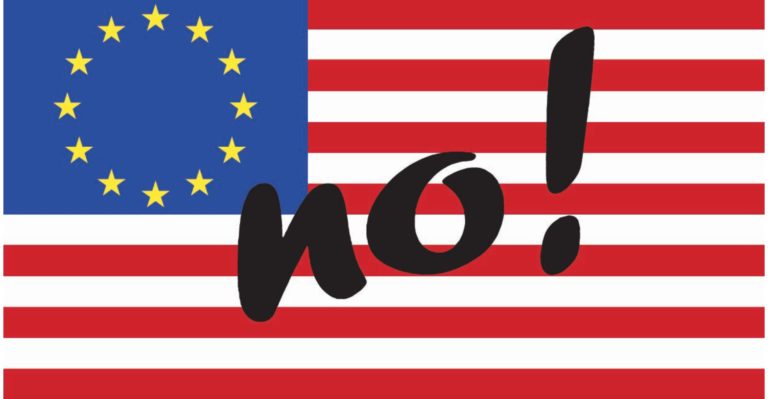
Less well known to the American public is a similar scam targeting Europe, known as the Transatlantic Trade and Investment Partnership (TTIP). Recently leaked documents have highlighted its profound dangers.

The Independent reports:

The European Commission will be obliged to consult with US authorities before adopting new legislative proposals following passage of a controversial series of trade negotiations being carried out mostly in secret.

A leaked document obtained by campaign group Corporate Europe Observatory (CEO) and the Independent from the ongoing EU-US Transatlantic Trade and Investment Partnership (TTIP) negotiations reveals the unelected Commission will have authority to decide in which areas there should be cooperation with the US – leaving EU member states and the European Parliament further sidelined.

The leaked document concerns the “regulatory cooperation” chapter of the talks, which the European Union says will result in “cutting red tape for EU firms without cutting corners”. It shows a labyrinth of procedures that could tie up any EU proposals that go against US interests, according to analysis by CEO.

The plans revealed by the document will give the US regulatory authorities a “questionable role” in Brussels lawmaking and weaken the European Parliament, CEO argues.

Nick Dearden, director of the Global Justice Now campaign group, said: “The leak absolutely confirms our fears about TTIP. It’s all about giving big business more power over a very wide range of laws and regulations. In fact, business lobbies are on record as saying they want to co-write laws with governments – this gets them a step closer. This isn’t an ‘add on’ or a small part of TTIP – it’s absolutely central.”

Mr Dearden said it was “scary” that the US could get the power to challenge and amend European regulations before elected European politicians have had the chance to debate them.

Referring to the imminent EU referendum, he said: “We’re talking about sovereignty at the moment in this country – it’s difficult to imagine a more serious threat to our sovereignty than this trade deal.”

All in all, the extent to which big business will be able to influence regulations under these proposals is a serious threat to democracy as we know it.

Considering Europe is already just a vessel state of the American imperial oligarchy, I guess we may as well put it in writing.

Clinton email reveals: Google sought overthrow of Syria's Assad

Washington Examiner | By RUDY TAKALA | March 19, 2016


Google in 2012 sought to help insurgents overthrow Syrian President Bashar Assad, according to State Department emails receiving fresh scrutiny this week.


Messages between former secretary of state Hillary Clinton's team and one of the company's executives detailed the plan for Google to get involved in the region.

"Please keep close hold, but my team is planning to launch a tool ... that will publicly track and map the defections in Syria and which parts of the government they are coming from," Jared Cohen, the head of what was then the company's "Google Ideas" division, wrote in a July 2012 email to several top Clinton officials.

"Our logic behind this is that while many people are tracking the atrocities, nobody is visually representing and mapping the defections, which we believe are important in encouraging more to defect and giving confidence to the opposition," Cohen said, adding that the plan was for Google to surreptitiously give the tool to Middle Eastern media.

"Given how hard it is to get information into Syria right now, we are partnering with Al-Jazeera who will take primary ownership over the tool we have built, track the data, verify it, and broadcast it back into Syria," he said.

"Please keep this very close hold and let me know if there is anything [else] you think we need to account for or think about before we launch. We believe this can have an important impact," Cohen concluded.

The message was addressed to deputy secretary of state Bill Burns; Alec Ross, a senior Clinton advisor; and Clinton's deputy chief of staff, Jake Sullivan. Sullivan subsequently forwarded Cohen's proposal to Clinton, describing it as "a pretty cool idea."

Cohen worked as a low-level staffer at the State Department until 2010, when he was hired to lead Google Ideas, but was tied to the use of social media to incite social uprisings even before he left the department. He once reportedly asked Twitter CEO Jack Dorsey to hold off of conducting system maintenance that officials believed could have impeded a brief 2009 uprising in Iran.

The unusual involvement by Google in foreign affairs highlights the difficulty of involvement in the internal politics of foreign states. While Cohen seemed to consider his company's effort as helpful to American interests, the effort to overthrow Assad helped spur the rise of the Islamic State, which eventually filled a vacuum resulting from Assad's loss of control over of Syria.

The exchange on Syria was highlighted by Wikileaks on Saturday. Earlier in the week, the secret-leaking website posted more than 30,000 emails that Clinton sent or received during her tenure leading the State Department.

Friday, February 12, 2016

Satanists Feel the Bern

Adan Salazar | Infowars - FEBRUARY 12, 2016


Democrat socialist Bernie Sanders’ campaign has evidently roused the satanic electorate.


In a highly popular pro-Sanders meme group created on Facebook, a post with an image stating, “Satanists for Bernie 2016,” has received over 1,100 likes and over 200 shares.


Several members of the Bernie Sanders’ Dark Meme Stash cautioned the image looks bad for the campaign and asked for it to be removed.

bernie-satan2
bernie-satan3
satan-6
bernie-satan11
But many, many others embraced the supposed endorsement.
bernie-satan4
bernie-satan5
bernie-satan6
bernie-satan7
bernie-satan8
bernie-12


While the image’s creator is unknown, it is discussed in the comments that the Church of Satan, a central hub of satanic worship, has not officially endorsed any candidate for president.

Another group entitled the Satanic Communist Party, boasting over 2,000 members, also appears to lean pro-Bernie.


While supporters attempt to distance Sanders’ brand of socialism from Communism, revolutionaries instrumental in shaping the ideology, in particular Vladimir Lenin, have openly admitted, “The goal of socialism is Communism.”

In a 1986 book entitled Marx & Satan, author Richard Wumbrand, who was imprisoned for 14 years by the Communist government of Romania for espousing Christian beliefs, demonstrates through direct quotes that the man credited as the father of Communism crafted the ideology with inspiration from the powers of darkness and with the intent to destroy religion.

“The good of the workers was only a pretense. Where proletarians do not fight for Socialist ideals, Marxists will exploit racial differences or the so-called generation gap. The main thing is, religion must be destroyed,” wrote Wumbrand.

“Marx believed in hell. And his program, the driving force in his life, was to send men to hell.”

Monday, February 8, 2016

Pentagon orders commanders to prioritize climate change in all military actions

By Rowan Scarborough - The Washington Times - Sunday, February 7, 2016

The Pentagon directive, “Climate Change Adaptation and Resilience,” is in line with President Obama’s view that global warming is the country’s foremost national security threat, or close to it. (Associated Press)


The Pentagon is ordering the top brass to incorporate climate change into virtually everything they do, from testing weapons to training troops to war planning to joint exercises with allies.


A new directive’s theme: The U.S. Armed Forces must show “resilience” and beat back the threat based on “actionable science.”

It says the military will not be able to maintain effectiveness unless the directive is followed. It orders the establishment of a new layer of bureaucracy — a wide array of “climate change boards, councils and working groups” to infuse climate change into “programs, plans and policies.”

The Pentagon defines resilience to climate change as: “Ability to anticipate, prepare for, and adapt to changing conditions and withstand, respond to, and recover rapidly from disruptions.”

To four-star generals and admirals, among them the regional combatant commanders who plan and fight the nation’s wars, the directive tells them: “Incorporate climate change impacts into plans and operations and integrate DoD guidance and analysis in Combatant Command planning to address climate change-related risks and opportunities across the full range of military operations, including steady-state campaign planning and operations and contingency planning.”

The directive, “Climate Change Adaptation and Resilience,” is in line with President Obama’s view that global warming is the country’s foremost national security threat, or close to it. Mr. Obama says there is no debate on the existence of man-made global warming and its ensuing climate change. Supporters of this viewpoint label as “deniers” any scientists who disagree.

But there are stubborn doubters. A climate center in Colorado has said its researchers looked at decades of weather reports and concluded there has been no uptick in storms. The United Nations came to a similar finding, saying there is not enough evidence to confirm an increase in droughts and floods.

A previous Pentagon report on climate change attributed Super Storm Sandy to climate change.

Dakota Wood, a retired Marine Corps officer and U.S. Central Command planner, said the Pentagon is introducing climate change, right down to military tactics level.

“By equating tactical actions of immediate or short-term utility with large-scale, strategic-level issues of profound importance, the issue of climate change and its potential impact on national security interests is undermined,” he said. “People tend to dismiss the whole, what might be truly important, because of all the little silly distractions that are included along the way.”

He said climate change is typically measured in long stretches of time.

“The climate does change over great periods of time, typically measured in millennia, though sometimes in centuries,” he said. “But the document mentions accounting for such down to the level of changes in ‘tactics, techniques and procedures’ as if reviewing how a squad conducts a patrol should be accorded the same level of importance and attention as determining whether the naval base at Norfolk, Virginia, might have to be relocated as sea levels rise over the next 100 years.”

Multipoint strategy

The directive originated in the office of Frank Kendall, undersecretary of defense for acquisition, technology and logistics. Final approval came from Deputy Defense Secretary Robert O. Work.

The directive is loaded with orders to civilian leaders and officers on specifically how counter-climate change strategy is to permeate planning.

“This involves deliberate preparation, close cooperation, and coordinated planing by DoD to provide for the continuity of DoD operations, services and programs,” it states.

“The DoD must be able to adapt current and future operations to address the impacts of climate change in order to maintain an effective and efficient U.S. military,” it adds. “Mission planning and execution must include anticipating and managing any risks that develop as a result of climate change to build resilience.”

Climate change must be integrated in:

• Weapons buying and testing “across the life cycle of weapons systems, platforms and equipment.”

• Training ranges and capabilities.

• Defense intelligence surveillance and reconnaissance.

• Defense education and training.

• Combatant commander joint training with allies to “assess the risks to U.S. security interests posed by climate change.”

• Joint Chiefs of Staff collaboration “with allies and partners to optimize joint exercises and war games including factors contributing to geopolitical and socioeconomic instability.”

Mr. Wood, now a military analyst at The Heritage Foundation, said the directive is muddled.

“I understand the motivation behind and intent for such guidance,” he said. “The problem is that it includes such a wide variety of issues with no explication or context that enables the offices mentioned to differentiate and prioritize activities and efforts across time or intensity.”

‘A lack of evidence’

The Department of Defense last issued a broad directive on climate change in July. It declared climate change an “urgent and growing threat to our national security” and blamed it for “increased natural disasters.”

The report also told commanders there are “more frequent and/or severe extreme weather events that may require substantial involvement of DoD units, personnel and assets in humanitarian assistance and disaster relief.”

This assertion is not supported by the U.N.’s most recent global warming predictions.

Roger Pielke Jr., a professor of environmental studies at the Center for Science and Technology Police Research at the University of Colorado, also has come to conclusions at odds with the Obama administration. He has testified on Capitol Hill, clashing with liberals who say his data are wrong.

“Current datasets indicate no significant observed trends in global tropical cyclone frequency over the past century,” he wrote in 2013. “No robust trends in annual numbers of tropical storms, hurricanes and major hurricanes counts have been identified over the past 100 years in the North Atlantic basin.

“In summary, there continues to be a lack of evidence and thus low confidence regarding the sign of trend in the magnitude and/or frequency of floods on a global scale.”

Rep. Raul M. Grijalva, Arizona Democrat, tried to silence Mr. Pielke by unleashing allegations and starting an investigation.

Fellow scientists have come to Mr. Pielke’s defense and accused Democrats of violating academic freedom.

“Congressman Grijalva doesn’t have any evidence of any wrongdoing on my part, either ethical or legal, because there is none,” Mr. Pielke wrote on a blog. “He simply disagrees with the substance of my testimony — which is based on peer-reviewed research funded by the U.S. taxpayer, and which also happens to be the consensus of the IPCC.”

The IPCC is the U.N.’s Intergovernmental Panel on Climate Change.

“I have no funding, declared or undeclared, with any fossil fuel company or interest. I never have. Rep. Grijalva knows this too, because when I have testified before the U.S. Congress, I have disclosed my funding and possible conflicts of interest,” Mr. Pielke said. “So I know with complete certainty that this investigation is a politically motivated ‘witch hunt’ designed to intimidate me [and others] and to smear my name.”

Thursday, February 4, 2016

Obama Urges Congress to Approve TPP ‘This Year’; Leading Presidential Candidates Oppose It

CNS News | By Patrick Goodenough | February 4, 2016 | 4:17 AM EST


After trade ministers from the U.S. and 11 other countries on either side of the Pacific on Thursday signed one of the biggest trade deals in history, President Obama called on Republicans and Democrats to approve it “this year.”


Obama said in a statement he would “continue working with Democrats and Republicans in Congress to enact it [the Trans-Pacific Partnership] into law as soon as possible so our economy can immediately start benefiting from the tens of billions of dollars in new export opportunities.”

“We should get TPP done this year and give more American workers the shot at success they deserve and help more American businesses compete and win around the world,” he said.

Obama clearly has the November election in mind: Leading candidates in both parties oppose the TPP while the deal has supporters and critics on both sides of the aisle in Congress.

America’s 11 partners in the TPP, which has been under negotiation for five years, are Australia, Brunei, Canada, Chile, Japan, Malaysia, Mexico, New Zealand, Peru, Singapore, and Vietnam. All 12 countries must now ratify it.

At the signing ceremony in Auckland, New Zealand, U.S. Trade Representative Michael Froman expressed confidence that Congress would approve the deal.

“We are working with members of Congress, working with the leadership of Congress, educating everybody as to what’s in the agreement, addressing their questions and concerns,” he said.

“And I’m confident that at the end of the day, because of the strong benefits to the U.S. economy – which have been estimated to be over $130 billion a year in GDP growth, as well as more than $350 billion in additional exports – that members of Congress will see the benefits for their constituents and we’ll have the necessary bipartisan support to be approved,” Froman said.


Democratic primary frontrunner Hillary Clinton moved from backing the TPP while secretary of state – saying in 2012 that it set “the gold standard in trade agreements” – to rejecting it last July.

Her socialist opponent, Sen. Bernie Sanders of Vermont, pledged last October to “lead the effort to defeat” the TPP.

Republican frontrunner Donald Trump has called the TPP “a horrible deal,”charging during a Fox Business Network debate last November that it was “designed for China to come in, as they always do, through the back door and totally take advantage of everyone.”

(Sen. Rand Paul accused Trump of mistakenly saying China was a TPP member although Trump did not exactly do so; TPP critics have warned that China may later join the original 12 members. Nonetheless, Politifact ratedTrump’s statement untrue.)

Among the other GOP candidates, former Florida Gov. Jeb Bush has been most supportive of the trade deal.

Sen. Marco Rubio of Florida voted last June in favor of Trade Promotion Authority (TPA), giving the president “fast track” authority to negotiate agreements like the TPP. Later in the year he declared himself “generally very much in favor of free trade” but said he would need to understand the details of the TPP “before we can commit to voting for something. But generally, it’s very positive.”

Sen. Ted Cruz of Texas voted against the TPA. After not taking a position in favor or against the TPP for months, he said in Iowa in November that he would vote against the trade pact.

Among others in the GOP pack, the TPP has the support of neurosurgeonBen Carson (“with reservations”) and of Ohio Gov. John Kasich, who has called it “critical.”

Former Hewlett-Packard CEO Carly Fiorina last June voiced skepticism about the TPP, and also cited concerns that China could join later.

New Jersey Gov. Chris Christie is on the record as saying he generally believes in free trade but that he has “real concerns about this president’s ability to negotiate anything that represents a great deal for America.”

The Secretive Hedge Fund That's Generating Huge Profits for Yale

Bloomberg | By Sabrina Willmer & Tom Moroney | February 4, 2016 — 5:00 AM EST

Yale University. IMAGE CREDIT: Flickr


In a year when titans Bill Ackman and David Einhorn each lost more than 20 percent for their investors, David Swensen’s bet on a little-known hedge fund kept making him money.


Nancy Zimmerman’s Bracebridge Capital has gone from $5.8 billion in assets four years ago to $10.3 billion today with a return of about 10 percent a year since its inception. That makes it the largest hedge fund in the world run by a woman. Zimmerman, who survived a 1990s scandal involving Russia, her husband and Harvard University, is so successful at avoiding the limelight that Leda Braga’s $9.5 billion Systematica Investments Ltd. is often cited as the top woman-led firm by assets.

David Swensen 
Photographer: Peter Foley/Bloomberg
Swensen, who runs Yale University’s $25.6 billion endowment, and Thomas Steyer of Farallon Capital Management originally staked Zimmerman in 1994 with about $50 million. Yale’s investment now is valued at around $1 billion, making it one of the endowment’s most profitable.


“She’s employing this leveraged strategy to exploit pricing differentials in the fixed-income world with an obsessive focus on risk,” Swensen said in an interview.

Bracebridge has had only eight losing months since 2009. The fund’s 2 percent gain last year eclipsed the industry, which was up 0.6 percent on average, according to data compiled by Bloomberg. Hedge funds had trouble navigating unexpected market events, including a devaluation in the Chinese currency in August, a rally in European government bonds and a steep drop in oil prices.

Ackman’s Pershing Square Holdings, the publicly traded part of his activist hedge fund, lost 20.5 percent last year, hurt in part by a drop in the shares of drugmaker Valeant Pharmaceuticals International Inc. Einhorn’s Greenlight Capital suffered the second losing year in its history, with its main fund falling 20.4 percent due to wrong-way stock picks.

“There were a lot of gopher holes that you could step in,” said Gabriel Sunshine, Zimmerman’s partner at Bracebridge. “We managed to miss most of them.’’

Heavyweight Network


Zimmerman, 52, has a powerful network of allies, including former New Jersey Governor Jon Corzine, who was Zimmerman’s boss at Goldman Sachs Group Inc., where he was co-chief executive officer. Among her top investors is Princeton University’s endowment, run by Swensen protege Andrew Golden.

Corzine said he remembers Zimmerman as a brilliant trader who attracted the brightest of co-workers.

Bracebridge is a relative-value fixed-income fund that exploits small pricing differences in the credit market and hedges against those bets.

Zimmerman offered a typical scenario: Bracebridge buys a corporate bond it considers cheap while at the same time purchasing a credit-default swap on the bond in order to make money even if the company goes bankrupt. Leverage boosts returns.

The strategy hasn’t always come up roses. Long-Term Capital Management, a highly leveraged hedge fund run by John Meriwether, pursued a similar investment approach. In 1998, after Russia stiffed lenders including LTCM, the fund failed and was bailed out by its Wall Street competitors. The demise of LTCM hit other hedge funds, including Bracebridge, which held some of the same assets. Bracebridge lost about 26 percent, making it the worst year in its history.
Russian Economy

A few years prior, in 1992, Zimmerman’s husband, Harvard economist Andrei Shleifer, signed on to help privatize the Russian economy under the auspices of the university and the U.S. government. Zimmerman bought up beleaguered Russian debt, betting its value would rise, court filings show.

Complaints arose about Shleifer and his business partner allegedly using their position and influence for personal gain, according to court documents. Harvard, Shleifer and the U.S. Justice Department eventually reached an agreement in which the university paid $26.5 million to settle a civil lawsuit and Shleifer paid $2 million. Zimmerman’s company paid $1.5 million to resolve civil claims that it improperly used resources and staff from the government-funded project.

Neither Zimmerman nor her husband admitted wrongdoing in connection with their Russia dealings.

Zimmerman was born and raised just north of Chicago in Skokie, Illinois, the youngest of two girls. While attending Brown University in Providence, Rhode Island, she worked summers at O’Connor & Associates, a Chicago derivatives-trading firm. She stayed with them for three years after graduation, on the raucous floor of the Chicago Mercantile Exchange. Her first job was buying Japanese yen options, she said.

She stands a few inches over five feet with brown hair that she sometimes tucks behind her ears. Though her roots are in the Midwest, she’s a Bostonian now, relishing Red Sox games and working behind the scenes for a number of the city’s philanthropies.

Zimmerman downplays the challenges faced by women in a male-dominated industry: “The bonds don’t know who owns them.”
Cashed Out

Initially, Zimmerman and Sunshine partnered with Steyer’s Farallon, which bought a minority stake in the new management company they called Farallon Fixed Income Associates. They had one employee.

Steyer cashed out after the Russia episode, but Swensen stuck with Bracebridge. “We took a hard look and found no reason to modify our relationship,” said Swensen, who describes himself as a close friend of Zimmerman’s.

After cutting ties with Farallon and changing its name, Bracebridge ended 1999 with $600 million under management.

Bracebridge’s biggest turnaround came in 2009. After losing 18 percent in the global financial crisis, it posted a 35 percent gain. That surpassed the 25.8 percent return on the HFRI Relative Value index.

Zimmerman owns most of Bracebridge, according to a 2015 filing with the U.S. Securities and Exchange Commission. As for the value, the document only says she and Sunshine control 12.6 percent of the assets. Of the $10.3 billion, that’s about $1.3 billion. It’s split between her and Sunshine and their partners, Zimmerman said, declining to be more specific.

Zimmerman credited her more than 100 employees for the firm’s success. “I’m very proud of the people who come to work here,” she said. “They are focused, intellectually honest and they love to collaborate.”


Wednesday, February 3, 2016

The “Zika” Virus Was Created and Patented By The Rockefeller’s, The goal Is to kill Millions of People

By conspiracyclub | Feb 2, 2016


According to WHO “Zika virus expands explosively” and the infectious agent, possibly genetically modified mosquitoes Panda foremen psychopaths who control world power, is already present in 23 countries in Latin America.

In Spain Valladolid it has been diagnosed in the third case of the virus in Spain zika in a man who had returned from an area of risk for this disease as Colombia.

Panda criminals who rules the world is the same that controls anti WHO reports to hide their interests while reporting falsehoods to allow countless harmful to health from certain vaccines and transgenic glyphosate herbicides criminal Monsanto, to the permissibility of harmful technologies such as phone masts or wireless waves, or even fear of Ebola spreading or complicity with swine flu and some others of atrocities.


These bullies are the same who profit by Big Pharma to hide preventive medicines for the benefit of the proliferation of medical products unsuitable for the population.

Well, not to tire reiterándonos to denounce these tipejos, Zika virus (ATCC® VR-84 ™) was patented, yes, patented in 1947 by the Rockefeller Foundation, one of the families more interested in manipulating power even in scientific medicine to study in universities to train future professionals who unknowingly diagnose and prescribe as learned bases.


Source:

http://www.lgcstandards-atcc.org/products/all/VR-84.aspx?geo_country=es#history

Monday, February 1, 2016

Is technology causing us to 'evolve' into a new SPECIES? Expert believes super humans called Homo optimus will talk to machines and be 'digitally immortal' by 2050

Daily Mail | By SARAH GRIFFITHS | PUBLISHED: 06:14 EST, 1 February 2016


If you're under the age of 40, there is a good chance you will achieve 'electronic immortality' during your lifetime.

This is the idea that all of your thoughts and experiences will be uploaded and stored online for future generations.

That's according to a futurologist who not only believes technology will let humans merge with computers, that this will create an entirely new species called Homo optimus.

And, he claims this could occur as soon as 2050.

The predictions were made by Dr Ian Pearson as part of the lead up to The Big Bang Fair 2016.

He believes that within the next 35 years, humans will 'live' online, and our pets could even 'talk' to us, like real-life Furbies.

He also claims transhumanism – the idea we can make people technologically better – will be the norm by 2050.

'With optimised genomes and bodies enhanced by links to external technology, people could be more beautiful...more intelligent, more emotionally sophisticated, more physically able, more socially connected, generally healthier and happier all round.'

As humans embrace technological advances and gradually become androids, we could gradually see Homo sapiens being replaced by Homo optimus.

'We can expect our evolutionary process to change in response to technology.

'What's exciting is that it is no longer nature which is forcing changes on us but our own breakthroughs enabling changes we want, ' Dr Pearson explained.

 
Futurologist Dr Ian Pearson claims that in the next 35 years, humans will be able to communicate with computers to evolve better senses, memory and even intelligence. Electronic gold skin and tiny implants between cells could enable a direct link with devices, while we could 'wear' muscle too (illustrated above)

As humans embrace technological advances and gradually become androids, we could gradually see Homo sapiens being replaced by Homo optimus. This conceptual image shows four stages of human evolution (left to right) showing Australopithecus, Homo habilis, Homo erectus and Homo sapiens

WE MAY TURN INTO 'FAIRIES' TO EXPLORE SPACE 

Biotech and nanotech developments will make it possible to develop small brains with far greater capabilities, so the rest of the body could be scaled down accordingly.
There are big advantages in being tiny for space travel, Dr Pearson explained, because it is a lot easier to accommodate and transport tiny people.
'It is not frivolous to suggest that most space travellers will be rather like fairies, and wings would make it easy to get around in zero gravity too,' he said.
'This could give rise to some weird and wonderful future forms and creations – from changing video displays on our faces to controlling our own dreams - our (evolving) imaginations are the only limit.'

Dr Pearson believes that with a full link between the human brain and a computer, people could move their mind into an improved android body.

'This would allow people to have multiple expistences and identities, or to carry on living long after their biological death,' he wrote in the 'Future Human Report.'

While this technology could be available as soon as in 2050, it may become cheap enough to be widespread by 2070.

Plus, by the end of the century, there will likely be several types of humans, including human-machine hybrids, and people living in android bodies, as well as 'smart creatures'.

Dr Pearson continued that anyone under the age of 40 today will have a good chance of electronic immortality, meaning they could essentially 'upload' their personality so it can continue posting after their death. In the film Transcendence (pictured) the character played by Johnny Depp uploads his consciousness onto a computer

Research from academics and experts, collated by Dr Pearson for The Big Bang Fair, suggests humans will be able to directly communicate with electronics  and we could clone teeth, fix surfaces and edit genes to make them self-replace (illustrated above)
Research from academics and experts, collated by Dr Pearson for The Big Bang Fair, suggests humans will be able to directly communicate with electronics and we could clone teeth, fix surfaces and edit genes to make them self-replace (illustrated above)

WHAT THE FUTURE COULD LOOK LIKE - FROM SKIN TO MUSCLE TIGHTS

Research from academics and experts collated by Dr Pearson for The Big Bang Fair suggests:
  • We will be able to connect directly with technology through 'electronic skin' or tiny implants between our skin cells.
  • Electronic 'support tights' will boost leg strength with wearable polymer gel muscles 1cm thick.
  • Smudged make-up will be a thing of the past with smart make-up applied on top of a membrane on the skin surface to give a flawless, changeable look.
  • Nanotechnology will monitor and repair our bodies from the inside, making self-replacing teeth a possibility.
  • Technology will be used to enhance pets and wildlife, with the potential to hear our pets talk or to increase their IQ, and to create real versions of kids-craze Furbies. 

'We will certainly technologically advance some of our pets and even wildlife too and we might create entirely new species such as real Furbies,' Dr Pearson continued.

The predictions mean futuristic characters such as Dug the talking dog in Pixar's Up and the human-robot hybrids popular in hit TV shows like Humans could be a reality.

The Big Bang Fair – the UK's largest celebration of science, technology, engineering and maths (Stem) for young people - will give access to technologies shaping these developments, from a sensor placed on the skin that allows people to hear music using bone conduction, to robot orchestras.

'We will certainly technologically advance some of our pets and even wildlife too and we might create entirely new species such as real Furbies,' Dr Pearson continued

'It's the young people who come to the fair who will help drive through the innovations our experts are predicting,' said Paul Jackson, chief executive of EngineeringUK, organisers of The Big Bang Fair.

'Today's young people will not only get to experience 'wearing' muscles or owning smart-pets, they will decide what these look like.'

The Big Bang Fair is free and runs from 16 to 19 March at the Birmingham NEC.

Company Developing ‘Tech Tattoos’ So People Can Track Their Medical, Financial Info

CBS | January 29, 2016 11:18 PM


NEW YORK (CBSNewYork) — Could we soon be carrying all of our medical and financial information on a tattoo?

Software company Chaotic Moon has developed a “tech tattoo” that gets embedded into a person’s arm and can track a person’s financial and medical information.


Eric Schneider, the company’s hardware creative technologist, explained the tattoo can monitor if a person is about to get sick.

“Rather than going to the doctor once a year for your physical, this tech tattoo can be something you put on your body once a year and it monitors everything that they would do in a physical and it sends that to your doctor, and if there’s an issue they can call you,” Schneider said. “So the tech tattoos can really tie in everything into one package. It can look at early signs of fever, your vital signs, heart rate, everything it needs to look at to notify you that you’re getting sick or your child is getting sick.”

The tattoo will transmit this information wirelessly to a mobile app or computer being monitored by their health professionals.

Schneider also said that people would be able to carry their financial information through this tattoo.

“We carry wallets around and they are so vulnerable. With the tech tattoo you can carry all your information on your skin and when you want your credit card information or your ID, you can pull that up automatically through the system,” he said.

The tattoos are made with “electro conductive ink” that contain various sensors, and in some cases tiny microchips. The makers say they will last for up to a year.

Tim Moynihan of Wired Magazine thinks there could be a future with these tech tattoos.

“Twenty percent of Americans, I think, have tattoos so there is a potential market there.” Moynihan told CBS2.

Lance Ulanoff of Mashable called it a “fascinating idea” that could potentially be used to help track missing children or checking up on soldiers in combat.

“Right now they wear suits to try and keep track of all their vitals, and if something goes wrong with the suit then maybe there’s a problem, but if it’s on your skin, they know all the time,” Ulanoff told CBS2.

Cosmetic company L’Oreal is also getting in on the action with a temporary tattoo that can track UV exposure and alert people if they’re in danger of burning.

Thursday, January 28, 2016

Hundreds of DHS badges, guns, cell phones lost or stolen since 2012

By Adam Shaw | Published January 27, 2016 | Fox News

Feb. 20, 2014: A U.S. Customs and Border Protection arm patch and badge is seen at Los Angeles International Airport, California. (Reuters)


Hundreds of badges, credentials, cell phones and guns belonging to Department of Homeland Security employees have been lost or stolen in recent years -- raising serious security concerns about the potential damage these missing items could do in the wrong hands.

Inventory reports, obtained by the news site Complete Colorado and shared with FoxNews.com, show that over 1,300 badges, 165 firearms and 589 cell phones were lost or stolen over the span of 31 months between 2012 and 2015.

The majority of the credentials belonged to employees of Customs and Border Protection (CBP), while others belonged to Immigration and Customs Enforcement (ICE) and U.S. Citizenship and Immigration Services (USCIS) employees.

The lost or stolen guns also mostly belonged to CBP employees, though others were cited as belonging to TSA and ICE workers. The agencies all fall under DHS.

The missing badges and guns suggest a shocking lack of security from federal law enforcement officers and represent a significant security risk, experts say.

“It’s scary that you’d have that number of credentials out there that someone could manipulate,” Tim Miller, a retired Secret Service special agent, told FoxNews.com.

While Miller said the phones are likely to have enough protocols in place to prevent them from being used for nefarious purposes, the badges and credentials are an entirely different matter and could allow access to sensitive areas such as cargo.

“The thing that’s particularly concerning is that if you get real credentials, it’s very easy to manipulate them, and you’ve got someone else’s picture on what law enforcement would see as valid," Miller said. "Then you factor in terrorism, it’s a significant concern that people would run around with authentic credentials and be able to access areas they wouldn’t otherwise be able to access.”

When reached for comment, DHS did not dispute the inventory report data -- which Complete Colorado, a Colorado-based online news site, had obtained via a Freedom of Information Act request. The reporter who obtained the data also works with Denver-based free-market think tank the Independence Institute.

In a statement to FoxNews.com, a DHS spokesman said they strive to be “good stewards of government resources” and have improved oversight and reduced the number of lost or stolen items over the past few years.

“If a credential holder loses or has their credentials stolen, the holder must report the incident to their supervisor and credential issuance office immediately,” spokesman Justin Greenberg said. “Once the incident has been reported, this information is entered into appropriate DHS and law enforcement databases, which disables use of the lost or stolen item.”

He also noted that DHS encrypts all mobile devices, laptops and tablets.

Miller said officials need to be doing more, considering the sheer number of guns and badges that have been lost or stolen.

Lawmakers also have expressed concern about the safety of DHS property in the past. In December, the Senate Commerce, Science, and Transportation Committee approved legislation that would tighten screening of TSA workers, review security protocols and increase fines and enforcement requirements related to missing credentials.

The legislation was put forward after members of the committee wrote to TSA officials in March expressing concern about reports of unaccounted TSA badges, and the reported use of badges to bypass security checkpoints.

“Officials entrusted with protecting the American public cannot consider the loss of sensitive items normal or routine," Sen. John Thune, R-S.D., chairman of the committee, told FoxNews.com.

"When the Commerce Committee looked at lost and missing airport security credentials, we discovered that existing rules weren’t being effectively enforced. Mistakes happen, but if we don’t work to eliminate them and insist on accountability, then we’re left with unacceptable risk,” Thune said.

IMF and World Bank move to forestall oil-led defaults

FT | Jack Farchy in Moscow and Shawn Donnan in Washington | January 27, 2016 6:47 pm

Secretary Kerry Holds Trilateral Meeting With Presidents of Azerbaijan and Armenia at NATO Summit in Wales | IMAGE SOURCE: WIKIPEDIA COMMONS


Officials from the International Monetary Fund and the World Bank are heading to Azerbaijan to discuss a possible $4bn emergency loan package in what risks becoming the first of a series of bailouts stemming from the tumbling oil price.

The Baku visit, which follows a currency crisis triggered by the collapse in crude, comes amid concern at the two global institutions over emerging market producers from central Asia to Latin America.

The fund and the bank have also been monitoring developments in other oil-producing countries such as Brazil, which is now mired in its worst recession in more than a century, and Ecuador. The oil-driven crisis in Venezuela has even raised the possibility of repaired relations between the fund and Caracas, a city IMF staff last visited more than a decade ago.

Azerbaijan depends on oil and gas for 95 per cent of its exports and the fallout of its currency weakness has sparked a series of protests across the country rattling the government of President Ilham Aliyev.

Last week the former Soviet republic became one of the first countries in the world to resort to capital controls in response to the collapse in oil prices, imposing a 20 per cent tax on exporting foreign currency.

The Azerbaijani currency, the manat, has fallen 35 per cent since the central bank in late December abandoned a dollar peg after spending more than half its reserves in a year.

The IMF team would be in Baku from January 28 until February 4 for “a fact-finding staff visit at the authorities’ request”, an IMF spokesperson said. It would discuss possible “technical assistance” and “assess possible financing needs”. The financing package under discussion was worth about $4bn, people familiar with the discussions said.

A World Bank spokesman said the IMF and it were discussing with the government immediate and longer-term measures “in response to the pressure on the local currency and low oil prices”.

The World Bank predicted this week crude prices would average just $37 a barrel this year and warned of long-term consequences. It also issued a caution that both producers and commodity markets still faced the significant risk of a bigger than expected slowdown in major oil-consuming emerging economies like China.

“These are bad times for oil producers and their creditors,” Oxford Economics warned clients on Wednesday. “History provides reason for extreme pessimism on the likely fortunes of commodity producers; suggesting that [emerging markets] are prone to default and that commodity slumps are possibly the biggest cause of defaults.”

Christine Lagarde, the managing director of the IMF, began the year with a visit to Nigeria when she warned that Africa’s largest economy would have to confront “tough choices” and the reality of lower oil prices for some time.

Discussions with Baku are at an early stage and the Azerbaijani government may yet opt to go without support from the IMF, people familiar with the matter said.

While Azerbaijan’s central bank reserves have fallen dramatically in the past year, the country has little debt and a sovereign wealth fund with assets of $34.7bn at the start of October, more than 60 per cent of GDP.

However, the fall in oil prices has put the Azerbaijani economy under extreme stress. Elman Rustamov, the central bank governor, said last week that over the course of 2015 the country’s balance of payments had fallen from $17bn to “practically zero”. Moody’s, the credit rating agency, said last month it expected Azerbaijan to record a budget deficit of 5.5 per cent in 2016 after a 9.2 per cent deficit last year.

Representatives of the Baku government did not respond to requests for comment on Wednesday. Samir Sharifov, finance minister, said in an interview on Azerbaijani television broadcast over the weekend that government bonds issued on the domestic market would be “one of the sources” to cover the budget deficit.

Delegations from other international financial institutions, including the European Bank for Reconstruction and Development and the Asian Development Bank, are also due to arrive in Baku in the next few days.

Campaigning in style: How Jeb Bush blew through his warchest

YahooBy Michelle Conlin and Grant Smith | January 26, 2016

IMAGE SOURCE: WIKIPEDIA COMMONS


NEW YORK (Reuters) - There were stays at boutique hotels featuring rooftop pools, private soirees at members-only, jacket-and-tie clubs and fundraisers at the Four Seasons, the St. Regis and the Mandarin Oriental.

In the world of Jeb Bush, the campaign for the 2016 Republican presidential nomination has at times been a whirl of private planes and high-end affairs, according to the federal filings of Bush’s campaign and his Super PAC, Right to Rise, which can raise unlimited funds for Bush as long as it does not coordinate directly with him.

It is not unusual for U.S. presidential candidates to fly private or even sometimes stay in luxury hotels. But some disgruntled donors say they are unhappy with Bush's large outlays, which also include big spending on staff and tens of millions of dollars in ad buys.

Eleven of 16 major donors contacted by Reuters questioned whether it was money well spent, especially given how the one-time frontrunner has stumbled badly in the polls and is now facing questions about whether he should withdraw from the race.

(Graphic on Bush spending vs performance in polls http://tmsnrt.rs/1SKC4O1)

In contrast to Bush, Senator Ted Cruz, who is running second in national polls of Republican voters, favors cheaper accommodation options like Holiday Inn and often flies on budget carriers, campaign finance filings through the third quarter show.

Several members of the Bush camp vigorously rejected the donor critiques. Bush spokeswoman Kristy Campbell said, “We are running a national campaign that is competing everywhere and we have made investments that have allowed us to do what serious campaigns must do to be competitive in the primary and general elections."

Ad-tracking firm SMG Delta says Bush's campaign and Right to Rise have spent $82 million on ads, significantly more than the three leading candidates in the Republican race: Donald Trump ($5 million); Senator Ted Cruz ($11 million) and Senator Marco Rubio ($49 million). The tracking firm’s data is more up to date than what has been reported so far in the federal filings.

"There is no return on investment on the Bush ad buys, zero,” said one high-dollar donor who asked not to be named, pointing to how the ads have done little, at least so far, to lift Bush in the polls or dent his opponents.

On Sunday, donors will learn just how much Bush has spent from his $100 million-plus warchest. That's when Republican and Democratic candidates and their Super PACs release their latest campaign finance reports. What is known so far is that Bush and Right to Rise spent at least $82 million, both in operating expenditures through the third quarter of 2015 and on ad spending through this month.

The campaign finance reports also show that between June 2015, when Bush formally announced his candidacy, and September, the Bush campaign spent $1.2 million on private planes versus the roughly $700,000 spent during the same period by Democratic frontrunner Hillary Clinton.

Cruz spent $158,000 on private planes, and Rubio $293,300. Trump flies around the country in his own Boeing 757.

MONEY DOES NOT EQUAL SUCCESS


The former Florida governor's spending pattern illustrates the limits of campaign donations: Even in an era when candidates can receive unlimited sums from wealthy donors, money doesn't guarantee success.

“They are burning money,” said a second major donor, who, like all the other high-dollar donors interviewed, asked not be named for fear of displeasing the Bush family.

“Look, this is not the election cycle to be spending like a silver-spoon Establishment candidate," said a third donor. "It just doesn’t look right,” the donor said, referring to the way income inequality has emerged as a key theme in the 2016 election.

Ambassador Jeanne Phillips, a member of the Right to Rise governance committee, laughed off the criticism.

“I’ve known Jeb for 30 years, so the idea that Jeb would allow anyone around him to be frivolous with money is hilarious, it’s ridiculous. The man is the most conservative, fiscally responsible person I’ve ever worked with.”

Bush’s campaign committee paid for all lodging on the campaign trail and the vast majority of private air charter, while Right To Rise paid for nearly all the known ad spending.

Money donated by both large and small donors kept the Bush camp traveling in style. There were stays at luxury hotels including the Wilshire in Beverly Hills, the Viceroy in Florida, the St. Regis in Dana Point, California, and the W in Stamford, Connecticut, the campaign finance filings show.

The filings do not offer a complete picture. It is not clear for example, how many nights were spent at each of the hotels or indeed whether it was Bush himself who stayed or staff members.

Bush isn’t the only candidate spending at high-end hotels, but it’s a high proportion of his overall hotel spending. He spent $125,000,or 70 percent of his total hotel spending between June and September on hotels defined as luxury or "upper upscale" luxury hotels by STR Global, which tracks supply and demand data in the hotel industry.

Cruz and Rubio each spent less on luxury hotels and a smaller proportion of their overall lodging expenses on them, at roughly 56 percent and 61 percent, respectively, federal filings through the third quarter show. Trump flies home nearly every night so he can sleep in his own bed.

POSH VENUES


Bush also spent more than $400,000 on renting facilities and catering at posh venues, including the Union League Club and the upscale beachfront 1 Hotel South Beach in Miami, where the campaign spent $60,000 last year. Rubio and Cruz spent roughly $265,000 and $185,000 respectively.

Bush defenders said the spending on high-end venues was simply how the donor world operated.

"If you can hold an event at a fancy hotel and raise millions, then it's well worth holding it at a swanky hotel” said Charlie Spies, counsel for Right to Rise.

Spies said Right to Rise had negotiated "below market" rates with vendors and consultants, including an overall compensation cap for staff.

Nevertheless the Bush camp has spent more on staff and consultants than any of the leading candidates. Starting roughly in the spring, Bush paid out about $8 million. Cruz spent just $2 million; Rubio, just under $2 million; and Trump, $1.7 million.

Overall, Trump, Cruz, and Rubio have spent a small fraction of the $82 million Bush has reported paying out. Cruz spent $18.5 million and Rubio outlayed $32 million, according to the filings made so far.

Bush is certainly not the only candidate to spend big on the trail. Wisconsin Governor Scott Walker, for instance, ran an expensive campaign and burned through nearly $10 million before quitting after three months.

Bush's prospects were far brighter last summer. Trump had yet to join the race and Bush was making headlines for the size of his warchest. His Super PAC had just cracked its goal of raising more than $100 million in just six months — an unprecedented haul in American politics.

To celebrate, Jeb’s parents and family welcomed their large network of well-heeled donors to their oceanside compound in Kennebunkport, Maine, where attendees were treated to rides in private trolley cars, lobster rolls and group photos with the sprawling Bush clan.

(Editing by Paul Thomasch and Ross Colvin)

Wednesday, January 27, 2016

TOP BILDERBERGER: “GLOBAL SUPER ELITE” MUST STOP DONALD TRUMP

Infowars | Paul Joseph Watson | JANUARY 27, 2016

IMAGE CREDITS: GAGESKIDMORE / FLICKR.

Regular Bilderberg attendee and associate editor of the Financial Times Martin Wolf insists that the “global super elite” must stop Donald Trump from winning the presidency.

According to a New Republic profile, Wolf is “staggeringly well-connected within the elite circles he is writing for” and counts amongst his close friends many influential central bankers.

In an editorial entitled The economic losers are in revolt against the elites, Wolf writes that economic “losers” have rejected “the elites that dominate the economic and cultural lives of their countries” and that “the potential consequences are frightening.”

Asserting that “it may already be too late” to stop the wave of populism that Trump has spearheaded, Wolf notes that elites have become, “detached from domestic loyalties and concerns, forming instead a global super-elite.”

This in turn has left ordinary Americans “alienated” and “abused,” with discord over high levels of immigration that only benefits big business leading to the view that elites are “incompetent and predatory.”

“Nativist populists must not win. We know that story: it ends very badly. In the case of the US, the outcome would have grave global significance. America was the founder and remains guarantor of our global liberal order. The world desperately needs well-informed US leadership. Mr Trump cannot provide this. The results could be catastrophic,” writes Wolf, adding that, “If western elites despise the concerns of the many, the latter will withdraw their consent for the elite’s projects.”

As we reported yesterday, Davos power brokers are intent on preventing Trump from capturing the White House, with prominent CEO Martin Sorrell asserting, “It doesn’t matter who the Republicans put up…Hillary will win.”

The Financial Times is the paper of record for the global elite and has been represented at Bilderberg confabs by several other individuals, including Gideon Rachman, who in 2008 called for an “global government” to be imposed.

In his editorial, Rachman admitted that such a system would only be effective if it is “anti-democratic” and promoted via “soothing language” that would prevent “people reaching for their rifles in America’s talk-radio heartland.”

More recently, the FT published an anonymous editorial which called for the abolition of cash in order to give central banks and governments more power.

DHS WANTS BETTER SOCIAL MEDIA SCREENING TECHNOLOGY

Nextgov | By Mohana Ravindranath | January 26, 2016

IMAGE CREDITS: Pixelkult

The Department of Homeland Security wants businesses to present their cutting-edge social media analytics services next month -- especially technology that could enhance criminal investigations, traveler screenings and situational awareness.

In a new request for information, DHS said it is looking for open source analytics tools that can make internal operations more efficient and reduce costs through "advanced analytic automation,” across the department, all while using “privacy, civil rights and civil liberties-protecting analytic methods.”

Respondents have until Feb. 9 to submit descriptions of their analytics capabilities, including geospatial processing, foreign and spoken language processing, and keyword, image and video analysis, among other elements.

DHS plans to ask 30 “exemplars of social media analytics capabilities in the market place” to present technology that could help analysts find patterns “in the context of homeland security investigative, screening and/or homeland security mission related situation awareness missions.”

Those groups will be asked to present on Feb. 26, the RFI said.

The solicitation also asked respondents to describe the way they “protect the privacy, civil rights and civil liberties of individuals involved in open source and social media communications,” including factors such as data removal methods, “role based access to information, user audit, system logging, policy enforcing mechanisms, encryption, etc.”

The announcement comes weeks after federal social media screening policies came under fire, especially in light of the San Bernardino shootings, when it was widely reported that one of the shooters had posted public pro-ISIS messages on Facebook. (Federal Bureau of Investigation director James Comey subsequently said those were private, direct communications.)

DHS policies in particular were criticized last month when Congress blasted the department for not examining immigrants' social media accounts closely and routinely when granting visas, The Hill reported.

DHS officials said they do occasionally look at social media accounts, according to The Hill. But a DHS memo obtained by MSNBC last month found that the department had rejected a policy to screen foreign visa applicants’ social media accounts in 2011, after a year of revisions.

According to a spokesperson, DHS does not comment on open solicitations and declined Nextgov's request for comment.

CONGRESS SET TO CRIMINALIZE CRITICISM OF ISLAM

Infowars | The Alex Jones Show | JANUARY 26, 2016


December 17, 2015 ought to be a date which will live in infamy, as that was the day that some of the leading Democrats in the House of Representatives came out in favor of the destruction of the First Amendment.


Sponsored by among others, Muslim Congressmen Keith Ellison and Andre Carson, as well as Eleanor Holmes Norton, Loretta Sanchez, Charles Rangel, Debbie Wasserman Schultz, Joe Kennedy, Al Green, Judy Chu, Debbie Dingell, Niki Tsongas, John Conyers, José Serrano, Hank Johnson, and many others, House Resolution 569 condemns “violence, bigotry, and hateful rhetoric towards Muslims in the United States.” The Resolution has been referred to the House Committee on the Judiciary.

Tuesday, January 26, 2016

VIDEO: SENATOR WARNS AUMF BILL IS “DECLARATION OF INTERNATIONAL MARTIAL LAW”

Adan Salazar | Infowars - JANUARY 26, 2016

IMAGE SOURCE: Wikipedia Commons

A new bill making its way through Congress contains “dangerous and unprecedented” language that could be considered a “declaration of international martial law,” a US senator warned last Thursday.


“This resolution is a total rewrite of the War Powers clause of the Constitution. Let’s be clear about that,” Democrat Senator Chris Murphy said on the Senate floor last week in regards to S.J. Res. 29, a bill purporting to give the sitting US president the power to declare war on ISIS.

“It is essentially a declaration of international martial law,” Murphy said.

Speaking out against the fast-track authorization for the use of military force bill proposed by Republican Majority Leader Mitch McConnell, Murphy explained the resolution would permanently hand over war-making authority to the office of the president.

“A sweeping transfer of military power to the president that will allow him or her to send US troops almost anywhere in the world for any reason with absolutely no limitations,” Sen. Murphy described, adding that Article I, Section 8, Clause 11 of the Constitution “vests in Congress the responsibility to declare war.”

“While the ink is still wet on this resolution… it’s safe to say that this resolution is the wrong way to authorize war against ISIS,” Murphy said. “The language of this resolution is dangerous and it is unprecedented.”

“[The American people] certainly don’t want Congress to hand over the power to the president to send our troops into any country anywhere in the world for almost any reason. And that’s what this resolution would do.”

Murphy went on: “It gives the power to the president without consulting Congress to deploy US forces in anyone of the 61 countries where ISIS has a single sympathizer.”

The Senator from Connecticut also warned the bill could possibly give the president the power to deploy troops on US soil:

“Well as we’ve seen here in the United States, the threat of ISIS is present in virtually every corner in the world. Thus this resolution would give the president total absolute carte blanche to send our young soldiers to any corner of the world without consulting Congress.”

Senator Murphy’s comments were echoed on Sunday by former Congressman Ron Paul, who said the new resolution would make the “Iraq War authorization of 2002 look like a walk in the park.”

“Let’s be clear: If Senate Majority Leader McConnell succeeds in passing this open-ended war authorization, the US Constitution will be all but a dead letter,” Dr. Paul wrote.

The bill currently has four co-sponsors, Sen. Daniel Coats, Sen. Joni Ernst, Sen. Lindsey Graham and Sen Orrin Hatch.

Watch: Alex Jones warns about SJ Res 29: